
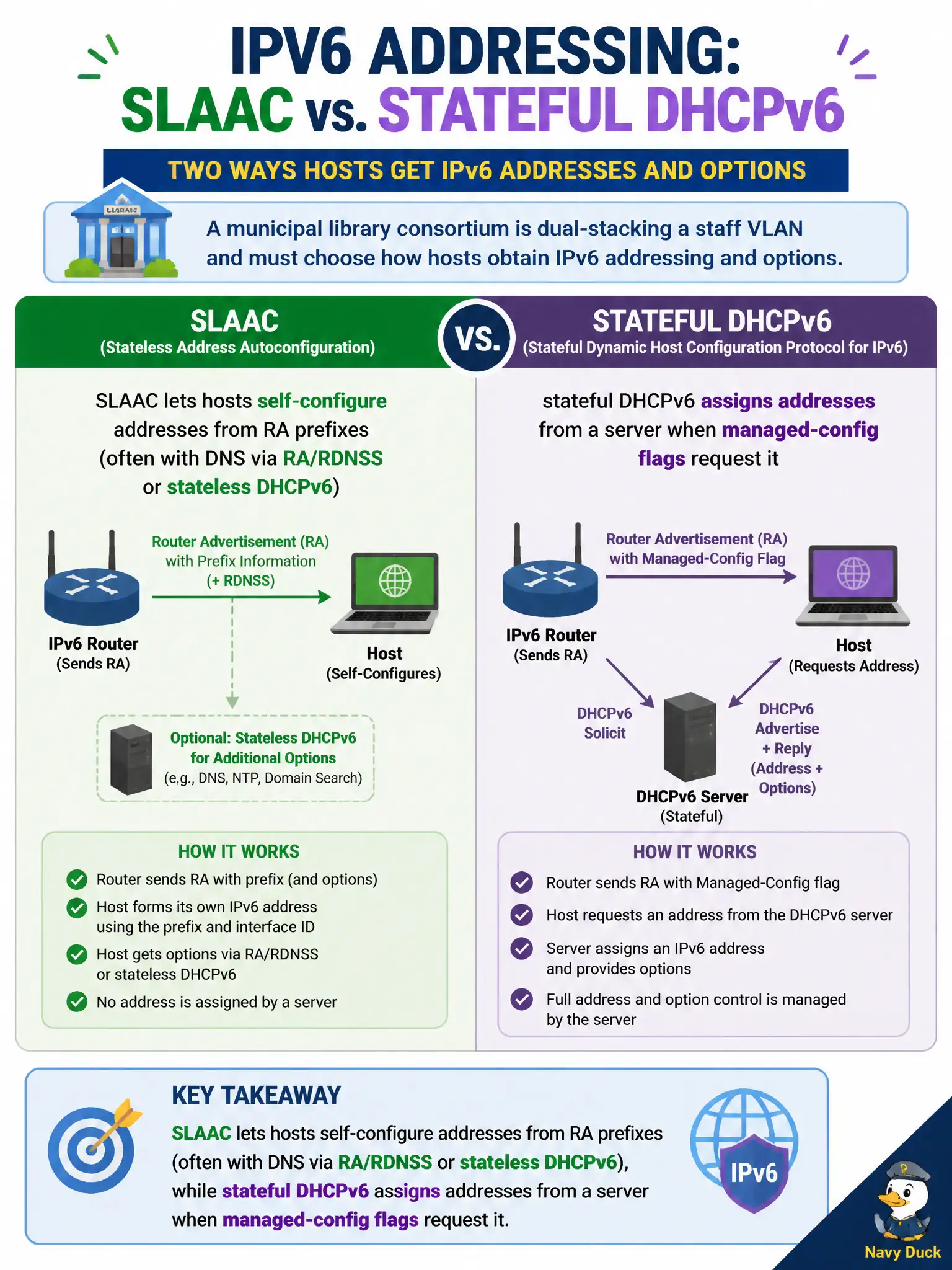
A municipal library consortium is dual-stacking a staff VLAN and must choose how hosts obtain IPv6 addressing and options. Which statement correctly contrasts SLAAC and stateful DHCPv6?
Select an answer to reveal the explanation.
Short Explanation
SLAAC is DIY addressing from the RA’s prefix—hosts build their own IPv6 addresses. Stateful DHCPv6 is the formal lease desk when you want the server handing out addresses. Many networks mix RAs with DHCPv6 options; they are not mortal enemies.
Full Explanation
Dual-stacking a library staff VLAN requires a clear contrast between SLAAC and stateful DHCPv6. SLAAC lets hosts self-configure addresses from RA prefixes, often obtaining DNS via RA/RDNSS or stateless DHCPv6, while stateful DHCPv6 assigns addresses from a server when managed-config flags request it. That statement correctly separates address assignment models without inventing false mutual exclusions.
Claiming stateful DHCPv6 always disables Router Advertisements because SLAAC and DHCPv6 cannot coexist is false—RAs remain central to IPv6, and flags steer host behavior. Saying SLAAC requires an IPv4 DHCP relay and cannot use RA prefixes alone confuses IPv4 helper concepts with IPv6 autoconfiguration. Claiming SLAAC assigns only IPv4 link-locals and never uses /64 prefixes is simply wrong.
Exam caveat: M and O bits in RAs determine managed/other configuration; hosts may combine SLAAC addresses with DHCPv6 options depending on flags and OS behavior. Operational check: set RA flags for the intended model on the staff VLAN, verify a host receives the expected address source (SLAAC vs DHCPv6), and confirm DNS options arrive via the chosen path. Library dual-stack guides should state clearly whether hosts expect SLAAC, stateful DHCPv6, or a hybrid with O-bit options so helpdesk scripts match reality.