
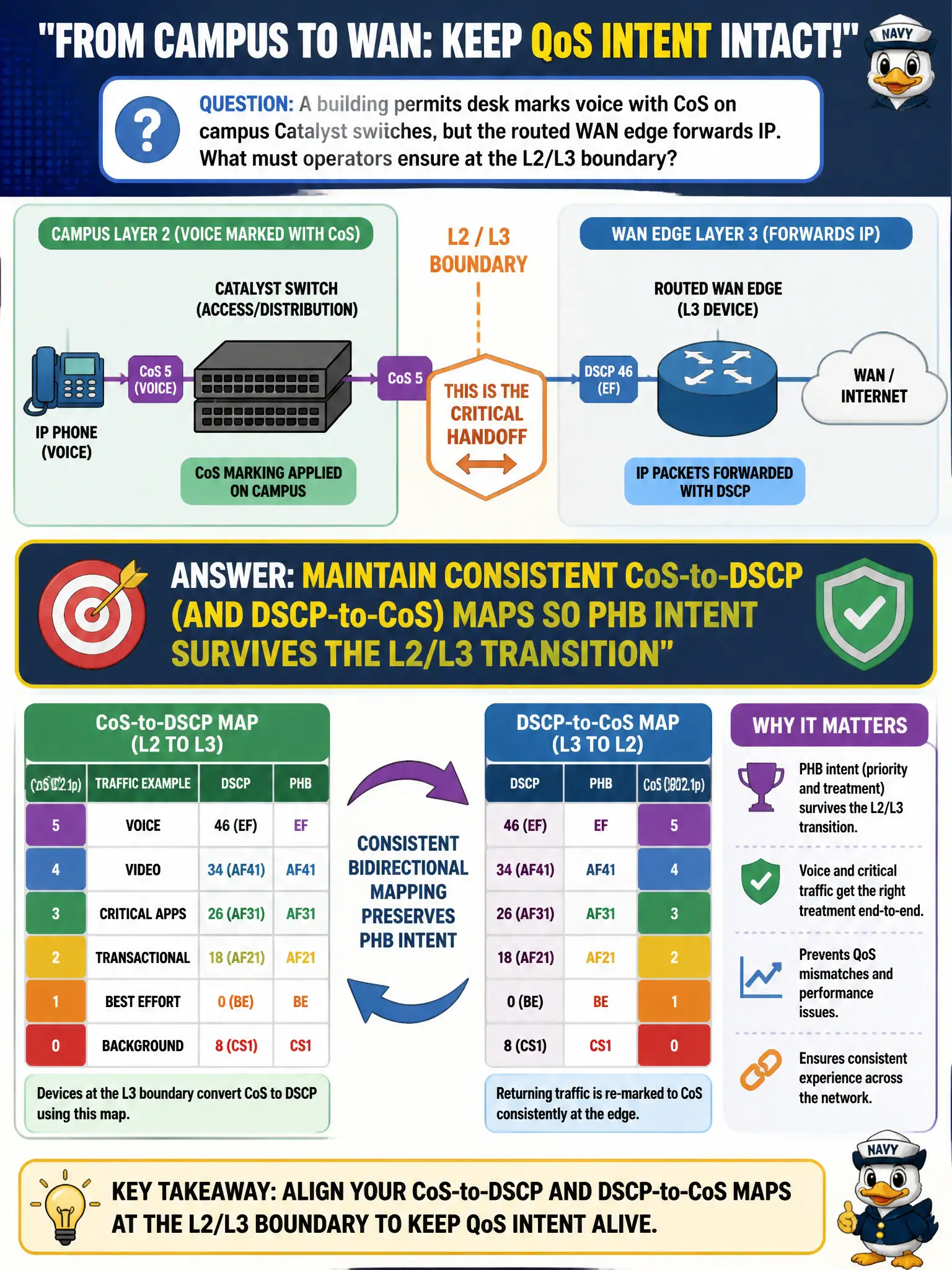
A building permits desk marks voice with CoS on campus Catalyst switches, but the routed WAN edge forwards IP. What must operators ensure at the L2/L3 boundary?
Select an answer to reveal the explanation.
Short Explanation
CoS is the sticky note on the Ethernet envelope; DSCP is the stamp once you put it in an IP mailbag. At the L2/L3 desk you need a translation chart so voice still gets VIP treatment after routing. Keep CoS↔DSCP maps consistent end to end.
Full Explanation
Campus Catalyst switches often mark voice with Layer-2 CoS, while routed WAN edges forward IP using DSCP. At the L2/L3 boundary, operators must maintain consistent CoS-to-DSCP and DSCP-to-CoS maps so PHB intent survives the transition. Without that translation, VIP treatment on the Ethernet segment evaporates once the packet is routed toward Metro-E.
Dropping all CoS-tagged frames before routing so DSCP is never consulted destroys QoS continuity. Ignoring DSCP on routers and trusting only 802.1p forever across a routed handoff fails when the IP header—not the 802.1Q tag—carries PHB across L3. Rewriting every packet to DSCP 0 at distribution “to simplify troubleshooting” intentionally erases classification work done on access switches.
Exam caveat: trust boundaries and rewrite behaviors differ by platform defaults; always confirm whether the L3 edge trusts incoming DSCP/CoS or rewrites. Operational check: send a known voice flow across the L2/L3 boundary, verify CoS on the switch fabric and DSCP on the routed egress, and document the maps used at the building-permits WAN edge. Building-permit operators should treat the redistribution point as a QoS trust boundary with explicit maps in the template, not as an accidental DSCP reset.