
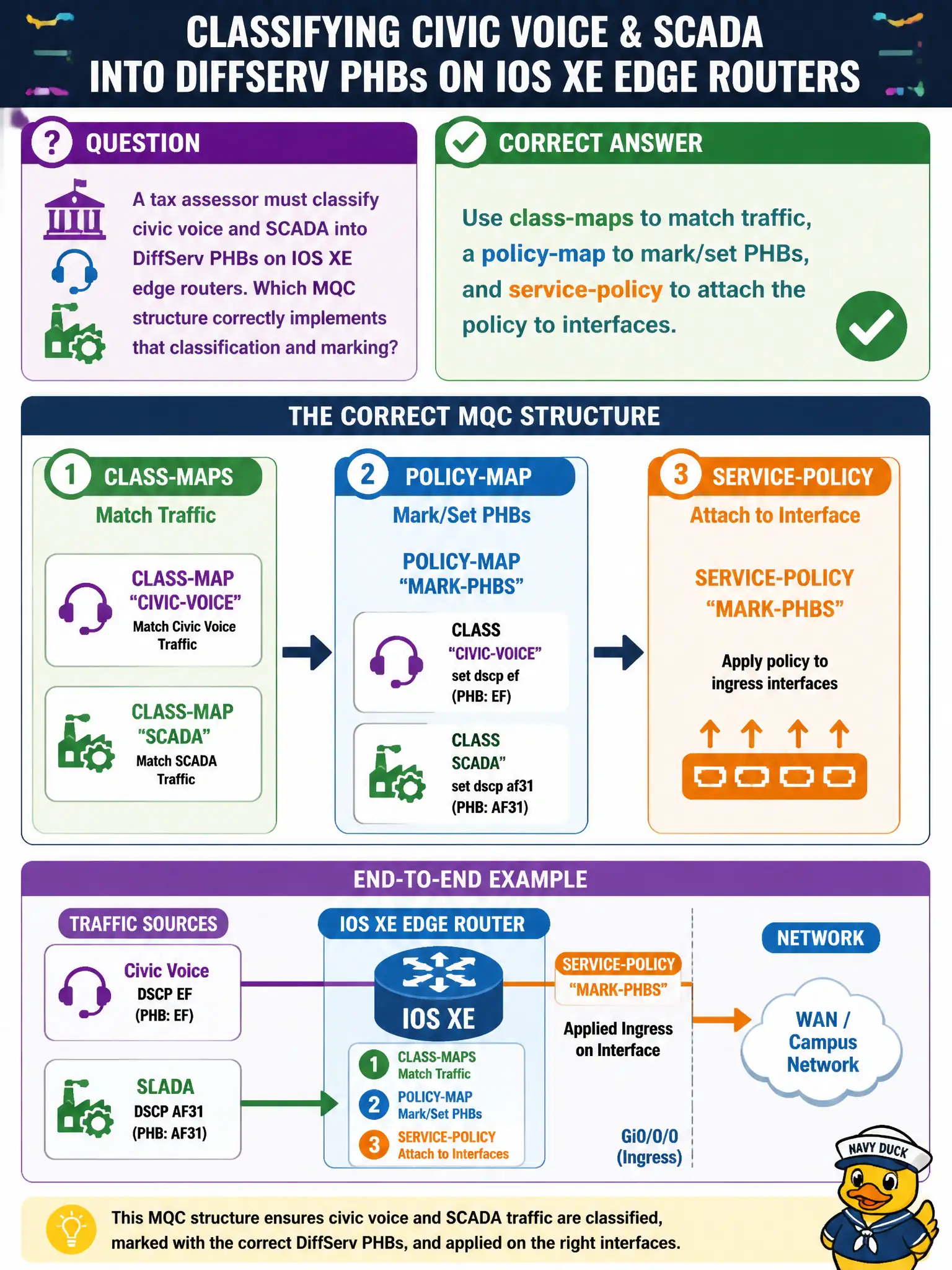
A tax assessor must classify civic voice and SCADA into DiffServ PHBs on IOS XE edge routers. Which MQC structure correctly implements that classification and marking?
Select an answer to reveal the explanation.
Short Explanation
MQC is the three-step recipe: pick the ingredients (class-map), cook the treatment (policy-map marks and queues), then plate it on an interface (service-policy). That is how voice and SCADA get real DiffServ PHBs instead of hope-and-FIFO.
Full Explanation
DiffServ marking for civic voice and SCADA on IOS XE follows Modular QoS CLI structure: class-maps match traffic, policy-maps mark or set PHBs and define treatment, and service-policy attaches the policy to interfaces. That three-layer MQC model is how edge routers correctly implement classification and marking rather than hoping unmarked traffic somehow receives the right PHB.
Shaping all traffic identically with a single FIFO queue and ignoring class-maps provides no differentiated marking for voice versus SCADA. Claiming campus routers cannot use MQC and must mark only on carrier CPE is false—IOS XE edge routers routinely classify and mark. Relying solely on port-number ACLs without attaching a policy-map never applies marking actions even if matches exist in an ACL.
Exam caveat: matching is necessary but not sufficient; without service-policy attachment, class-maps and policy-maps do nothing on the wire. Operational check: build class-maps for voice and SCADA, mark DSCP in a policy-map, attach service-policy in the correct direction, and verify markings with show policy-map interface or packet captures at the tax-assessor edge. For assessor voice and SCADA, keep classification close to the trust boundary and avoid remaking conflicting marks deeper in the path unless a deliberate rewrite policy exists.