
An election office updates SD-WAN device templates through vManage APIs and must avoid promoting untested changes into production. Which pipeline practice is soundest?
Select an answer to reveal the explanation.
Short Explanation
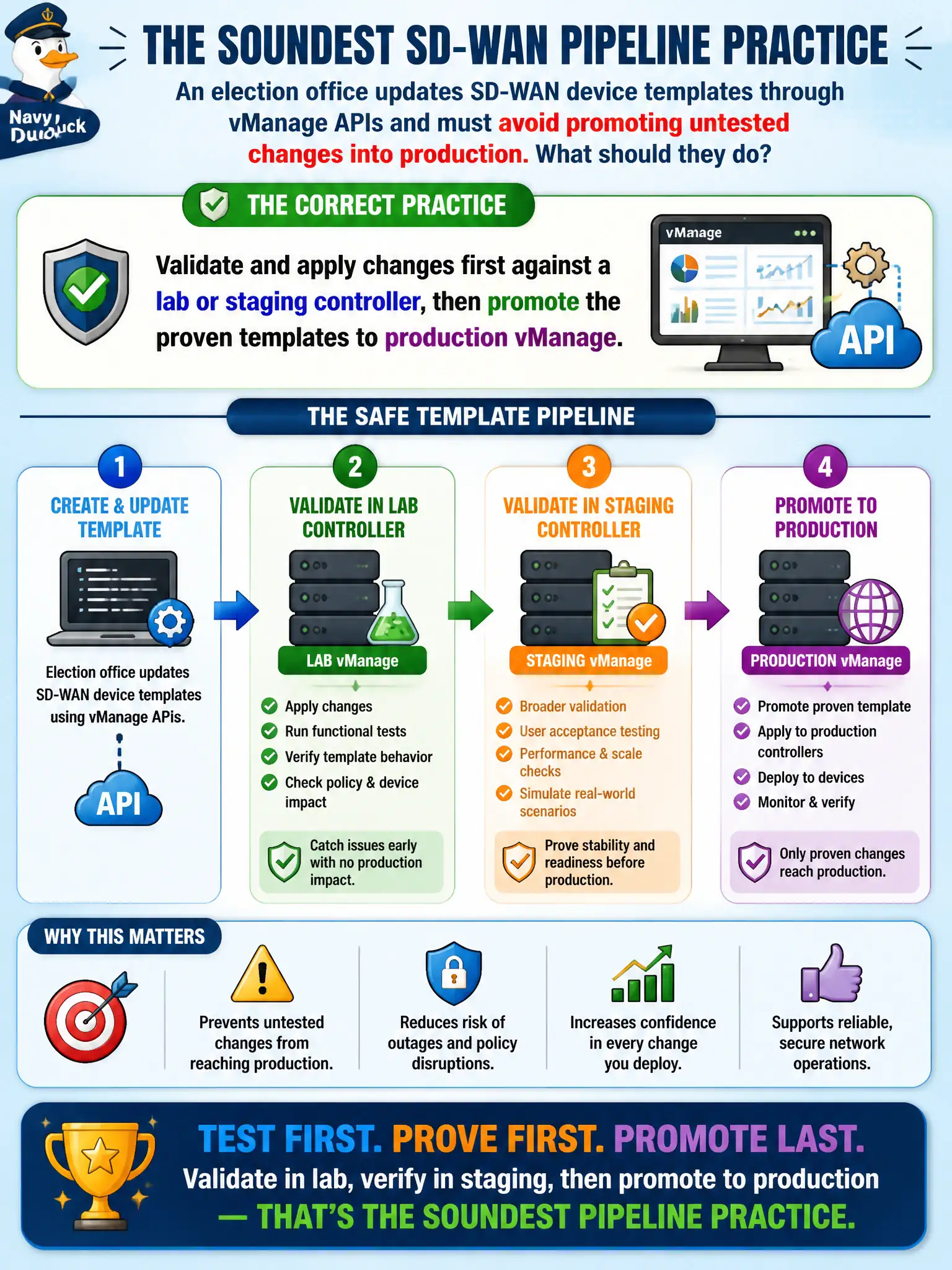
Treat production vManage like election night—you do not invent new ballot layouts on the live machines. Prove the template in lab or staging, then promote. Local JSON lint alone is not a dry run against a real controller.
Full Explanation
Election offices updating SD-WAN device templates through vManage APIs must avoid promoting untested changes into production by validating and applying changes first against a lab or staging controller, then promoting proven templates to production vManage. Staged promotion is the soundest pipeline practice for civic SD-WAN intent. Local JSON validity alone is not production readiness.
Pushing every template revision straight to production as soon as JSON validates locally skips environmental proof. Editing production templates interactively on the live GUI while scripts also write the same objects creates race conditions. Disabling API write access and pasting templates only via serial console on each Edge abandons centralized control.
Exam caveat: staging must mirror production device models/feature templates closely enough that promotions are meaningful. Operational check: commit templates to version control, deploy to staging vManage, soak against lab Edges, then promote with change approval. Retain diff evidence for election-network auditors. Record the chosen control and rejected alternatives in the municipal change record so future on-call engineers understand the failure modes avoided for city services.