
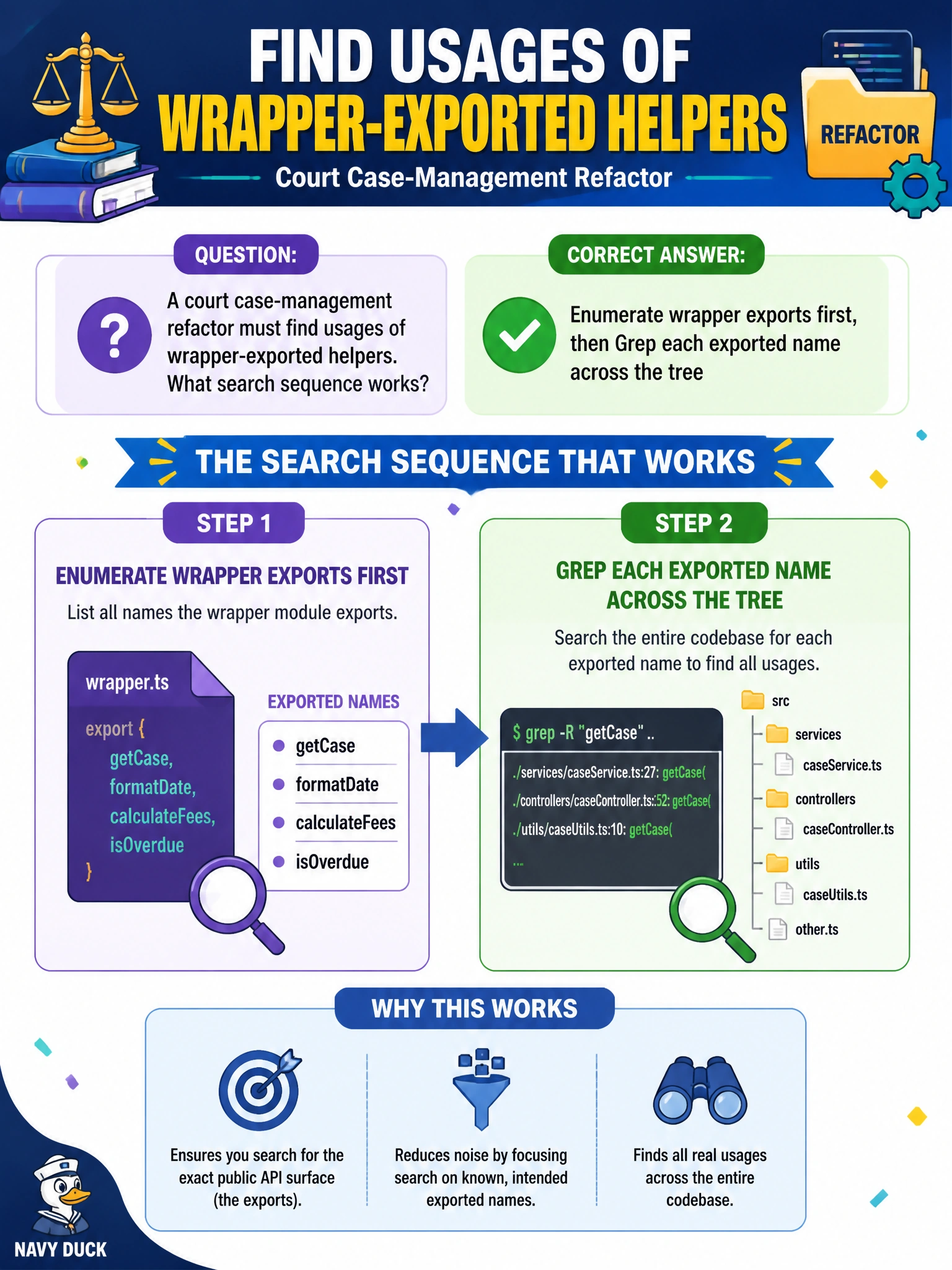
A court case-management refactor must find usages of wrapper-exported helpers. What search sequence works?
Select an answer to reveal the explanation.
Short Explanation
Wrappers hide the real names. List what they export, then Grep each name across the courthouse codebase—that's how you find the real call sites.
Full Explanation
Usages of helpers re-exported through wrappers are invisible if you only search the wrapper filename. For a court case-management refactor, the working sequence is to enumerate what the wrapper exports first, then Grep each exported name across the tree to find real call sites.
Why the correct option works: wrappers alias or re-export symbols; callers often import the exported names, not the deep implementation path. Listing exports builds the search term set; Grep then locates each name in judges’ workflow modules, filing services, and tests so refactors do not miss dependents.
Why the other three fail by concept: editing every file in the monorepo without searching for references is blind mutation. Relying on Glob alone fails because filenames rarely match export names one-to-one. Asking Bash to truncate git history instead of locating call sites destroys audit trails and still does not list usages.
Exam caveat: export enumeration then per-name Grep is the pattern—do not stop at finding the wrapper file. Operational check: list wrapper exports, Grep each symbol, record call-site files, and only then plan Edit/Write for the case-management refactor. Court case-management codebases often hide helpers behind barrel files and facade modules; without enumerating exports, Grep for the wrapper path alone undercounts dependents. After the Grep pass, keep a call-site checklist so refactors update every filing and docket consumer, not only the wrapper itself.