
A water SCADA helper needs to understand a large legacy tree without loading everything. What built-in strategy fits?
Select an answer to reveal the explanation.
Short Explanation
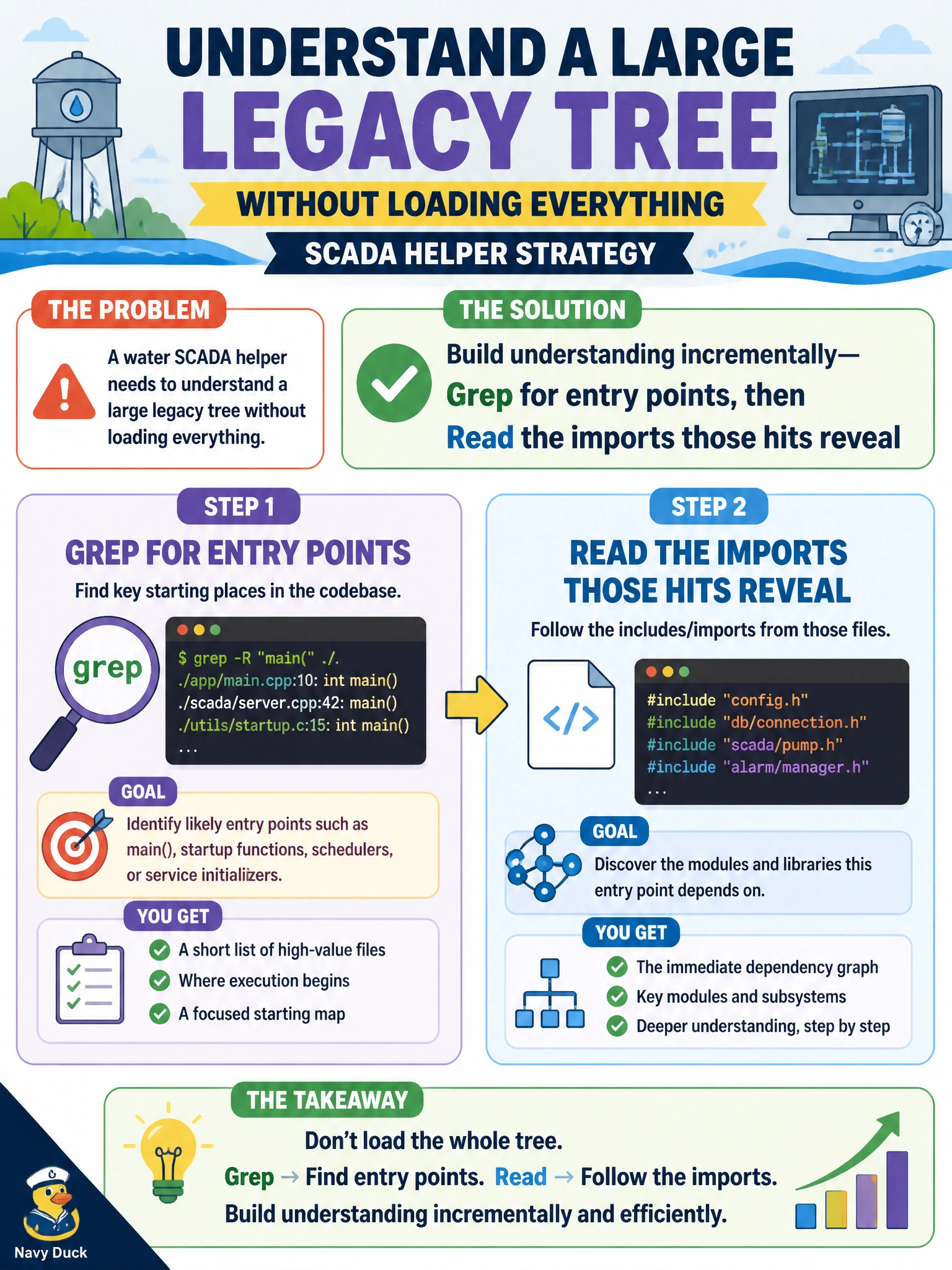
Don't drink from the SCADA firehose. Grep the entry points, then Read what those imports point to—little sips beat flooding the context.
Full Explanation
Large legacy trees overwhelm context if loaded wholesale. A water SCADA helper should build understanding incrementally: Grep for entry points (main, service bootstrap, controller registration), then Read the imports and modules those hits reveal, expanding only along the dependency path needed for the task.
Why the correct option works: incremental Grep→Read preserves tokens, focuses on live control paths, and avoids drowning the session in unused PLC stubs or archived experiments. Each Read is justified by a prior hit, which is the right strategy for sprawling industrial/civic codebases.
Why the other three fail by concept: reading every file before any judgment exhausts context and delays useful work. Using only Write without inspecting existing SCADA code invents controllers that ignore real telemetry contracts. Ignoring the codebase and regenerating all controllers from scratch immediately is reckless for operational water systems.
Exam caveat: incremental understanding is a strategy using built-ins, not a separate tool name. Operational check: Grep SCADA entry points, Read the first import tier, stop when the change site is clear, and refuse full-repo Read “for completeness” on large trees.