
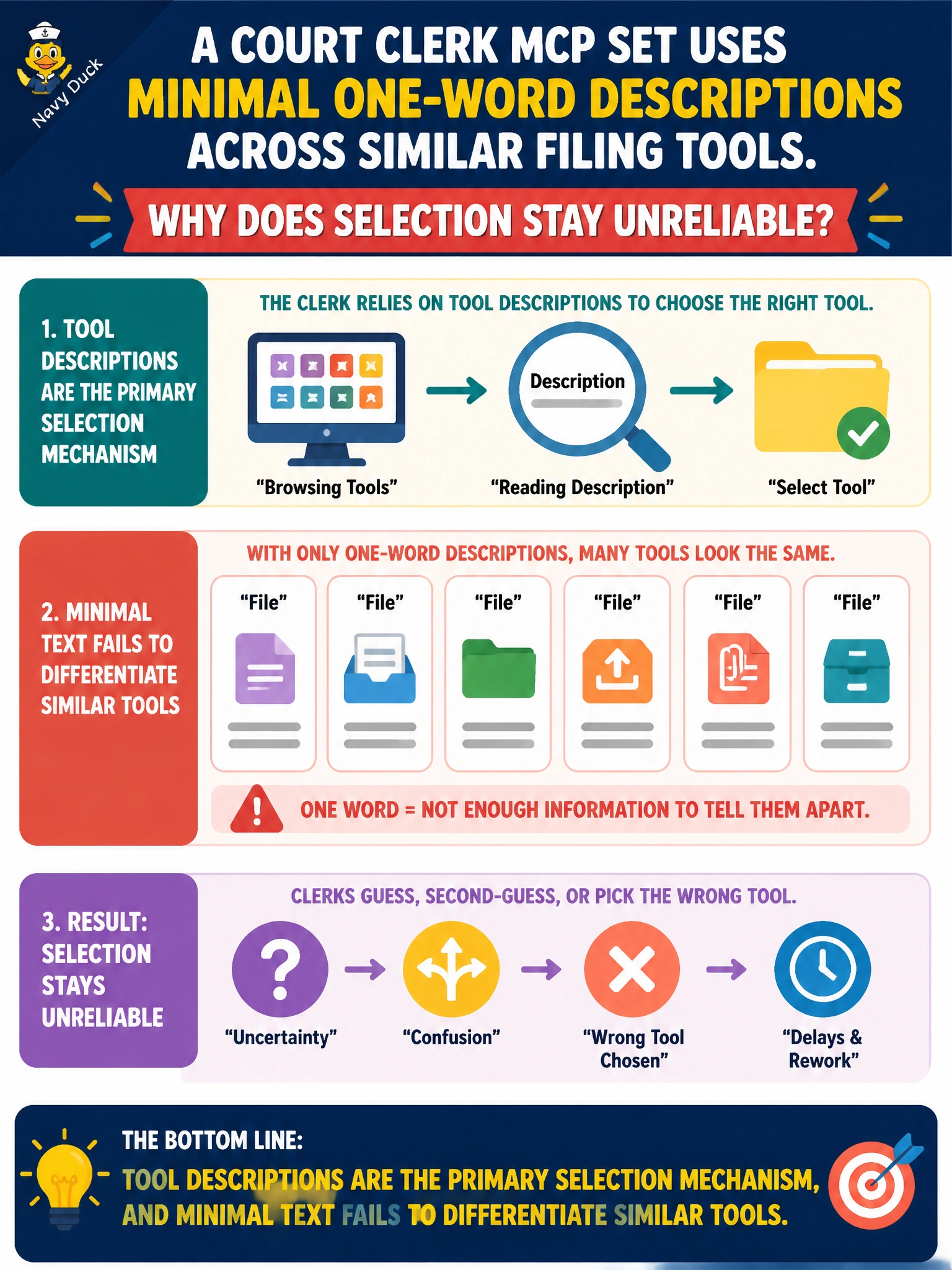
A court clerk MCP set uses minimal one-word descriptions across similar filing tools. Why does selection stay unreliable?
Select an answer to reveal the explanation.
Short Explanation
Claude picks tools from what you write about them. One-word clerk-filing blurbs leave similar tools looking identical, so selection stays a coin flip.
Full Explanation
A court clerk MCP set that uses minimal one-word descriptions across similar filing tools stays unreliable because tool descriptions are the primary selection mechanism, and minimal text fails to differentiate similar tools. Without purpose, inputs, outputs, and boundaries, filing, amendment, and status tools look interchangeable to the model.
Detailed differentiation works because clerk workflows are high-stakes and structurally similar: many tools touch case numbers and documents. Rich descriptions are how the agent learns which civic filing action matches the user’s request, protecting docket integrity.
The claim that LLMs ignore descriptions entirely and only read internal SQL is false; descriptions are exposed as the selection channel, not private SQL. Asserting that one-word descriptions always outperform detailed contracts contradicts observed misrouting among similar tools. Believing selection quality depends only on alphabetical tool order ignores how models match intent to descriptive contracts.
Exam caveat: length alone is not enough—descriptions must contrast siblings, not repeat the same adjective with different nouns. Operational check: expand one-word clerk-tool blurbs into differentiated contracts and measure reduction in wrong filing-tool calls on the same prompts.