
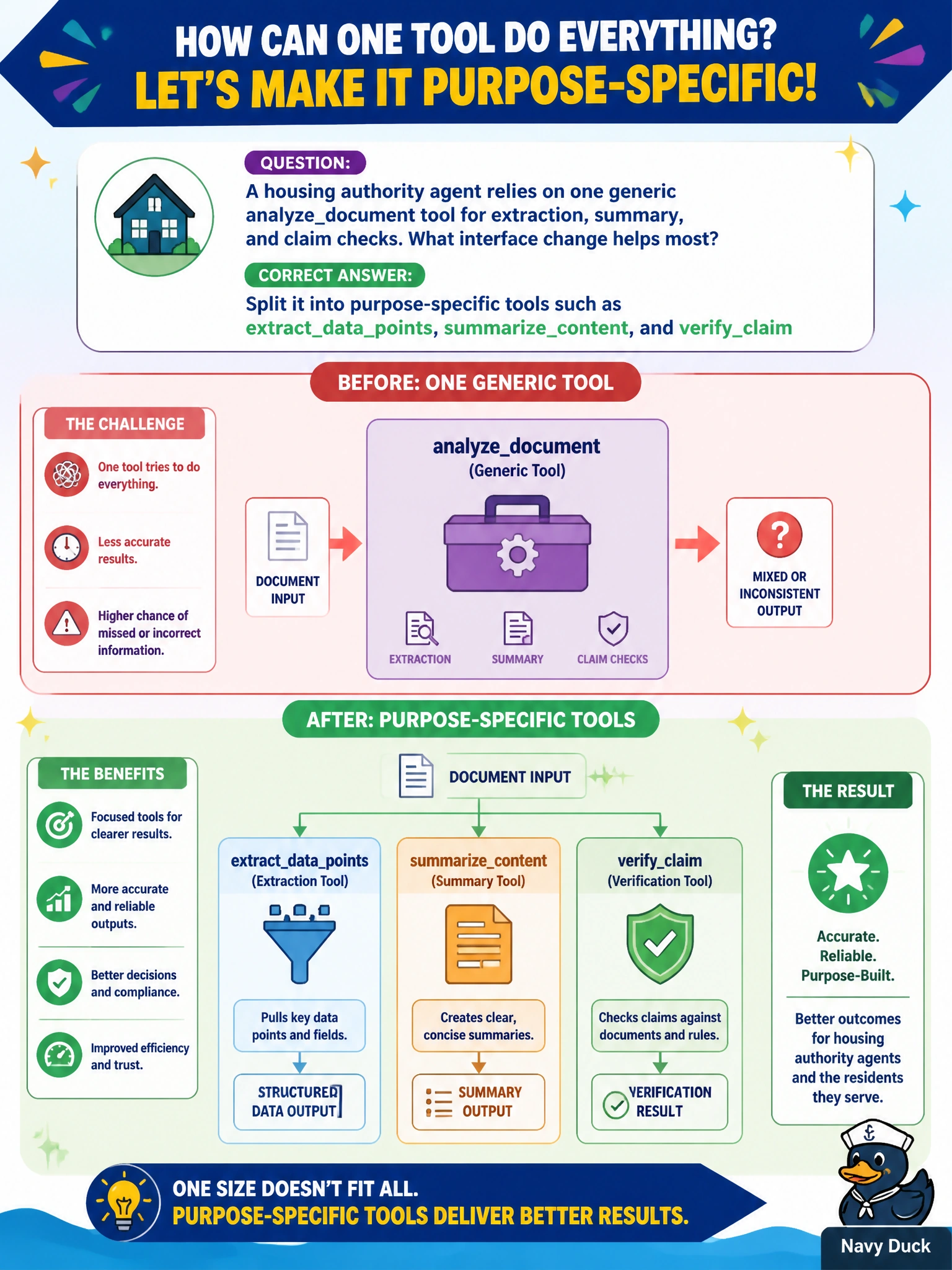
A housing authority agent relies on one generic analyze_document tool for extraction, summary, and claim checks. What interface change helps most?
Select an answer to reveal the explanation.
Short Explanation
One giant analyze_document for housing files is like one wrench for every job. Split extraction, summary, and claim checks into purpose-specific tools.
Full Explanation
A housing authority agent that relies on one generic analyze_document tool for extraction, summary, and claim checks lacks clear selection cues. Splitting into purpose-specific tools—extract_data_points, summarize_content, and verify_claim—gives each civic document task its own contract, inputs, and outputs.
Purpose-specific tools work because housing workflows mix distinct operations: pulling structured fields from applications, summarizing case notes for caseworkers, and verifying resident claims against policy. Separate tools make intent matchable and reduce mode confusion inside a mega-tool.
Keeping one mega-tool and never documenting which mode applies leaves the model guessing which behavior to invoke, producing wrong housing outcomes. Renaming nothing and shortening the description to a single word removes differentiation entirely. Merging document tools with unrelated billing APIs into one endpoint muddies boundaries further and increases dangerous cross-domain miscalls.
Exam caveat: splitting without rewriting descriptions still fails; each new tool needs explicit when-to-use guidance versus its siblings. Operational check: feed housing prompts that require extract vs summarize vs verify and confirm the agent selects the matching purpose-specific tool after the split.