
Scanned utility bills arrive with messy dates and amounts. What should sit beside a strict extraction schema?
Select an answer to reveal the explanation.
Short Explanation
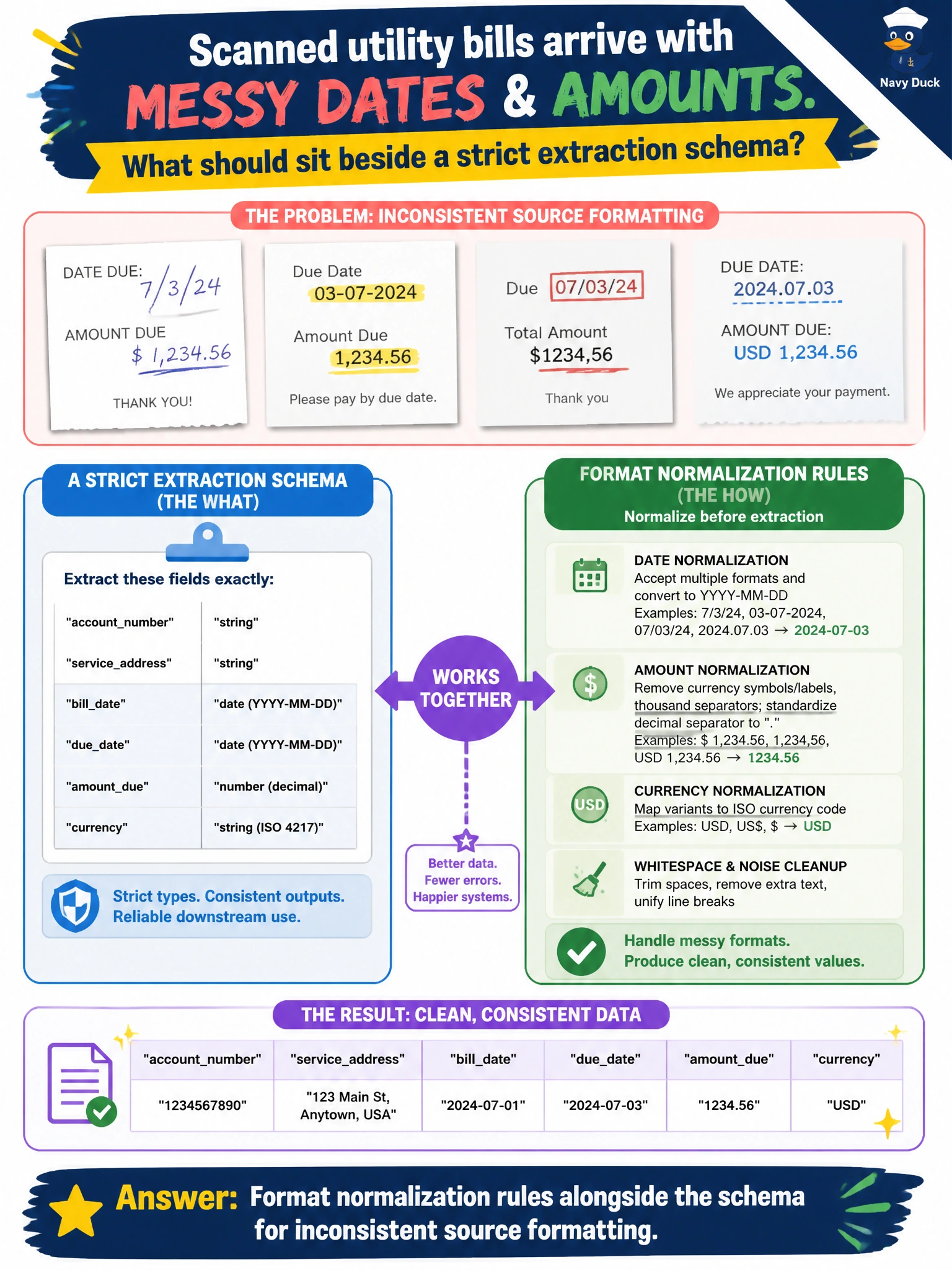
Messy bills need a tidy-up crew next to the blueprint—normalization rules beside the schema. The schema alone won't fix wild date and amount spellings.
Full Explanation
Scanned municipal utility bills routinely mix handwritten corrections, OCR noise, and inconsistent date or currency spellings, so a strict extraction schema alone is not enough. Place format normalization rules beside the schema: the schema enforces which fields and types must appear, while normalization converts MM/DD/YY, ISO dates, and locale amount strings into comparable canonical values for billing workflows. Without that pairing, downstream assessment or AR systems receive syntactically valid but operationally incomparable extracts. Dropping the schema for free-form narrative extracts removes machine-checkable structure and invites silent field drift across clerks and vendors. Rejecting every imperfect scan before prompting is unrealistic for civic document intake—most paper bills are imperfect—and stalls the queue without improving field usability. Storing only raw OCR text and skipping normalization preserves noise that billing logic cannot safely total or match to accounts. Exam caveat: schema success proves shape compliance, not semantic comparability of dates and amounts. Operational check: on a sample of messy bills, confirm normalized date and amount fields round-trip into the municipal billing matcher and that mismatches still surface when OCR garbles a digit rather than being silently accepted as free text.