
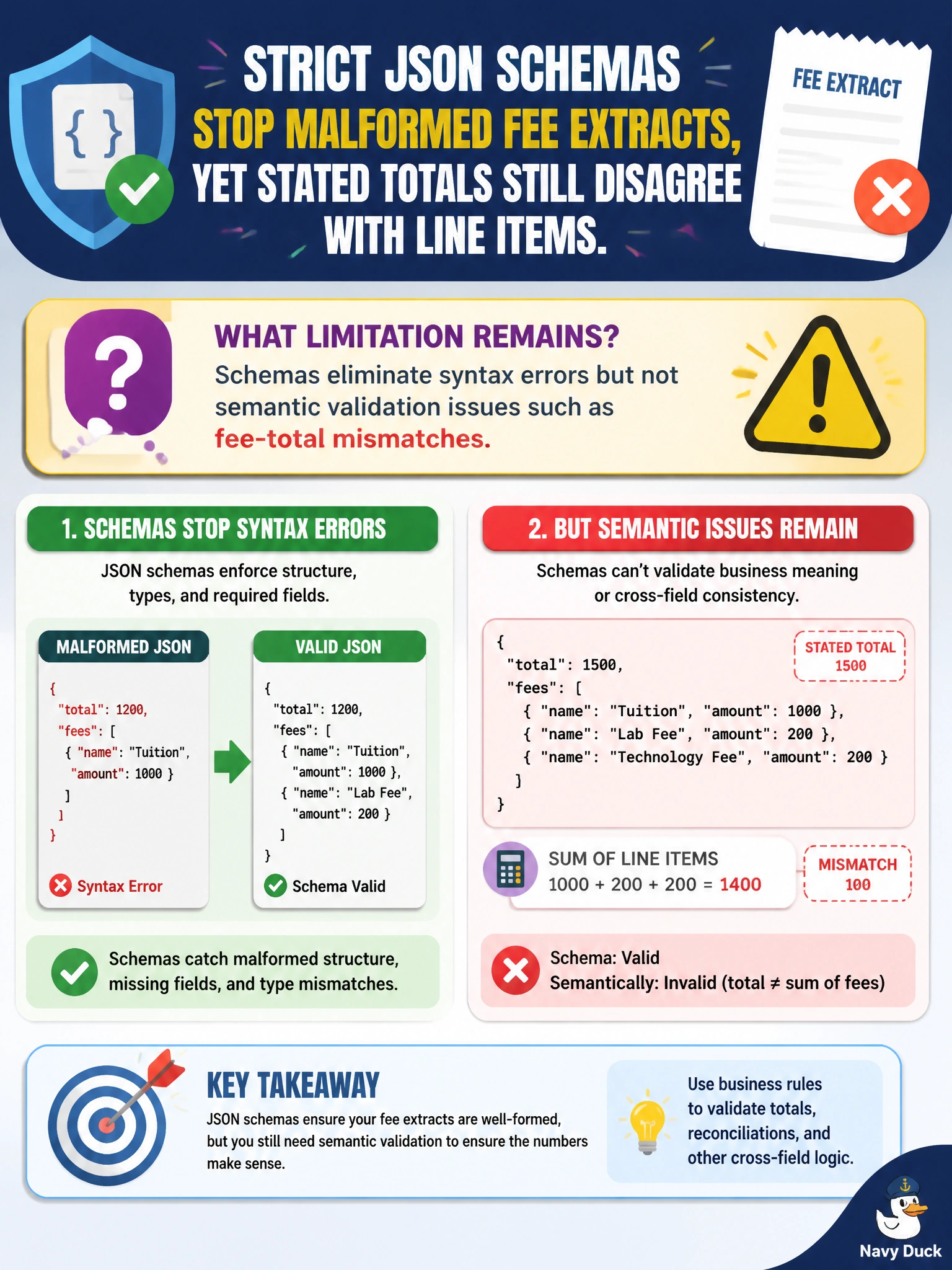
Strict JSON schemas stop malformed fee extracts, yet stated totals still disagree with line items. What limitation remains?
Select an answer to reveal the explanation.
Short Explanation
A perfectly shaped JSON box can still hold the wrong sum—like a neat receipt that doesn't add up. Schemas catch syntax, not semantic fee mismatches.
Full Explanation
Strict JSON schemas stop malformed fee extracts by enforcing keys, types, and required fields, yet stated totals can still disagree with line items. That remaining gap shows schemas eliminate syntax errors but not semantic validation issues such as fee-total mismatches. Structural validity is necessary for municipal fee pipelines; arithmetic and policy consistency require separate checks.
Claiming schemas alone always detect every semantic fee mismatch fails because schema languages typically do not encode cross-field arithmetic rules for arbitrary fee tables. Asserting that syntax validity guarantees arithmetic across fee lines is correct fails the same distinction—the stem's disagreeing totals are syntactically fine and semantically wrong. Saying that once schema validation passes no further checks are ever needed fails operationally for finance-facing civic systems that must reconcile totals before posting.
Exam caveat: do not treat schema success as business-rule success; also remember semantic validators can have false positives if fee rules are incomplete. Operational check: after schema validation, run a semantic fee reconciler (sum lines versus stated total, tax rules, rounding policy), quarantine mismatches for clerk review, and only then accept the extract into billing.