
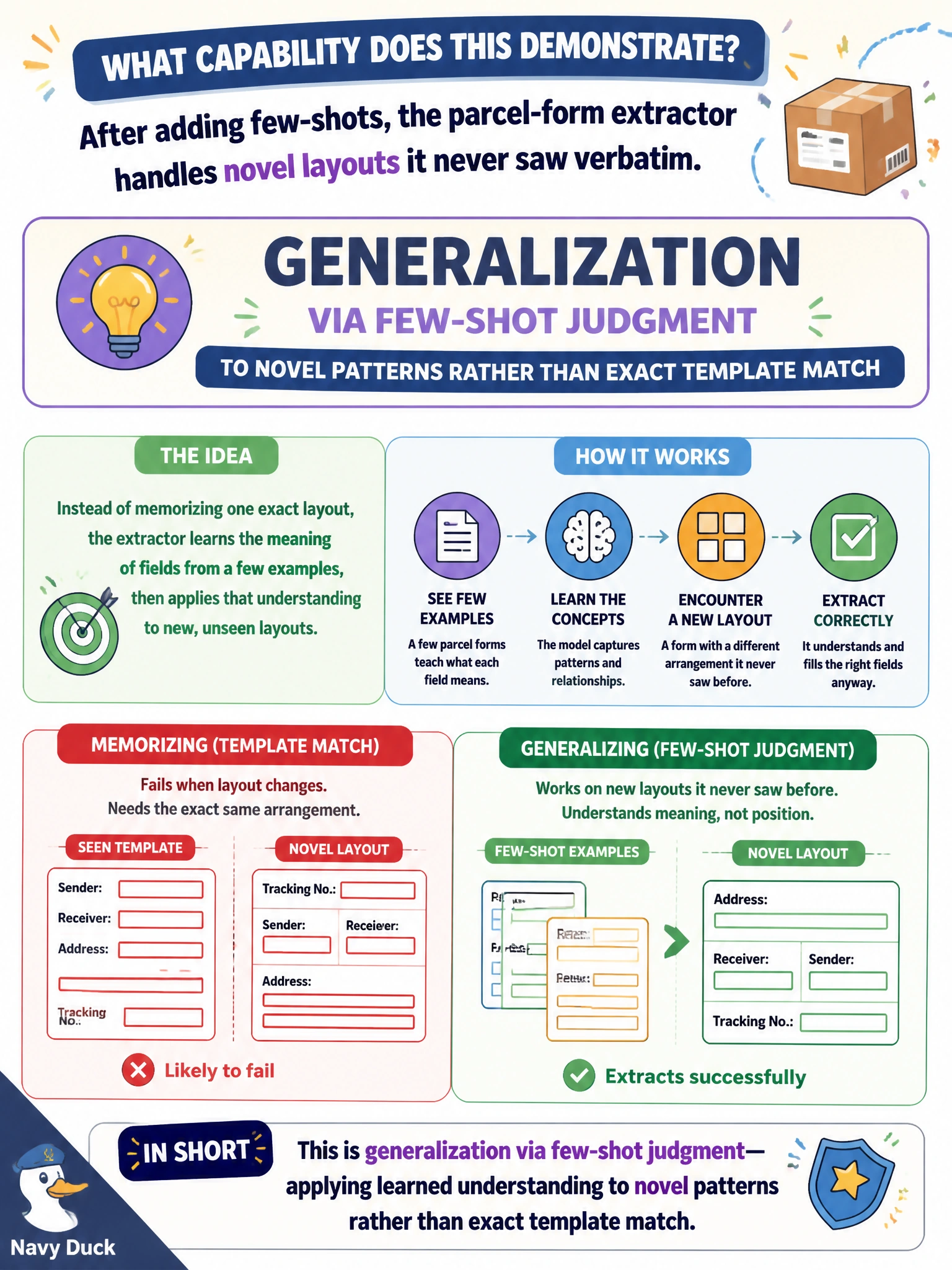
After adding few-shots, the parcel-form extractor handles novel layouts it never saw verbatim. What capability is that?
Select an answer to reveal the explanation.
Short Explanation
Good examples teach judgment, not photocopying. Few-shots help the extractor generalize to new parcel layouts instead of demanding an exact template twin.
Full Explanation
After few-shots are added, a parcel-form extractor that handles novel layouts it never saw verbatim is demonstrating generalization via few-shot judgment—not exact template matching. Good exemplars teach how to locate parcel fields under layout variation so new assessor forms can be processed without a byte-identical twin in the prompt set. That judgment-oriented learning is why a small, diverse example set often beats a large pile of near-duplicate PDFs.
Memorization that only works on identical training PDF bytes fails as an explanation of the observed behavior: novel layouts succeeding means the model is not limited to photocopy recall. Requiring hard-coded one template per parcel form forever fails as architecture for a living municipal forms catalog and contradicts the generalization result. Claiming few-shots prevent handling of unseen layouts fails directly: the stem shows the opposite capability when examples teach transferable structure.
Exam caveat: generalization is powerful but not infinite—radical redesigns may still need new exemplars or schema tweaks; monitor confidence and null rates on unfamiliar packets. Operational check: hold out a parcel layout absent from the few-shot set, run extraction, and verify key fields populate correctly without adding that exact PDF as an example.