
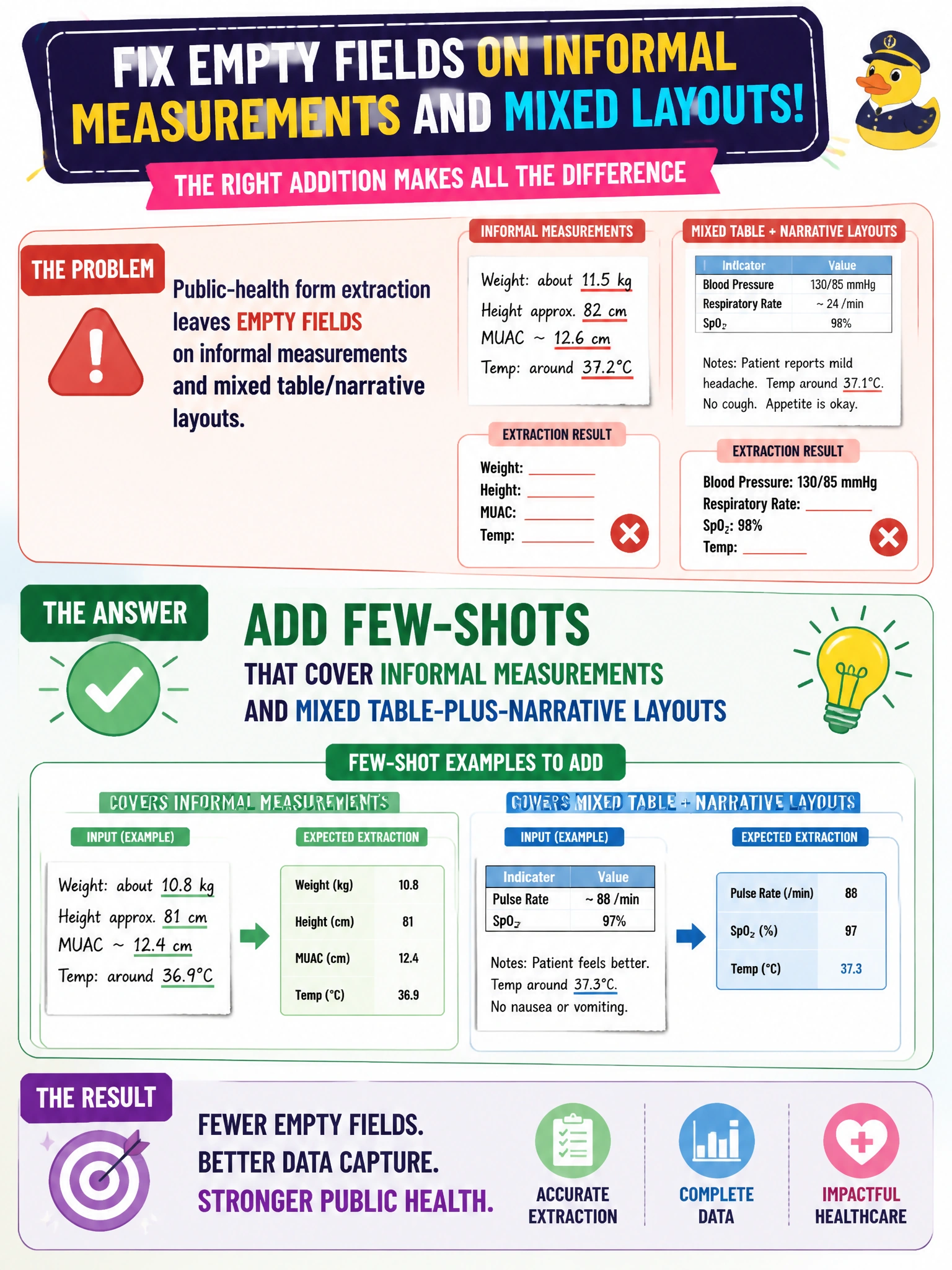
Public-health form extraction leaves empty fields on informal measurements and mixed table/narrative layouts. What should be added?
Select an answer to reveal the explanation.
Short Explanation
Clinic forms aren't always neat spreadsheets—sometimes the nurse scribbles a measurement in a sentence. Few-shots of those messy layouts cut empty fields and made-up numbers.
Full Explanation
Public-health form extraction leaves empty fields when measurements appear as informal narrative and layouts mix tables with prose. Few-shots that cover informal measurements and mixed table-plus-narrative layouts teach the model where values live in messy civic clinic paperwork, reducing blanks and the temptation to invent numbers.
Removing all examples so the model never sees informal measurement styles fails because the training signal for scribbled-in-sentence values disappears and empty fields persist. Requiring perfect tables only and discarding narrative sections fails conceptually: many clinic forms store critical measurements only in narrative, so discarding them loses real data. Filling missing clinical fields with fabricated averages without examples fails ethically and analytically—fabricated health data is worse than an explicit null.
Exam caveat: diverse layout few-shots reduce empty fields and hallucination pressure; they do not replace PHI handling rules or human review for clinical decisions. Operational check: include mixed-layout exemplars with informal measurements, measure empty-field and fabrication rates on held-out forms, and require nulls rather than guesses when values are absent.