
A court clerk's office feeds a 40-page hearing transcript into a single prompt asking Claude to extract every stipulated deadline into a structured JSON list. Deadlines mentioned on pages 15-25 are reliably missed, while ones near the start and end are captured correctly. What is the most likely cause, and what is a reasonable fix?
Select an answer to reveal the explanation.
Short Explanation
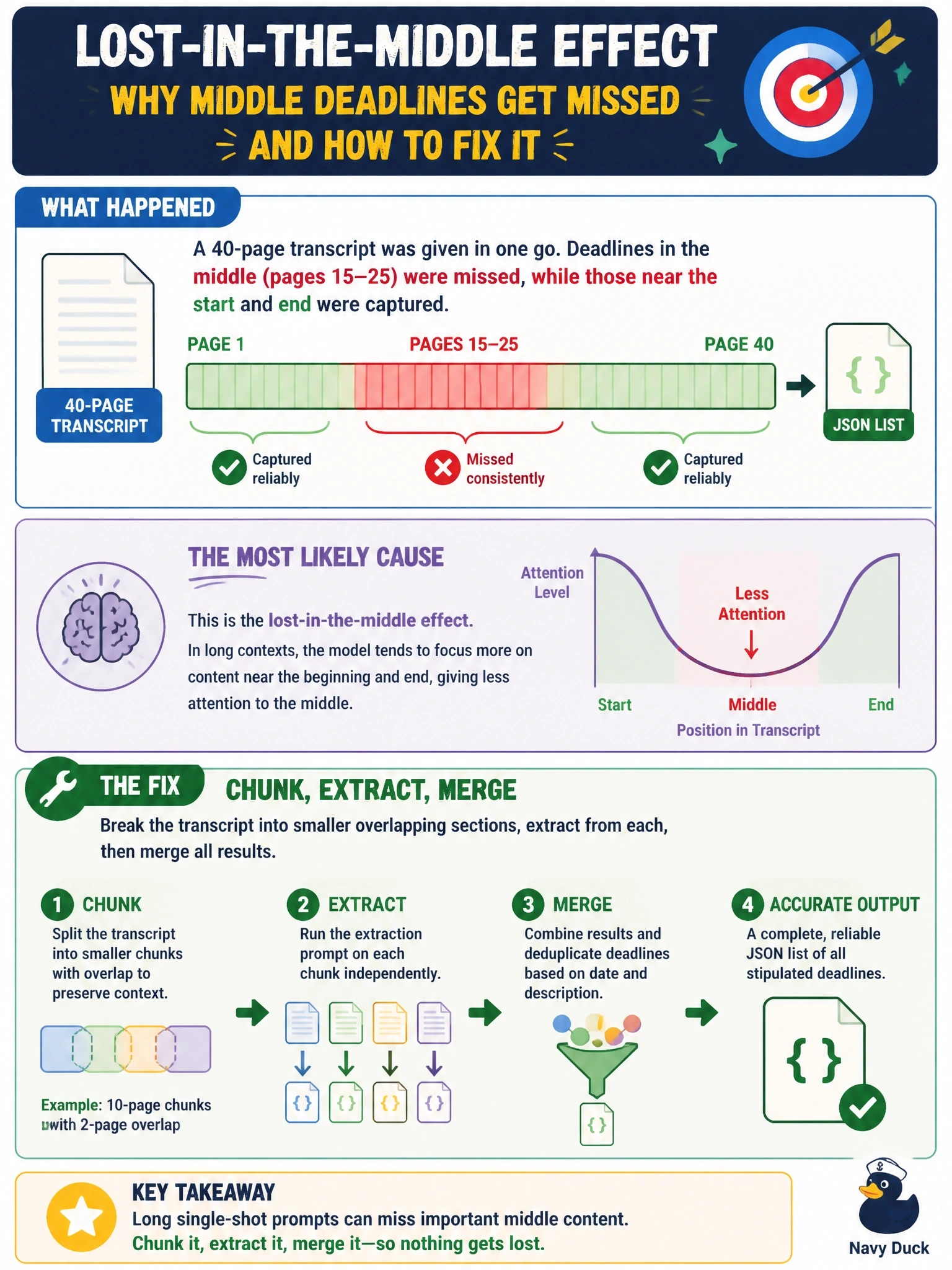
Long-context attention behaves like a spotlight brightest at the edges of the stage, so page 20 of a 40-page transcript gets read least. Chunk it with overlap so no page is ever in the middle.
Full Explanation
Where information sits inside a long input affects how reliably it is recovered. Recall is strongest near the beginning and the end of a large context and weakest in between, so a 40-page single-pass extraction is architecturally predisposed to miss exactly the pages the clerk's office reports missing.
Naming the effect points at the right lever, which is document architecture rather than prompt wording. Chunking the hearing transcript into smaller sections and extracting from each independently puts every page near an edge of its own context, and overlapping the chunks means a deadline mentioned near a boundary appears in two chunks rather than falling into the seam between them. Merging the per-chunk results then reassembles the full deadline list.
A hard token limit at page 15 would truncate content out of the model's view entirely, whereas the symptom is content present but under-attended, and shortening the transcript would discard real information rather than repair attention; a schema defect tied to a page range is not a coherent mechanism, since schemas do not vary by document position; and blaming the court reporter's formatting ignores that the failure tracks position rather than any described formatting difference, and it offers no fix matching the symptom.
Exam caveat: chunking trades a recall problem for a coherence problem, because a stipulation whose meaning depends on discussion several pages earlier can be extracted wrongly from a chunk that cannot see it. Operational check: seed one known deadline near a chunk boundary and one that depends on earlier context, run the chunked pipeline, and confirm both appear exactly once and correctly in the merged output.