
Before spawning the next wave of exploration subagents, what should the coordinator do with the prior phase?
Select an answer to reveal the explanation.
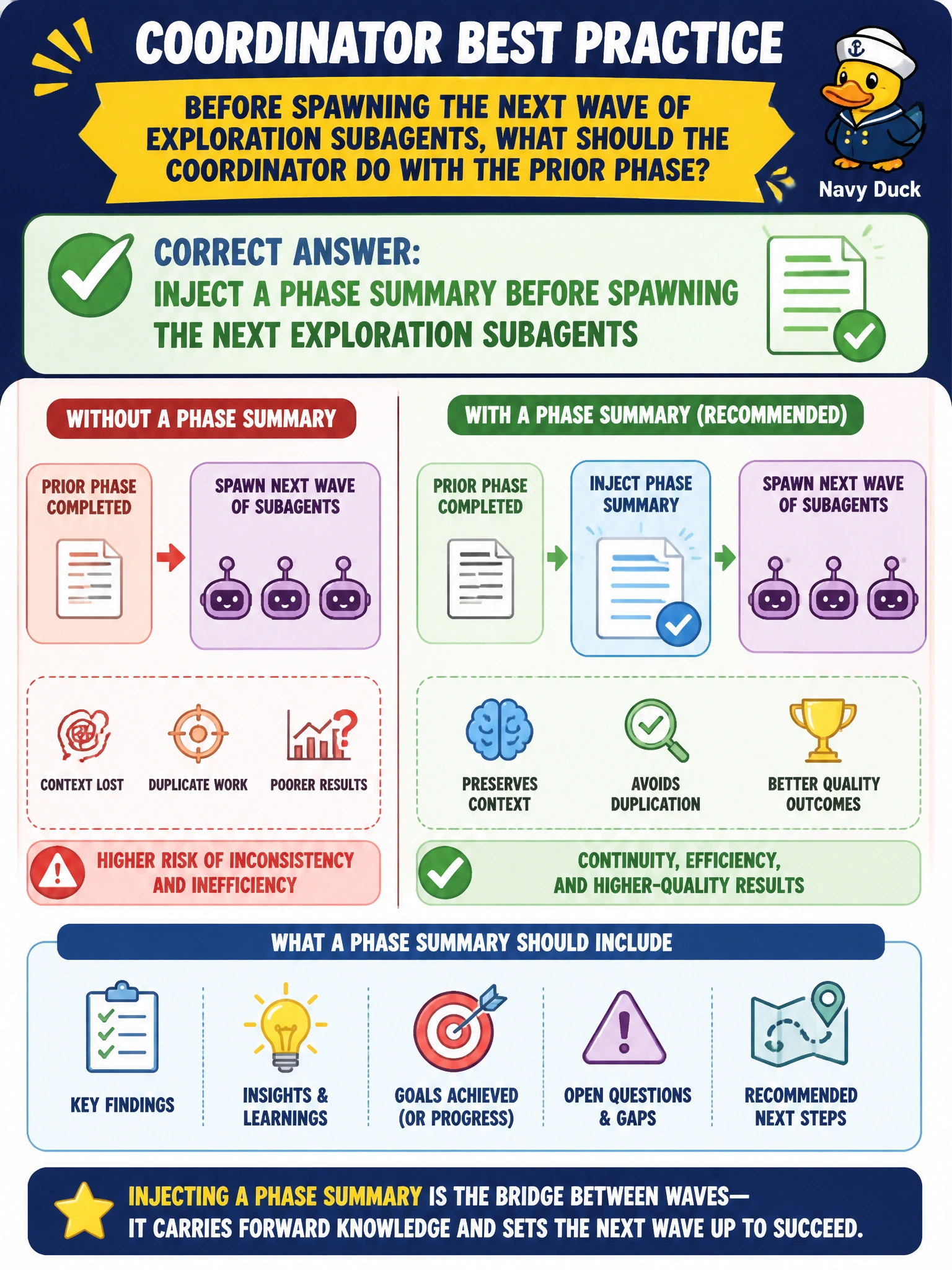
Short Explanation
Before the next scout team heads out, brief them on the last ridge you mapped. Phase summaries fight context rot between waves.
Full Explanation
Before spawning the next wave of exploration subagents on a municipal codebase, the coordinator should inject a phase summary of prior findings. That briefing transfers maps, dead ends, confirmed modules, and open questions so the new wave does not rediscover or contradict the last ridge already surveyed.
Phase summaries work because each wave otherwise starts cold, burning tokens on already-answered questions and fragmenting the investigation. A concise injection preserves continuity without flooding every worker with the entire prior transcript.
Spawning the next wave with no summary of prior findings fails because workers repeat searches and miss cross-links the prior phase already proved. Discarding all prior phase notes to free tokens fails because it trades short-term space for long-term amnesia. Duplicating the entire prior raw transcript into every new subagent fails because raw dumps cause context bloat and dilute instructions; summaries beat verbatim history.
Exam caveat: summaries should be curated and structured (what was found, what failed, what to try next), not motivational fluff. Operational check: after each exploration phase, write a short phase summary and include it in the prompt for the next subagent wave before they start tool use.