
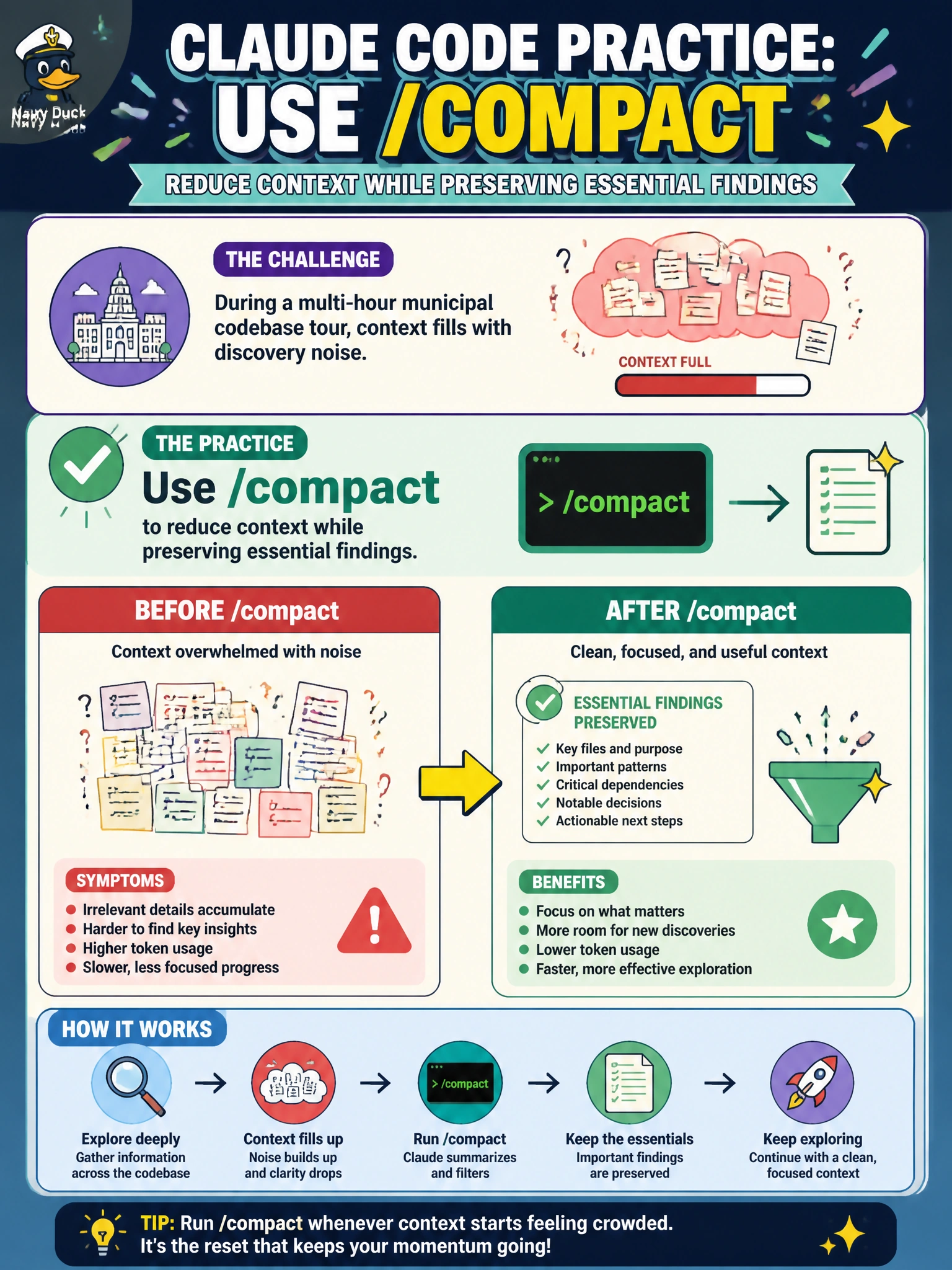
During a multi-hour municipal codebase tour, context fills with discovery noise. What Claude Code practice helps?
Select an answer to reveal the explanation.
Short Explanation
When the backpack is stuffed with trail litter, /compact lightens the load without tossing the map. Use it on long noisy tours.
Full Explanation
During a multi-hour municipal codebase tour, discovery dumps fill the context window with noise. The Claude Code practice that helps is using /compact to reduce context while preserving essential findings—summarizing what matters and dropping redundant tool debris so exploration can continue.
/compact works because long tours accumulate file reads, greps, and dead ends that are no longer needed once findings are extracted. Compaction retains the spine of the investigation (maps, decisions, open questions) without deleting project guidance or disabling capabilities.
Never compacting and keeping every discovery dump forever fails because the session will hit context limits and degrade reasoning quality. Deleting CLAUDE.md so rules stop consuming tokens fails because project rules and civic constraints are load-bearing; freeing a few tokens by discarding governance is the wrong trade. Disabling all tools to shrink context artificially fails because exploration then cannot verify anything in the codebase.
Exam caveat: compact preserves essentials—pair it with scratchpads/manifests so compacted details remain recoverable outside the prompt. Operational check: when context pressure rises mid-tour, run /compact after writing key findings to durable notes, then continue with tools still enabled.