
A county IT team keeps a /deploy-check slash command that is supposed to reason about the repository's current state before a release window. Staff report it often describes a branch state that is hours stale, because the command's text only tells the model to consider the working tree. The architect wants the actual git status output present in the prompt at the moment the command runs. What should the command contain?
Select an answer to reveal the explanation.
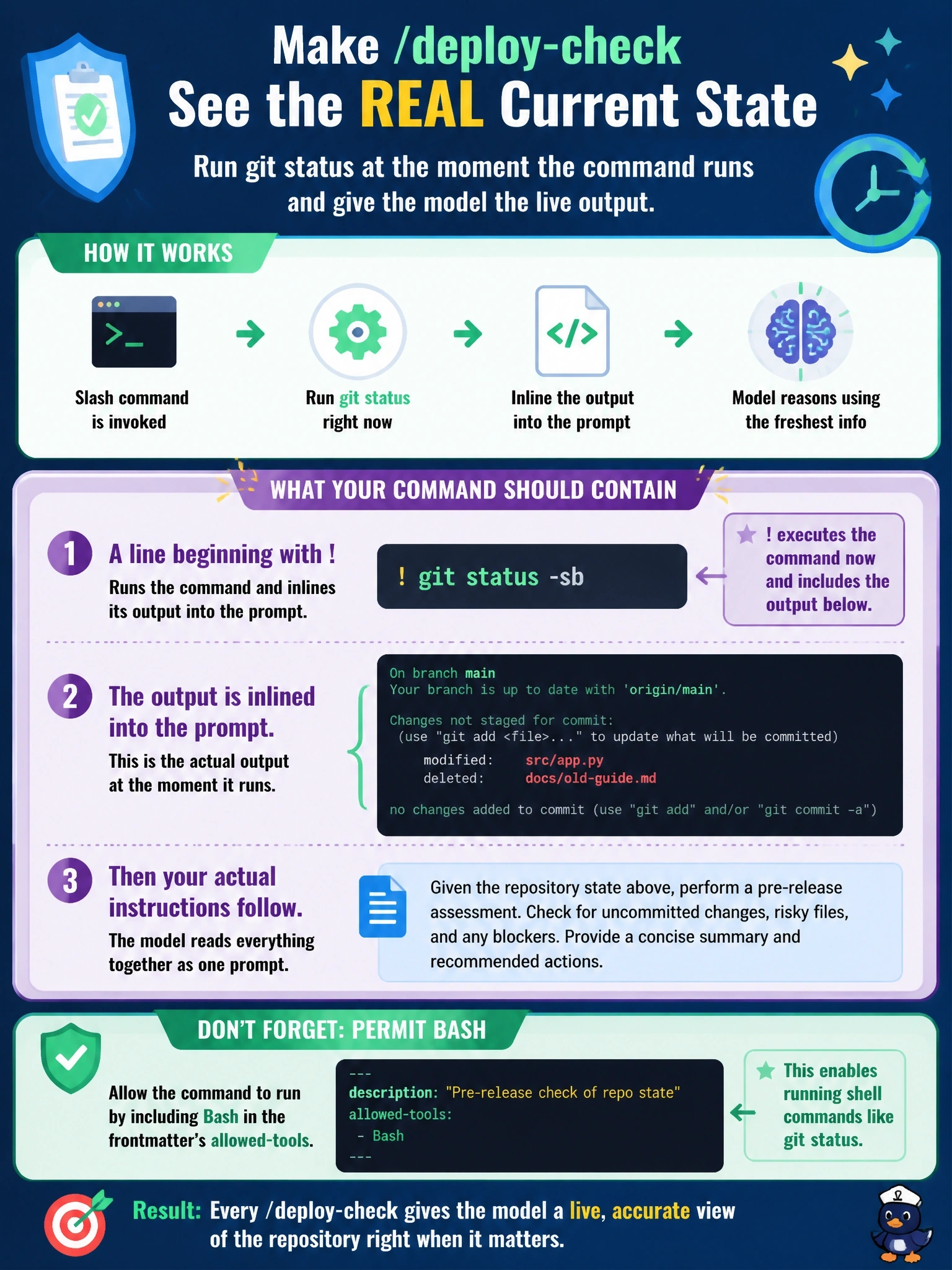
Short Explanation
A ! line in a slash command runs first and staples its real output into the prompt, like printing the current gauge reading onto the checklist before you hand it over. Permit Bash in allowed-tools to enable it.
Full Explanation
An instruction to go find data and a mechanism that delivers data are different things, and only one of them is deterministic. The /deploy-check command is describing a stale branch state because its text asks the model to consider the working tree instead of putting the working tree in front of it.
Slash commands support bash execution at expansion time. A line beginning with ! is executed while the prompt is being assembled and is replaced by its output, so the model receives live git status text as ordinary context before its first token of reasoning. The allowed-tools frontmatter entry permitting Bash is what authorizes that execution, and the pairing is what makes freshness guaranteed rather than merely hoped for.
Having the operator paste output through $ARGUMENTS moves a mechanical step onto a human during a release window and reintroduces staleness the moment they paste something old; there is no @git-status reference form, because @ inlines files by path and does not run git subcommands; and instructing the model in prose to run git status first is guidance rather than mechanism and guarantees nothing about ordering, which is precisely why the command fails today.
Exam caveat: inlined output is a snapshot taken at expansion time, so a long session can still reason over a repository state that has since moved on. Operational check: run the command, change the branch state, run it again, and confirm the second prompt carries the new status rather than a repeat of the first.