
A code-enforcement office maintains a custom slash command that drafts inspection-notice language and is run dozens of times a day. The team wants that one command to always execute on a specific Claude model, regardless of which model the operator has selected for the surrounding session. Which mechanism expresses this?
Select an answer to reveal the explanation.
Short Explanation
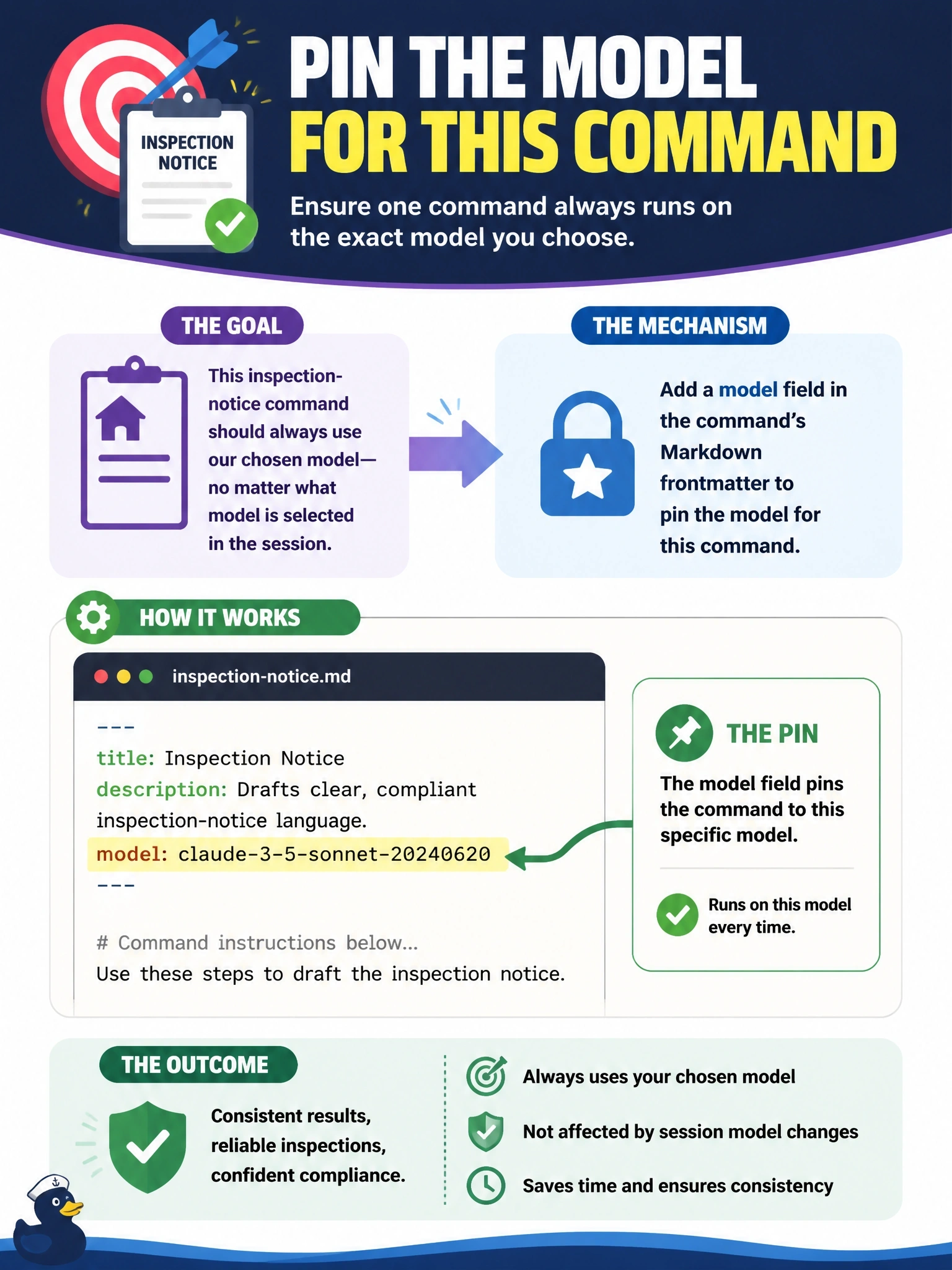
Custom slash commands are Markdown files with a small frontmatter block, and model: is one of its keys. Pin it there and the inspection-notice command runs on that model even when the session is set to something else.
Full Explanation
Where a setting lives determines both its scope and its lifetime. A requirement that holds for one command on every invocation belongs in that command's own definition, not in session state an operator can change between runs and not in prose the model has to remember while it works.
A custom slash command is a Markdown file whose YAML frontmatter carries its metadata, including fields such as description, argument-hint, allowed-tools, and model. Setting model pins the command at the definition level, so the pin travels with the command in version control, applies on every one of the dozens of daily runs, and scopes the choice narrowly enough that the operator's session default still governs everything else in the code-enforcement workflow.
There is no tools: key that selects a model, since tool scoping in a command uses allowed-tools and constrains what the command may do rather than which model runs it; CLAUDE.md is project context injected into the conversation rather than a configuration file with model-selection keys, so a defaultModel entry there would be read as ordinary prose; and an @ reference inlines file contents by path and is not a model switch.
Exam caveat: pinning a model buys consistency, not permanence, because model identifiers are versioned and eventually retired, which makes a pinned command a maintenance item rather than a set-and-forget one. Operational check: invoke the command from a session set to a different model, confirm the run reports the pinned model, and add that identifier to whatever list the team reviews when models are deprecated.