
An emergency-management skill runs a lengthy damage-assessment analysis that produces a lot of intermediate tool output the main conversation doesn't need to see, only the final summary. Which skill configuration keeps that noise out of the main context?
Select an answer to reveal the explanation.
Short Explanation
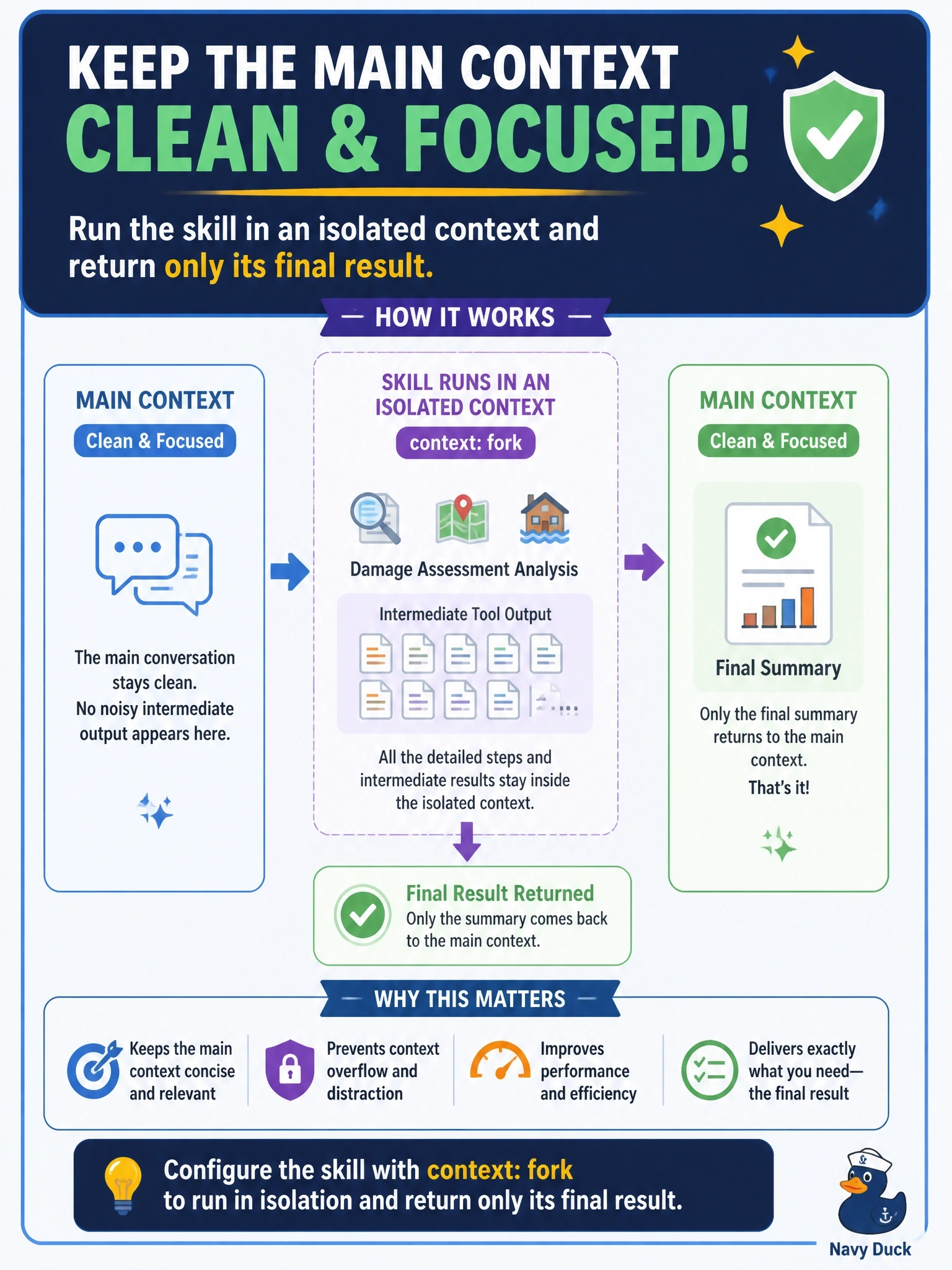
context: fork sends the damage-assessment team out on a separate radio channel. All the noisy back-and-forth happens out there; only the final report comes back to command.
Full Explanation
Context is a shared, finite resource, and work that produces far more intermediate material than conclusion should not spend that resource in the main conversation. An emergency-management damage assessment has exactly that shape: many tool calls, one summary that anyone actually needs to read.
Configuring the skill with context: fork runs its execution—every intermediate tool call and every step of reasoning—in a context isolated from the main conversation, and only the skill's final output flows back. The analysis still happens in full; what changes is that its byproducts never enter the channel leadership is reading during an active incident.
Running the skill inline and deleting messages afterward still lets the noise occupy context for the duration of the run, and manual cleanup is error-prone under incident pressure. Disabling tool use inside the skill removes the very capability the damage assessment depends on, trading noise for uselessness. Increasing the context window makes room for the clutter rather than removing it, and diluted attention stays diluted at any window size.
Exam caveat: the isolation is two-way—a forked skill cannot see the main conversation either, so anything it needs must arrive through its inputs. Operational check: run the same assessment once forked and once inline, and compare how many intermediate messages land in the main transcript.