
After Claude Code generates a parks-fee patch in CI, how should automated review be run?
Select an answer to reveal the explanation.
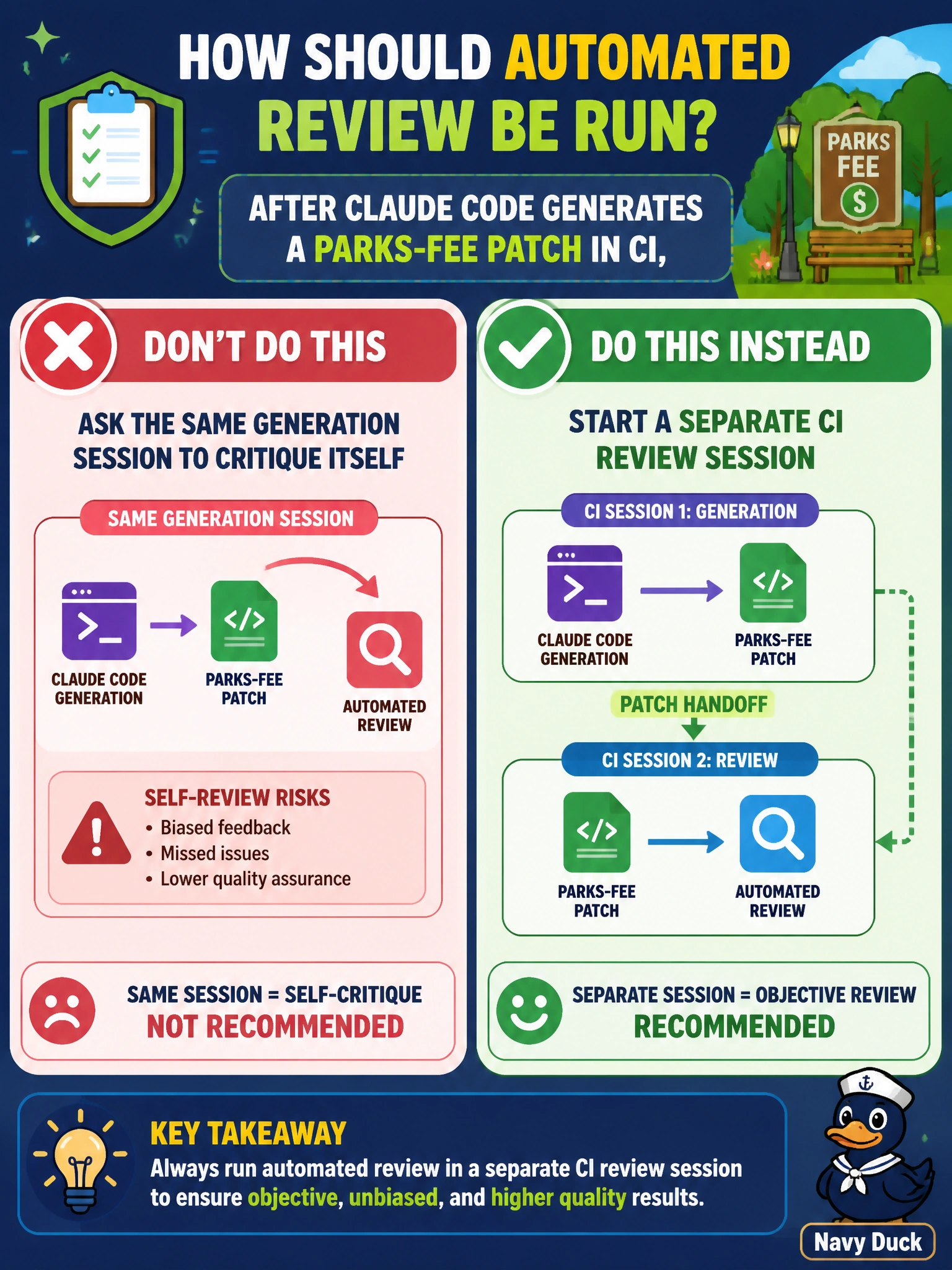
Short Explanation
You don't ask the same contractor who poured the sidewalk to inspect their own cracks. A separate CI review session catches issues the generator session is biased to miss.
Full Explanation
After Claude Code generates a parks-fee patch in CI, review quality depends on session context isolation. Starting a separate CI review session—fresh history, review-focused system prompt, no generator self-justification—lets the reviewer evaluate the diff against standards without defending the choices just made. Separate sessions reduce confirmation bias and make findings more useful for municipal PR gates before merge.
Reusing the generator session so it can defend every choice fails by concept: the same context that produced the patch is biased to rationalize it, so subtle fee-edge bugs and policy misses are under-reported. Skipping review once generation finishes without errors fails because a clean compile or green unit smoke does not prove correctness of fee logic, authorization, or civic policy; generation success is not a substitute for review. Merging the PR before automated or human review completes fails operationally and for change control—municipal repos typically require review evidence before production paths that touch public money or permits.
Exam caveat: a separate review session improves independence; it does not guarantee zero false positives or remove the need for human approval on sensitive parks billing changes. Operational check: in CI, run generation in job A, then invoke Claude Code review in job B (or a distinct session) with the diff and prior standards only—never the generator's private chain-of-thought as the sole evidence—and block merge until that review step completes.