
CI-generated tests for the permitting service keep missing fixture conventions. What should the team put in project CLAUDE.md?
Select an answer to reveal the explanation.
Short Explanation
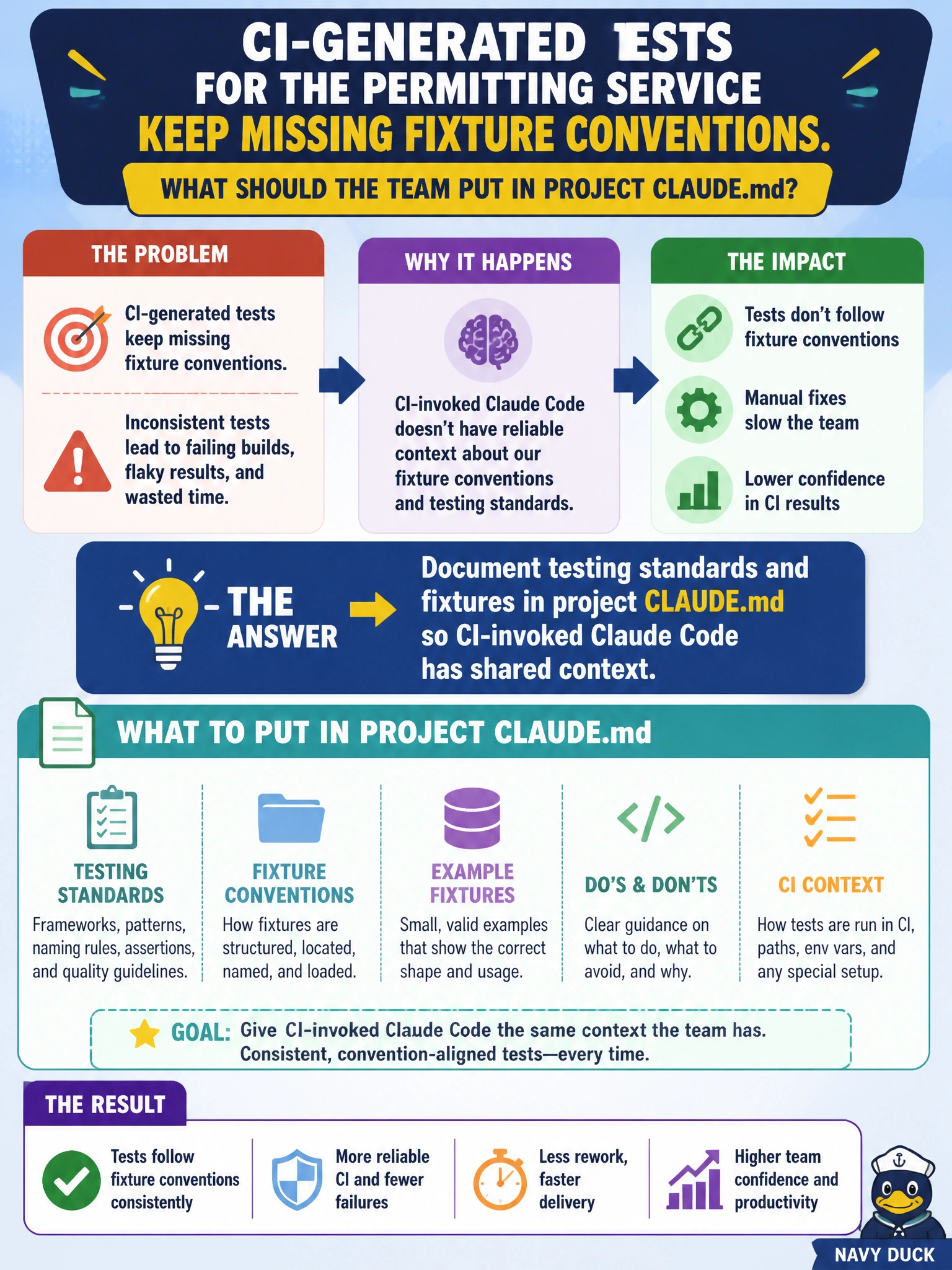
If the fixture playbook isn't in project CLAUDE.md, the CI bot is flying blind. Put testing standards and fixtures where every automated run can read them.
Full Explanation
When CI invokes Claude Code to generate tests for a municipal permitting service, the model only sees what the project makes available in that non-interactive run. Documenting testing standards and fixture conventions in project CLAUDE.md gives every automated invocation the same shared playbook: naming for fixtures, where golden files live, how mocks for fee tables or parcel lookups are built, and what coverage gaps CI is allowed to fill. That project-level context is what stops generated tests from inventing parallel fixture styles that break the suite.
Deleting CLAUDE.md so CI invents fixtures without context fails because the model then guesses from local file noise and produces inconsistent helpers that other developers cannot maintain. Storing testing standards only in one developer's user-level CLAUDE.md fails conceptually because user-level instructions never travel into the CI runner identity; other engineers and the bot do not share that private context. Forbidding Claude Code from reading project documentation during CI fails because it deliberately blinds the generator to the only durable source of municipal test conventions, lowering quality and increasing flaky or duplicate cases.
Exam caveat: project CLAUDE.md improves shared CI context; it does not replace a real test plan, code review of generated tests, or permission boundaries on what CI may write. Operational check: open the permitting repo's CLAUDE.md on the CI branch, confirm fixture and testing standards are present, run a CI Claude generation job, and verify new tests reuse documented fixture patterns instead of inventing a second convention.