
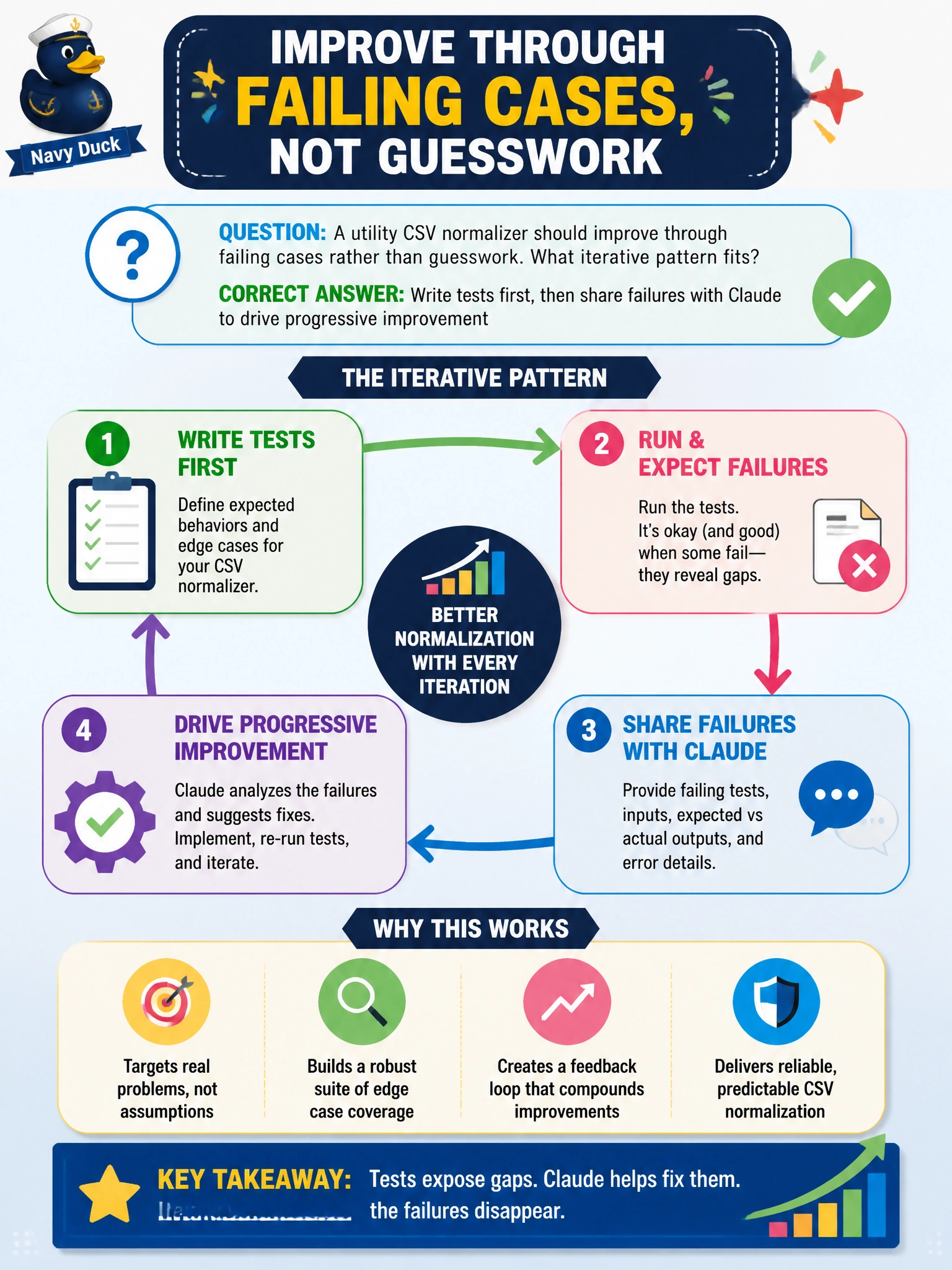
A utility CSV normalizer should improve through failing cases rather than guesswork. What iterative pattern fits?
Select an answer to reveal the explanation.
Short Explanation
Failing CSV tests are the coach's whistle—here's what still breaks. Write the tests first, hand Claude the red ones, and iterate until the whistle goes quiet.
Full Explanation
A utility CSV normalizer that should improve through failing cases rather than guesswork fits a test-first iterative pattern: write tests first, then share failures with Claude to drive progressive improvement. Failures become the coaching signal for the next edit.
That pattern works because executable expectations encode utility CSV rules—column order, encoding, missing values, decimal formats—more reliably than informal requests to "make it better." Sharing red tests with Claude focuses changes on real gaps, and re-running the suite confirms progress without shipping guesswork to production.
Deleting the test suite so failures cannot guide changes fails by destroying the feedback loop. Asking Claude to ignore failing tests and mark the ticket done fails by celebrating false completion while resident-facing data remains wrong. Shipping to production first and refining only after resident complaints fails by concept: municipal data quality should be proven in test before residents absorb CSV defects.
Exam caveat: test-first iteration is a refinement loop with Claude, not a license to skip human review of what the tests assert. Operational check: author failing CSV normalizer tests for known bad rows, feed those failures to Claude, iterate until green, and only then promote the normalizer.