
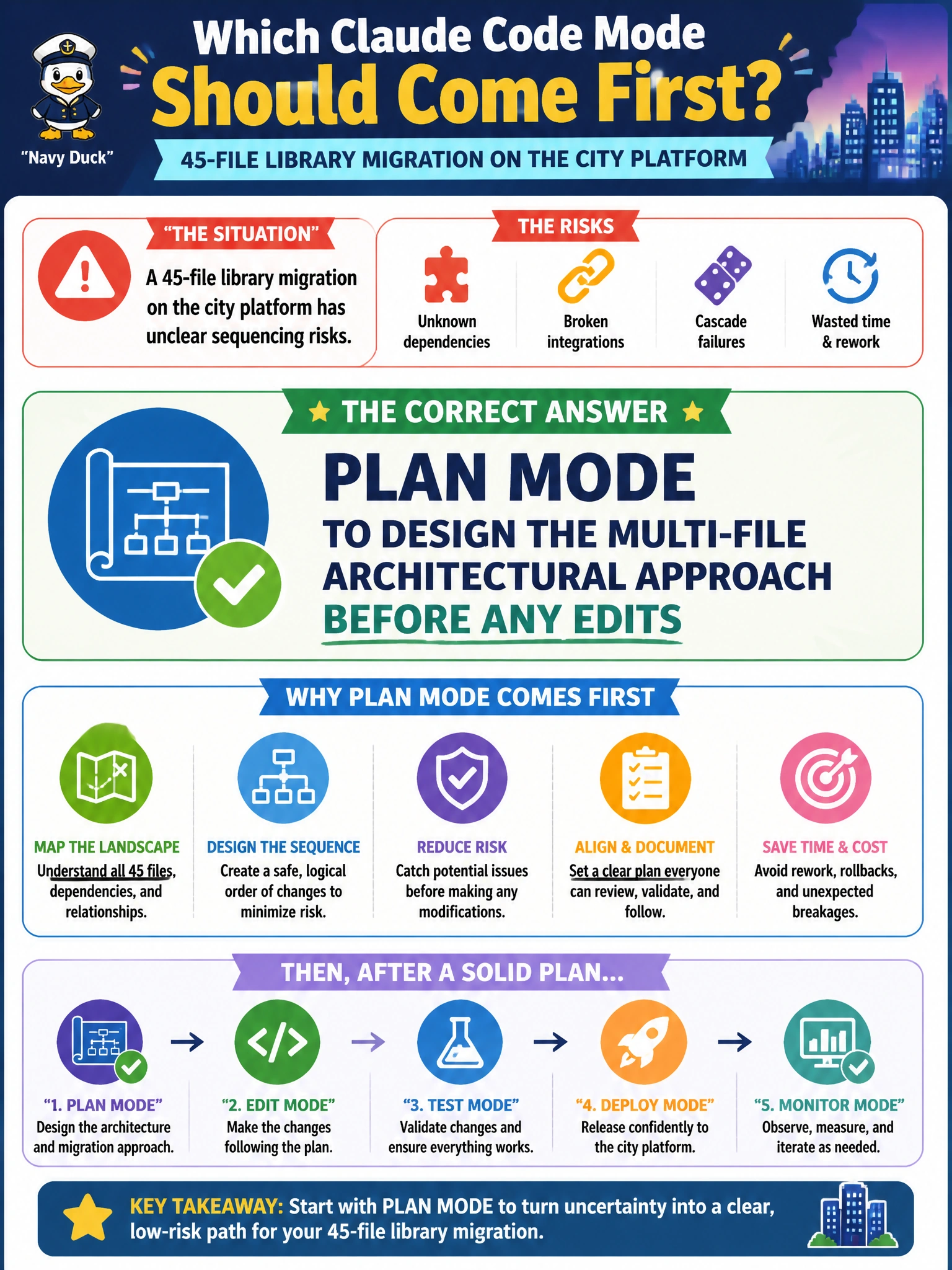
A 45-file library migration on the city platform has unclear sequencing risks. What Claude Code mode should come first?
Select an answer to reveal the explanation.
Short Explanation
Forty-five files and fuzzy sequencing? That's a blueprint job, not a sledgehammer. Start in plan mode, agree on the map, then touch code.
Full Explanation
A 45-file library migration on the city platform with unclear sequencing risks should begin in plan mode to design the multi-file architectural approach before any edits. Plan mode is the Claude Code mode for exploring structure, ordering, and tradeoffs when blast radius and sequencing are uncertain.
Plan mode works here because a large municipal library migration can break dependents if file order, compatibility shims, or package boundaries are wrong. Designing the approach first surfaces sequencing risks, rollback points, and CLAUDE.md-aligned standards before the codebase is rewritten. Once the plan is agreed, the team can switch to execution deliberately.
Direct execution that edits all forty-five files in one unreviewed burst fails by skipping design under high uncertainty, inviting cascading civic outages and rework. Disabling CLAUDE.md so no project standards constrain the migration fails because removing guardrails increases inconsistency across the forty-five files. Bash-only mode that force-pushes to main before any design review fails by concept: it bypasses review, planning, and safe delivery practices required for city platform changes.
Exam caveat: plan mode first is indicated by scale plus unclear sequencing—not by every small bug. Operational check: enter plan mode, produce a sequenced migration plan for the forty-five files, get agreement, then only afterward apply edits under direct execution.