
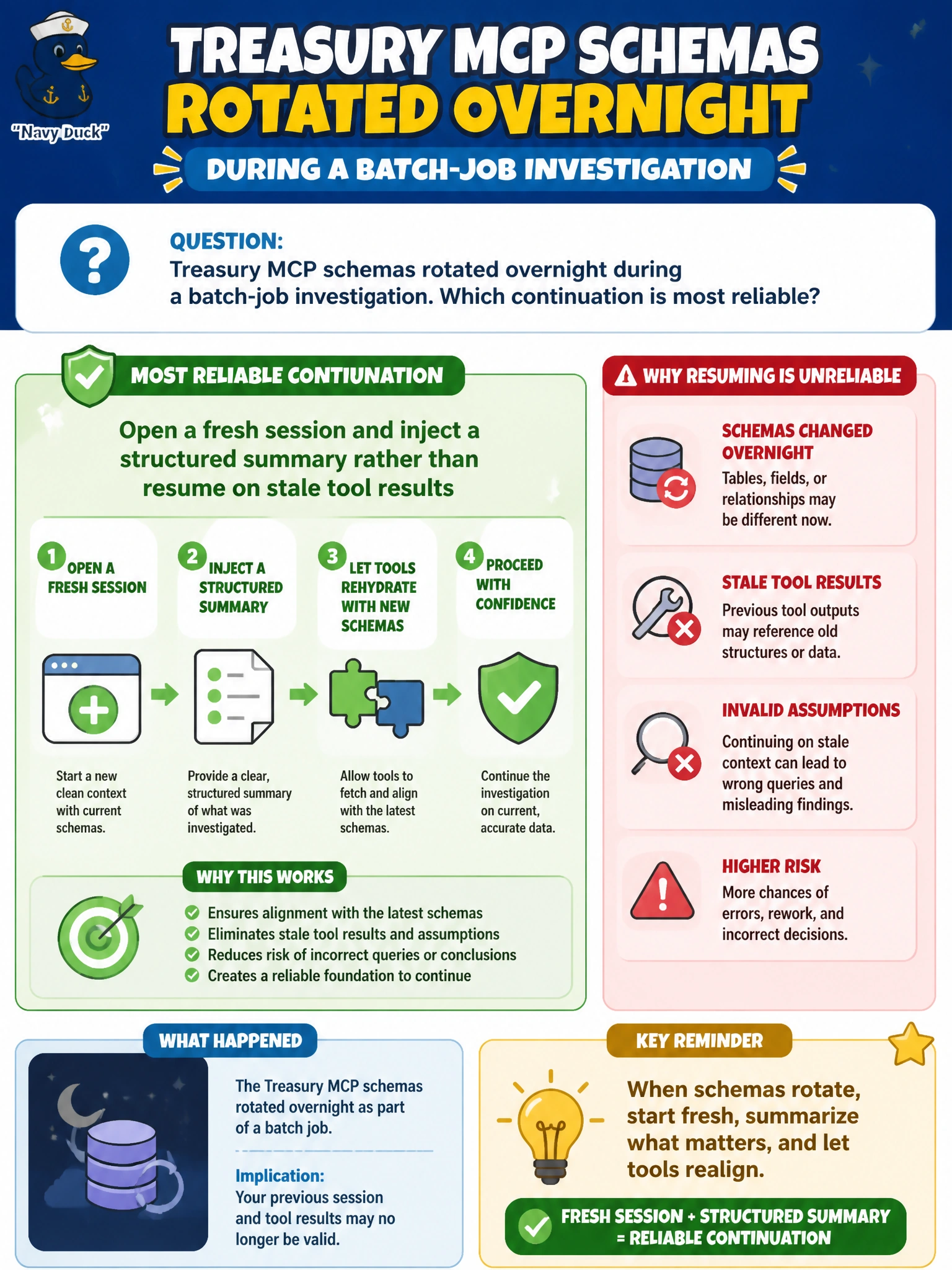
Treasury MCP schemas rotated overnight during a batch-job investigation. Which continuation is most reliable?
Select an answer to reveal the explanation.
Short Explanation
Schema rotation means yesterday's tool dumps are museum pieces. Fresh session plus a structured summary beats a stale treasury resume every time.
Full Explanation
When treasury MCP schemas rotate overnight during a batch-job investigation, prior tool payloads in the resumed session may no longer match live request and response contracts. The most reliable continuation is to open a fresh session and inject a structured summary of confirmed findings—which batch jobs failed, which account IDs were verified, which hypotheses remain open—then issue new MCP calls against the rotated schemas.
Fresh session plus summary works because treasury tooling is schema-sensitive: field renames, enum changes, or endpoint splits silently invalidate yesterday’s JSON. Forcing re-query prevents the agent from posting or reconciling against obsolete shapes that could misstate municipal fund movements.
Resuming and assuming yesterday’s tool payloads still match the new schemas risks reasoning over rotten data and recommending incorrect batch remediations. Keeping the old session but disabling all tools so the model invents schema fields replaces authoritative treasury MCP evidence with hallucination. Merging every historical tool dump into one prompt without noting the schema rotation buries version boundaries and invites the model to mix pre- and post-rotation structures.
Exam caveat: the summary should carry conclusions and identifiers, not unversioned raw dumps treated as still-true. Operational check: after schema rotation, attempt a resume that still references old fields, then open a fresh session with a structured summary and confirm subsequent treasury tool calls validate against the new schema.