
An adult patient undergoes a complex open colorectal resection that lasts five hours, after receiving appropriate weight-based cefazolin plus metronidazole prophylaxis 30 minutes before incision. Assume normal renal function. Under ASHP/IDSA/SIS/SHEA surgical antimicrobial-prophylaxis guidance, which step helps maintain effective prophylaxis?
Select an answer to reveal the explanation.
Short Explanation
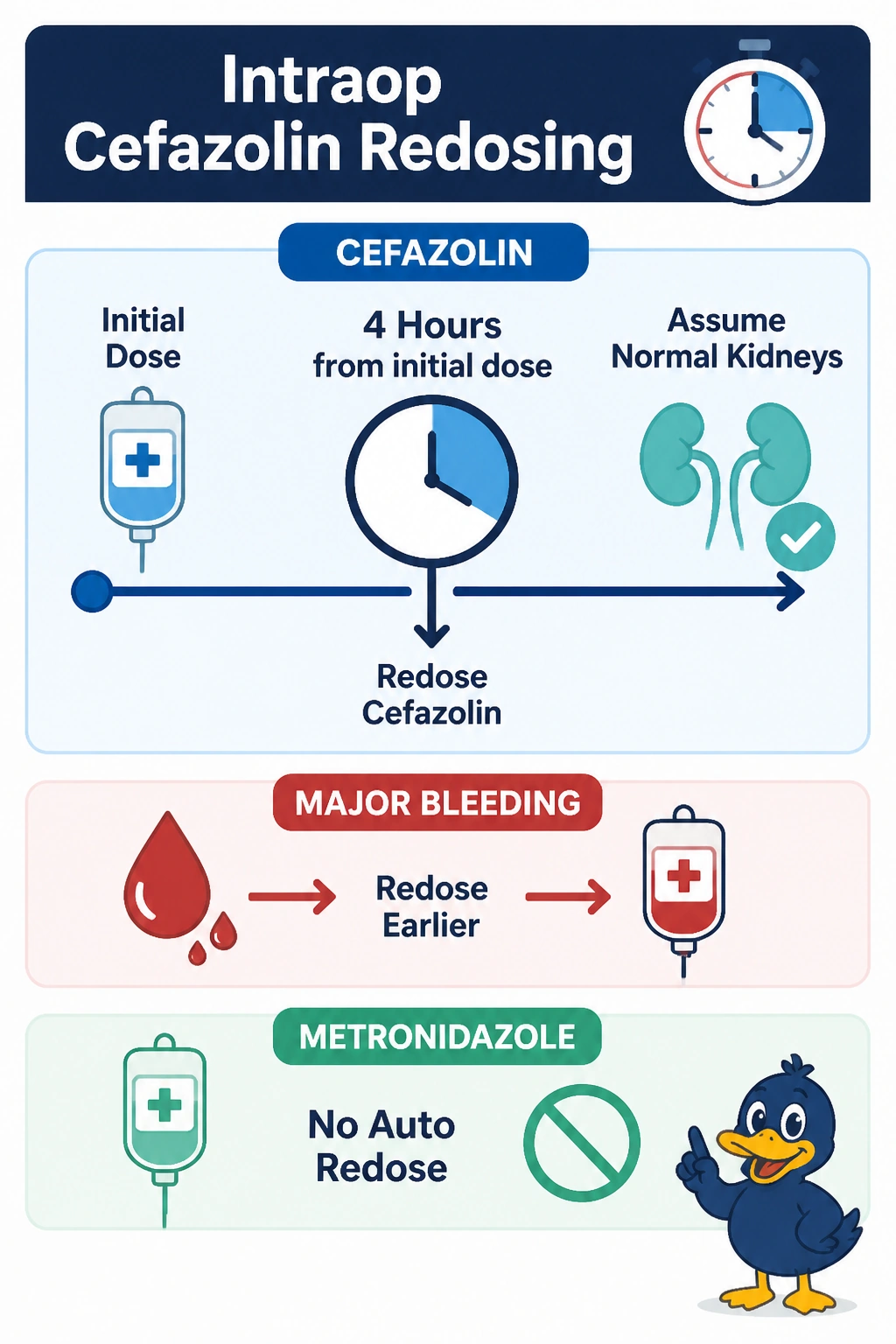
Think of prophylaxis as keeping your umbrella open while it rains: you want coverage through closure in this five-hour case. You maintain that coverage by redosing cefazolin at its recommended intraoperative interval—commonly four hours from the initial dose with normal renal function, or earlier if major blood loss warrants—and this does not automatically require redosing metronidazole.
Full Explanation
Maintaining bactericidal concentrations in serum and tissue from incision through closure is central to surgical site infection prevention under ASHP/IDSA/SIS/SHEA prophylaxis guidance. In this five-hour colorectal operation, redose cefazolin at its recommended intraoperative interval, commonly four hours from the initial dose with normal renal function, or earlier if major blood loss warrants. This sustains targeted coverage without changing the regimen; metronidazole does not automatically need redosing in this case because redosing intervals are drug-specific. CDC 2017 found insufficient randomized-trial evidence to make its own intraoperative-redosing recommendation, while the clinical action is supported by multidisciplinary prophylaxis guidance. Extending oral postoperative antibiotics for seven days after skin closure without infection is discouraged: it offers no added protection and increases risks such as Clostridioides difficile infection and antimicrobial resistance. Doubling the initial dose regardless of patient weight or renal function risks toxicity and does not extend the drug’s elimination half-life through a long operation. Switching routinely to a broad-spectrum carbapenem after the fourth hour unnecessarily broadens coverage rather than maintaining targeted protection against likely skin and surgical-site flora. A practical check is to track elapsed time from the initial dose, not from incision.
Prefer to study offline? Printable PDF study book + test engine ($7.50, unofficial). These questions stay free here.