
During respiratory therapy rounds on an adult medical ward, an infection preventionist observes a clinician rinsing a reusable small-volume medication nebulizer with tap water and allowing it to air dry between doses for the same patient. What practice should the infection preventionist require?
Select an answer to reveal the explanation.
Short Explanation
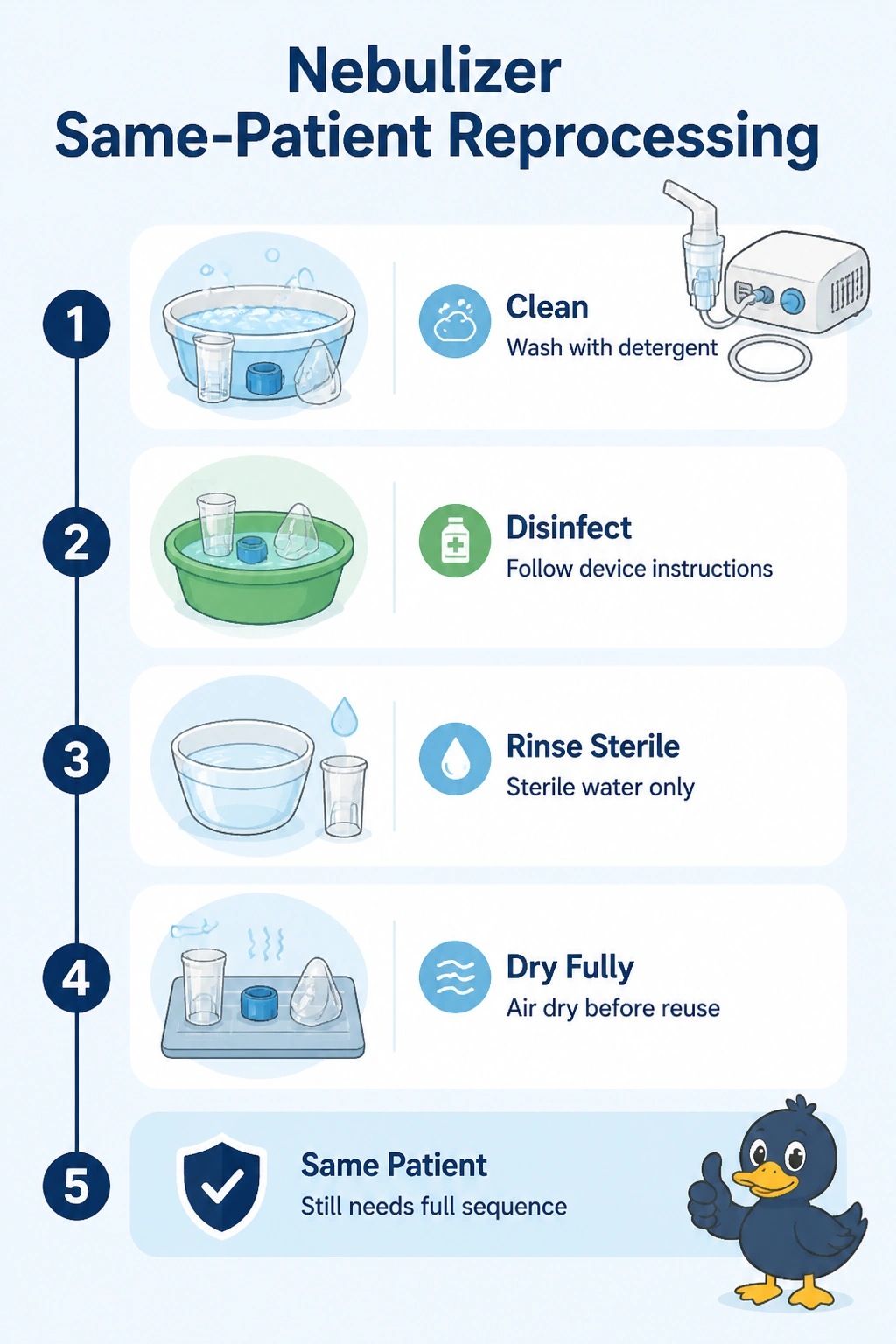
You protect the patient by requiring the full validated sequence, even when the nebulizer is reused for the same person: clean and disinfect it, rinse with sterile water if rinsing is needed, and dry it between treatments according to the device instructions. Sterile water matters because distilled water is not necessarily sterile.
Full Explanation
Clean and disinfect the nebulizer, rinse with sterile water if rinsing is needed, and dry it between treatments, following the device instructions. Reuse for the same patient still requires this sequence: residual medication, moisture, and biofilm can support bacterial growth, and aerosolization can carry organisms deep into the lower respiratory tract. Rinsing with warm municipal tap water and wiping the interior with a paper towel can introduce waterborne pathogens, such as Legionella, Pseudomonas aeruginosa, and nontuberculous mycobacteria, and may leave lint or contamination in the aerosol pathway. Discarding residual medication and refilling without cleaning or disinfection leaves organisms and biofilm able to persist between doses. Rinsing with nonsterile distilled water confuses low mineral content with sterility; distilled water is not necessarily sterile and can still pose an aerosolization risk. Exam caveat: if the device is shared between patients, bedside reprocessing is insufficient; high-level disinfection or sterilization is required as directed by the manufacturer. Practically, check the device instructions for approved cleaning and disinfection steps, whether a rinse is needed, the required rinse water, and how to dry the device between treatments.
Prefer to study offline? Printable PDF study book + test engine ($7.50, unofficial). These questions stay free here.