
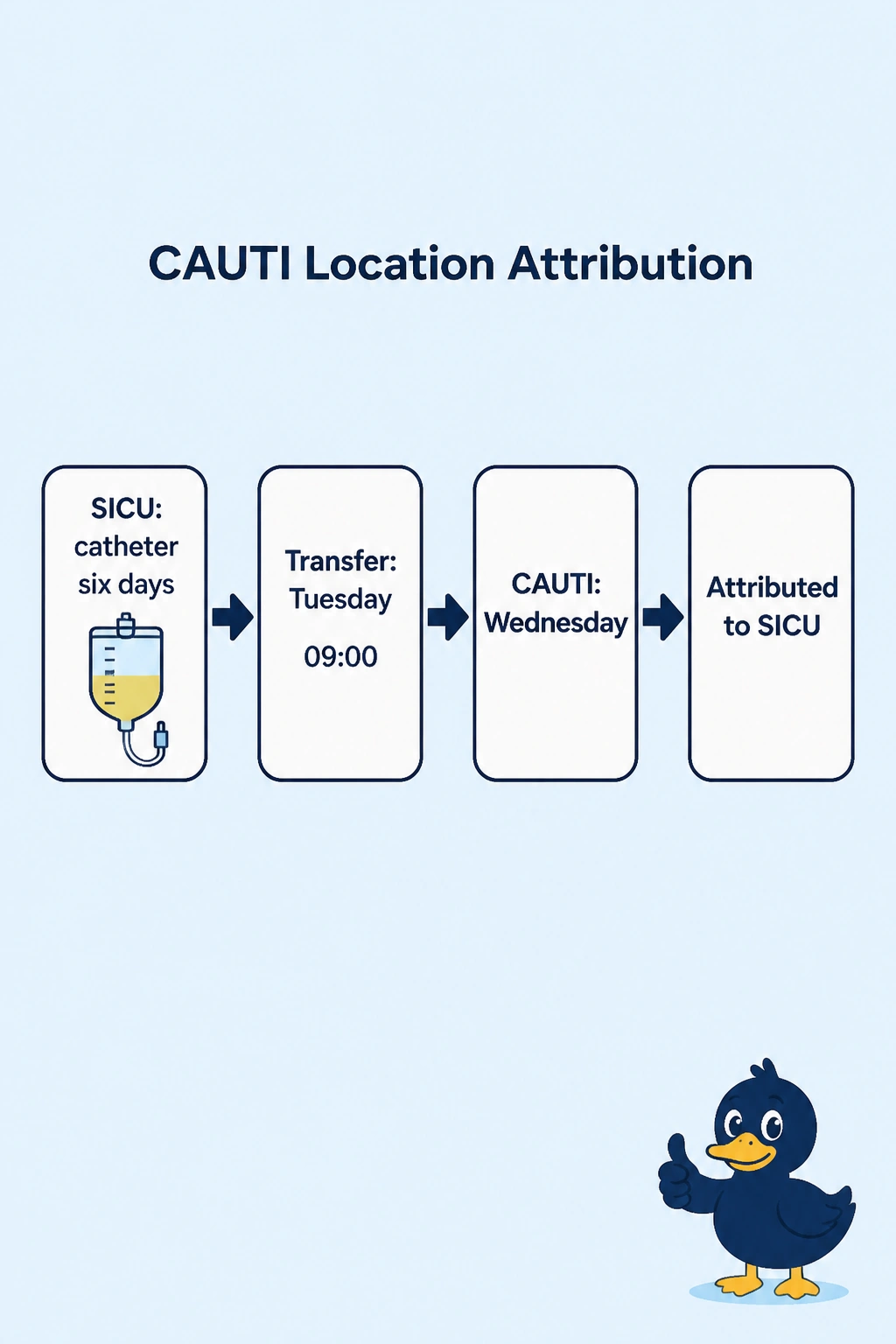
An inpatient has an indwelling urinary catheter in the surgical intensive care unit (SICU) for six days and is transferred to a general medical ward on Tuesday morning at 09:00. On Wednesday afternoon, the patient develops a fever of 38.7 degrees Celsius, and a urine culture collected that day grows more than 100,000 CFU/mL of Escherichia coli, meeting CDC NHSN CAUTI criteria. To which inpatient location must this CAUTI be attributed?
Select an answer to reveal the explanation.
Short Explanation
Think of the NHSN transfer rule like a hot potato—an infection showing up right after a move still belongs to the unit where it brewed. The trap is blaming the receiving ward just because the fever spiked there on Wednesday. You must attribute this CAUTI back to the surgical intensive care unit since the event occurred within the day of transfer or the next calendar day.
Full Explanation
Under CDC NHSN surveillance methodology, the Transfer Rule assigns a healthcare-associated infection to the transferring inpatient location if the date of event falls on the day of transfer or the next calendar day. Because the patient left the SICU on Tuesday and met CAUTI criteria on Wednesday—the very next calendar day—the infection is attributed to "The surgical intensive care unit, under the NHSN location transfer rule" rather than the receiving ward. Attributing it to "The general medical ward, because the patient was housed there when the fever began" ignores the incubation and exposure period that occurred during the six-day SICU stay. Choosing "Both units equally, by splitting the infection event between monthly denominators" is invalid because NHSN assigns each event to exactly one location. Claiming "Neither unit, because a transfer resets the two-day catheter eligibility clock" is wrong because intrafacility location transfers do not reset device-day eligibility once the catheter has been in place for more than two consecutive calendar days. As a caveat, if a patient transfers through multiple units within the same two-day window, NHSN rules attribute the event to the first transferring location where the patient was housed at the start of that window. Operationally, document transfer timestamps accurately in surveillance logs and share CAUTI feedback with the SICU leadership.
Prefer to study offline? Printable PDF study book + test engine ($7.50, unofficial). These questions stay free here.