
A patient is admitted to a medical intensive care unit on Monday (hospital day 1) after a motor vehicle collision and has a central venous catheter placed that evening. On Tuesday (hospital day 2), the patient develops fever and hypotension, and blood cultures drawn Tuesday grow Staphylococcus aureus with no other infection source. Under CDC NHSN surveillance rules, how is this event classified?
Select an answer to reveal the explanation.
Short Explanation
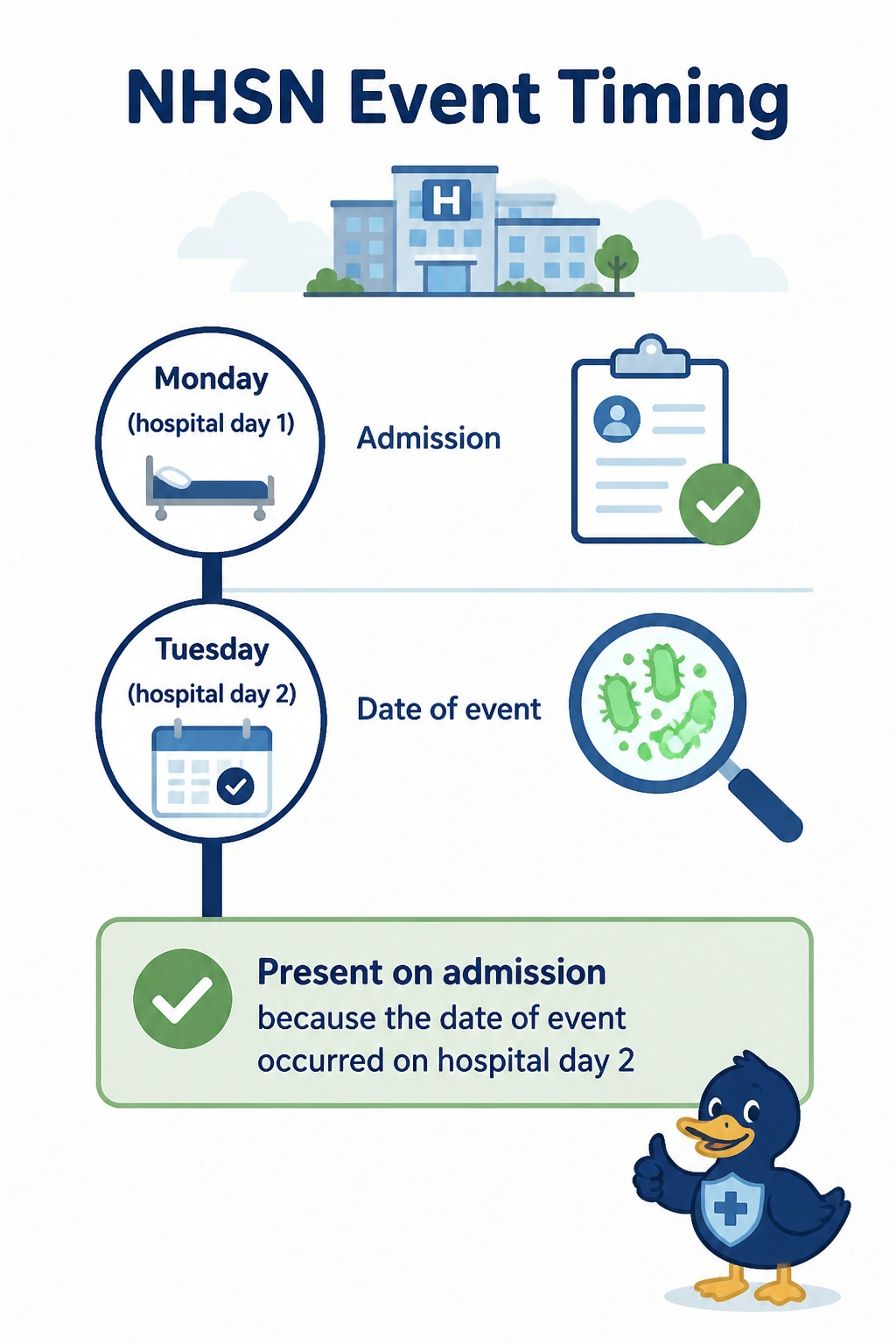
In NHSN surveillance, the calendar clock matters just as much as the culture result. The trap is seeing a positive blood culture with a central line in place and immediately counting it as a CLABSI. Because the date of event fell on hospital day 2—before the day 3 threshold—you must classify this infection as present on admission.
Full Explanation
Present on admission because the date of event occurred on hospital day 2 is the correct CDC NHSN classification. Use the date of the first element occurring within the infection window period; if that DOE is in the POA timeframe the infection is POA, even when other qualifying elements occur later within the window. Under NHSN rules, hospital day 1 is the admission date, and an infection whose date of event occurs on hospital day 1 or day 2 is designated present on admission rather than healthcare-associated. A central line-associated bloodstream infection attributed to the intensive care unit is incorrect because an event must occur on or after hospital day 3 to qualify as a healthcare-associated infection, even when a central line is present. A secondary bloodstream infection attributed to the admission trauma cannot be assigned without a documented primary site-specific infection meeting NHSN secondary attribution criteria. An indeterminate event excluded from all NHSN surveillance reporting is incorrect because NHSN classifies every qualifying event as either present on admission or healthcare-associated using clear calendar rules. Caveat: central line days still count in the unit denominator even when a bloodstream infection is classified as present on admission. Operational check: verify the exact admission date, symptom onset date, and blood culture collection date in the electronic health record before finalizing NHSN reporting.
Prefer to study offline? Printable PDF study book + test engine ($7.50, unofficial). These questions stay free here.