
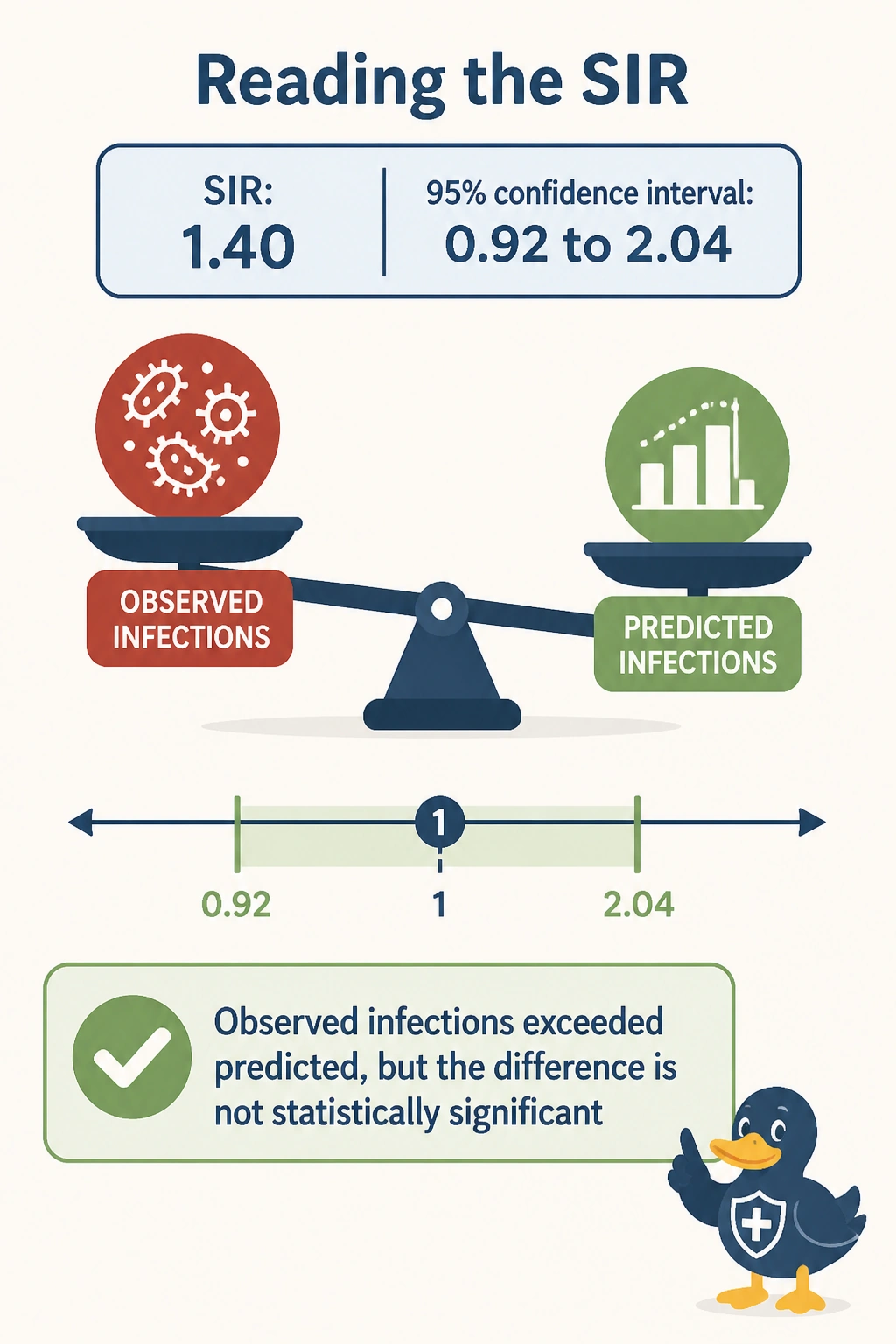
An infection preventionist reviews a quarterly NHSN report for catheter-associated urinary tract infections and notes a Standardized Infection Ratio (SIR) of 1.40 with a 95% confidence interval of 0.92 to 2.04. Which interpretation of this surveillance metric is accurate?
Select an answer to reveal the explanation.
Short Explanation
An SIR above one always catches leadership's eye, but the point estimate never tells the whole story on its own. The trap is declaring a statistically significant spike without checking whether the confidence interval crosses one. When that interval spans both below and above one, your apparent excess could still be due to chance.
Full Explanation
In NHSN surveillance, an SIR of 1.40 means "Observed infections exceeded predicted, but the difference is not statistically significant" because the 95% confidence interval of 0.92 to 2.04 includes the null value of 1.0. An SIR compares observed healthcare-associated infections to the number predicted from the national baseline adjusted for facility and patient-level risk factors; statistical significance at the five percent level requires the entire confidence interval to lie either above or below 1.0. Claiming that "Observed infections were significantly higher than predicted because the ratio exceeds one" ignores the wide confidence interval caused by small numbers. Stating that "Observed infections were significantly lower than predicted because the lower bound is under one" misreads a confidence bound as a point estimate. Asserting that "The unit performed worse than forty percent of comparable hospitals nationwide this quarter" confuses an infection ratio with a percentile rank, whereas 1.40 represents forty percent more infections than predicted. As a caveat, a non-significant SIR above 1.0 should still prompt clinical review of catheter practices, especially on low-volume units. For an operational check, verify device-day denominators and review each reported infection against NHSN criteria before presenting the quarterly dashboard.
Prefer to study offline? Printable PDF study book + test engine ($7.50, unofficial). These questions stay free here.