
A county health department investigates an outbreak of Salmonella enteritidis among attendees of a three-day street food festival that had no ticketed entry or attendance roster. Investigators identify 42 ill attendees and want to determine which food vendor was associated with illness. Which epidemiologic study design is most appropriate?
Select an answer to reveal the explanation.
Short Explanation
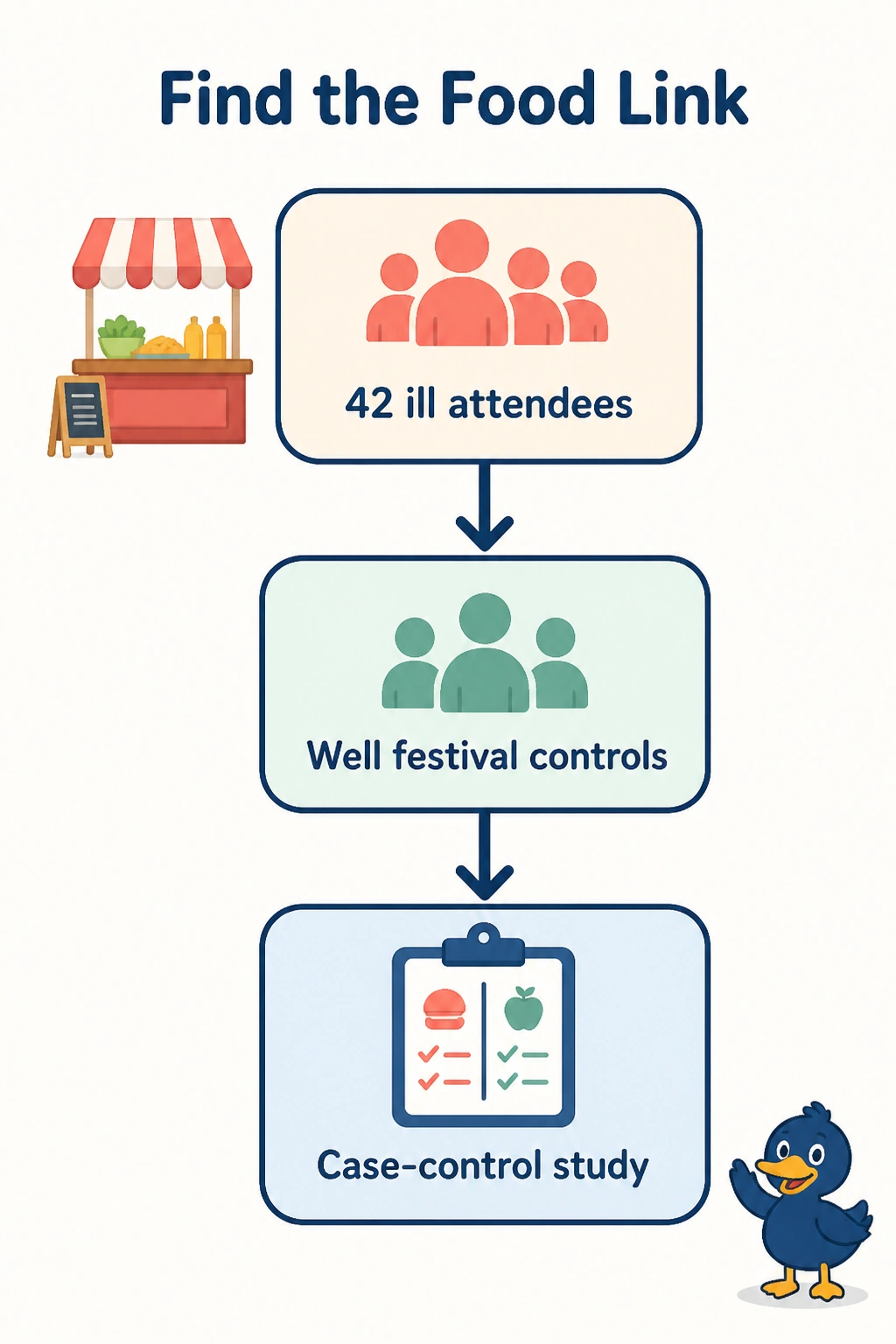
When a street festival has no guest list, you cannot count everyone who walked by the taco stand! The trap is trying to run a cohort study without a denominator, when a case-control study lets you compare ill cases against well controls using odds ratios.
Full Explanation
Because an open street festival has no defined roster of total attendees at risk, investigators cannot calculate true attack rates and should conduct A case-control study comparing food histories of ill cases and well festival controls. By enrolling confirmed ill attendees and a comparable group of non-ill festivalgoers, epidemiologists can calculate exposure odds ratios to pinpoint the implicated vendor. Attempting A retrospective cohort study calculating attack rates for all festival attendees is infeasible because the denominator of total exposed and unexposed attendees is unknown. Proposing A randomized controlled trial assigning festival attendees to different vendors is both impossible retrospectively and unethical when investigating a harmful pathogen. Running An ecological study comparing county-wide Salmonella rates across seasons analyzes population-level aggregates rather than individual-level food exposures and cannot link illness to a specific booth. As a caveat, case-control studies are vulnerable to recall bias if interviews are delayed. For an operational check, use standardized food-history questionnaires and interview cases and controls as soon as possible to preserve memory accuracy.
Prefer to study offline? Printable PDF study book + test engine ($7.50, unofficial). These questions stay free here.