
An infection preventionist evaluates a new rapid screening assay with 95% sensitivity and 95% specificity for a rare multidrug-resistant organism whose prevalence in the hospital is 1%. When the assay is used for routine universal admission screening, most positive results turn out to be false positives on confirmatory culture. Which epidemiologic principle explains this finding?
Select an answer to reveal the explanation.
Short Explanation
Even a very accurate metal detector will mostly beep on bottle caps if almost nobody on the beach dropped a gold ring. When true prevalence is tiny, even a 5% false-positive rate swamps the few real cases, dropping your positive predictive value sharply. The trap is blaming the lab assay's intrinsic specificity instead of recognizing how prevalence drives predictive value.
Full Explanation
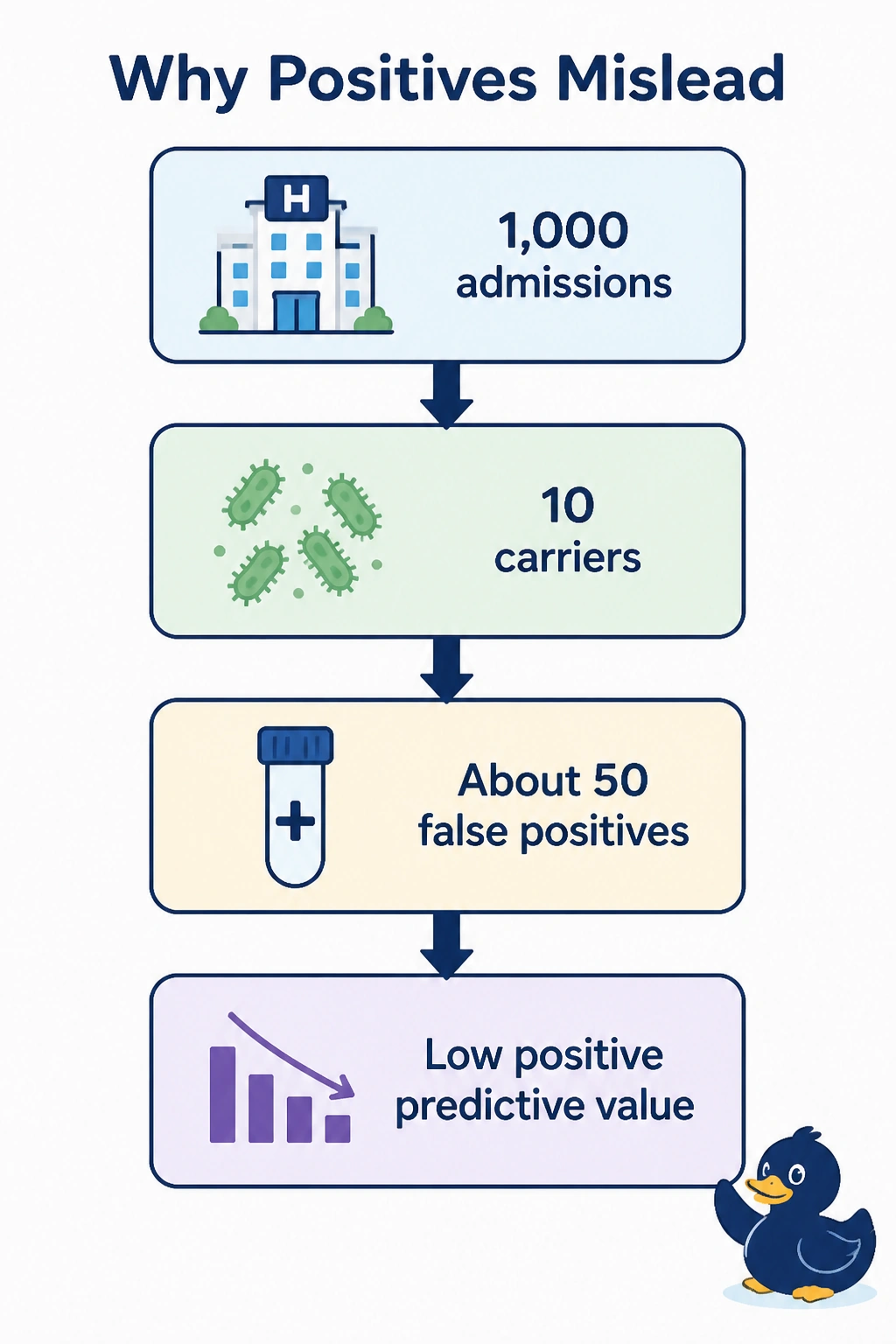
Selecting Low disease prevalence produces a low positive predictive value despite high specificity explains why universal screening for a 1% prevalence organism yields mostly false positives. In 1,000 admissions, only 10 patients carry the organism (producing about 9 to 10 true positives at 95% sensitivity), whereas 990 unaffected patients generate roughly 50 false positives at 95% specificity, leaving a positive predictive value well under 20%. Choosing High assay sensitivity reduces the negative predictive value during screening reverses the relationship, because high sensitivity strengthens negative predictive value by minimizing false negatives. Choosing Confirmatory cultures always have lower specificity than rapid screening assays is inaccurate, as culture confirmation is used precisely for its high specificity to rule out rapid-test false positives. Choosing Low disease prevalence lowers the intrinsic specificity of the laboratory assay confuses test characteristics with population metrics; sensitivity and specificity are intrinsic to the assay, whereas predictive values shift with prevalence. As a caveat, universal admission screening without targeted risk criteria can trigger unnecessary isolation and antibiotic pressure. For an operational check, calculate expected positive predictive value using local prevalence before adopting any rapid admission screen.
Prefer to study offline? Printable PDF study book + test engine ($7.50, unofficial). These questions stay free here.