
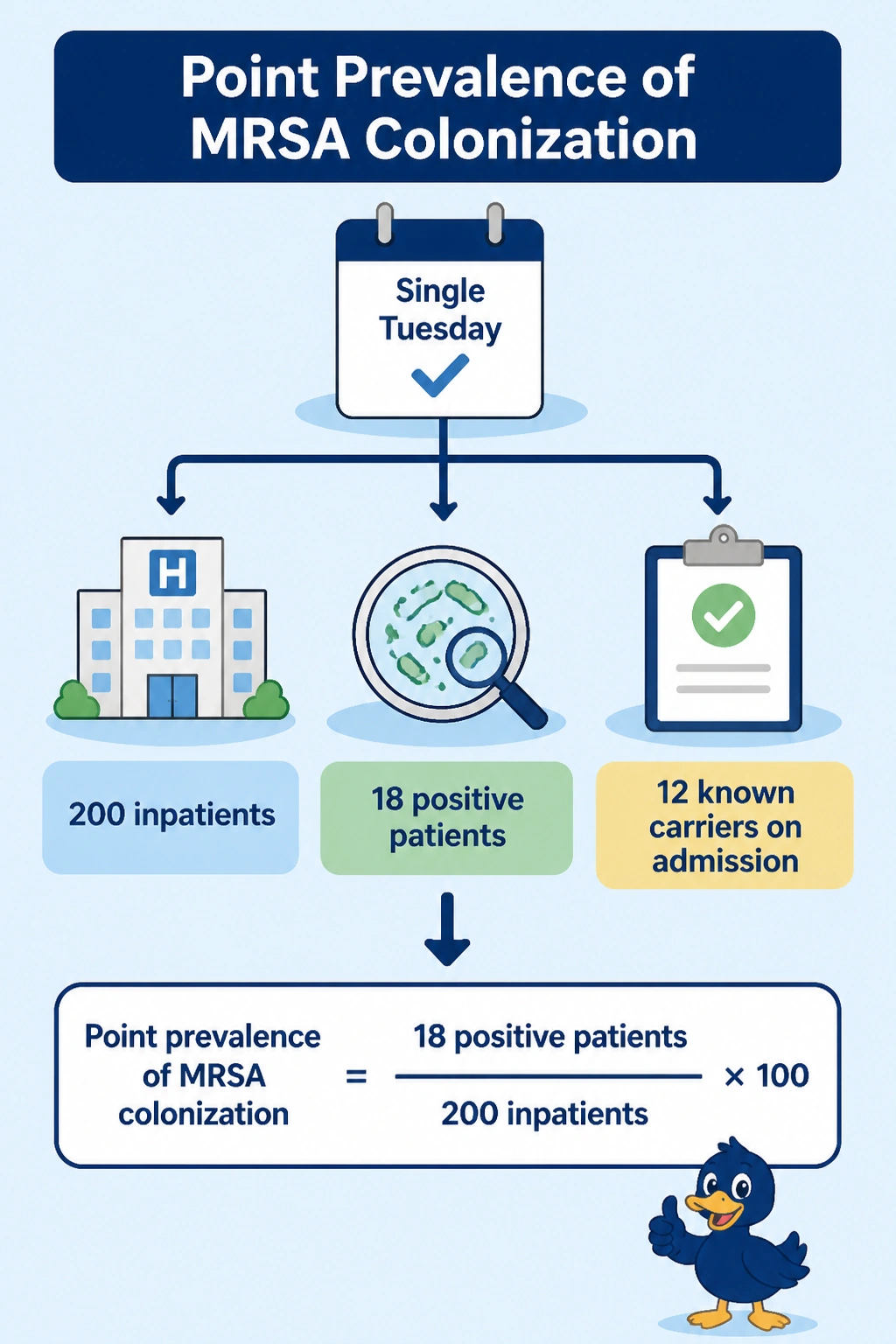
On a single Tuesday, an infection prevention team screens all 200 inpatients for nasal methicillin-resistant Staphylococcus aureus (MRSA) colonization and identifies 18 positive patients, including 12 who were known carriers on admission. Which epidemiologic measure do the 18 positive patients out of 200 represent?
Select an answer to reveal the explanation.
Short Explanation
Think of prevalence as a snapshot in time and incidence as a movie of new cases! The trap is calling a one-day screening total an incidence measure, when mixing existing carriers with newly detected ones on a single day gives you point prevalence.
Full Explanation
Measuring all existing cases present in a population at one specific moment in time defines Point prevalence of MRSA colonization. Because the team screened all 200 inpatients on a single Tuesday and counted both newly identified and previously known carriers (18/200, or 9%), the numerator captures total burden at that snapshot rather than new acquisitions over time. Calling this a Hospital-onset incidence density rate is incorrect because incidence density requires counting only new hospital-onset cases in the numerator divided by patient-days at risk over a defined period. Labeling it Cumulative incidence of new infections fails for two reasons: it includes preexisting carriers present on admission, and nasal screening detects colonization rather than clinical infection. Describing it as a Standardized infection ratio for MRSA is wrong because a standardized infection ratio compares observed healthcare-associated events to predicted events from a national baseline model, not a raw single-day proportion. As a caveat, repeating point-prevalence surveys without separating admission carriers can overestimate unit transmission. Separate admission-known carriers from newly detected positives; establish acquisition using appropriate admission/serial screening and exposure history, because a first positive screen alone does not prove hospital acquisition.
Prefer to study offline? Printable PDF study book + test engine ($7.50, unofficial). These questions stay free here.