
An intensive care unit reports 6 central line-associated bloodstream infections (CLABSIs) over 1,500 central line days, while total patient days for the quarter were 3,000. Which statement accurately describes the unit's surveillance metrics for this quarter?
Select an answer to reveal the explanation.
Short Explanation
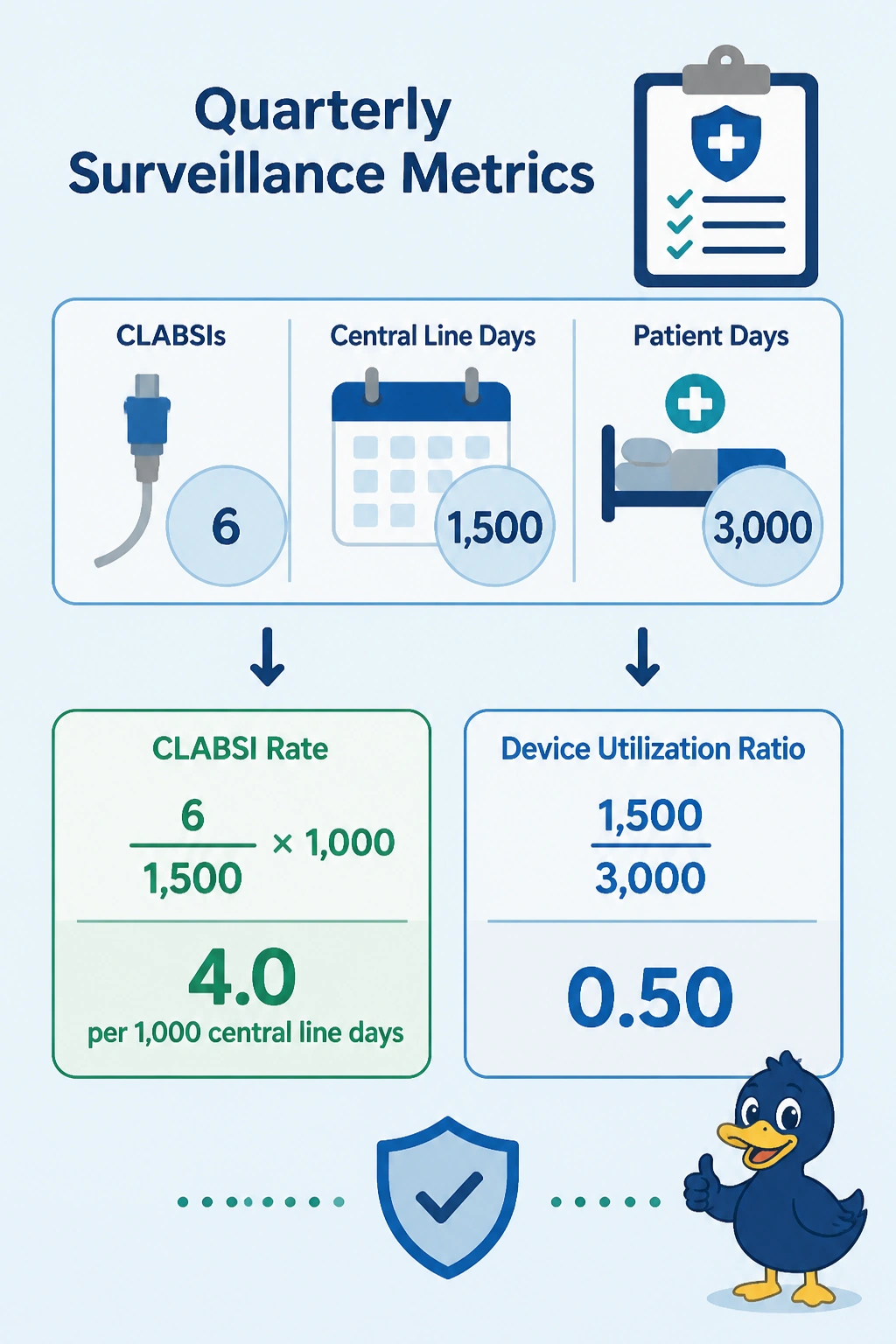
Surveillance math is all about matching the right denominator to the right question, just like miles per gallon needs gallons, not trips. You divide 6 CLABSIs by 1,500 line days times 1,000 for 4.0, and 1,500 line days by 3,000 patient days for 0.50—watch out for the trap of swapping patient days into the infection rate.
Full Explanation
Under CDC NHSN surveillance calculations, The CLABSI rate is 4.0 per 1,000 central line days with a device utilization ratio of 0.50. The device-associated infection rate divides the 6 CLABSI events by the 1,500 central line days at risk and multiplies by 1,000, yielding 4.0 infections per 1,000 central line days, while the device utilization ratio divides 1,500 central line days by 3,000 patient days to yield 0.50. Selecting The CLABSI rate is 2.0 per 1,000 patient days with a device utilization ratio of 2.00 uses the wrong denominator for the infection rate and inverts the utilization ratio. Choosing The CLABSI rate is 4.0 per 1,000 patient days with a device utilization ratio of 0.50 mislabels the denominator as patient days instead of central line days, which would obscure true device-specific risk. Reporting The CLABSI rate is 0.4 per 1,000 central line days with a utilization ratio of 0.25 reflects arithmetic errors in both the multiplier (using 100 instead of 1,000) and the utilization division. As a caveat, crude CLABSI rates should be interpreted alongside risk-adjusted Standardized Infection Ratios when comparing across units. For an operational check, validate daily central line day counts against electronic device documentation to prevent denominator drift.
Prefer to study offline? Printable PDF study book + test engine ($7.50, unofficial). These questions stay free here.