
During central sterile processing rounds, an infection preventionist observes a technician stacking paper-plastic peel pouches flat on top of one another in dense piles inside a steam sterilizer cart. Why must this loading practice be corrected?
Select an answer to reveal the explanation.
Short Explanation
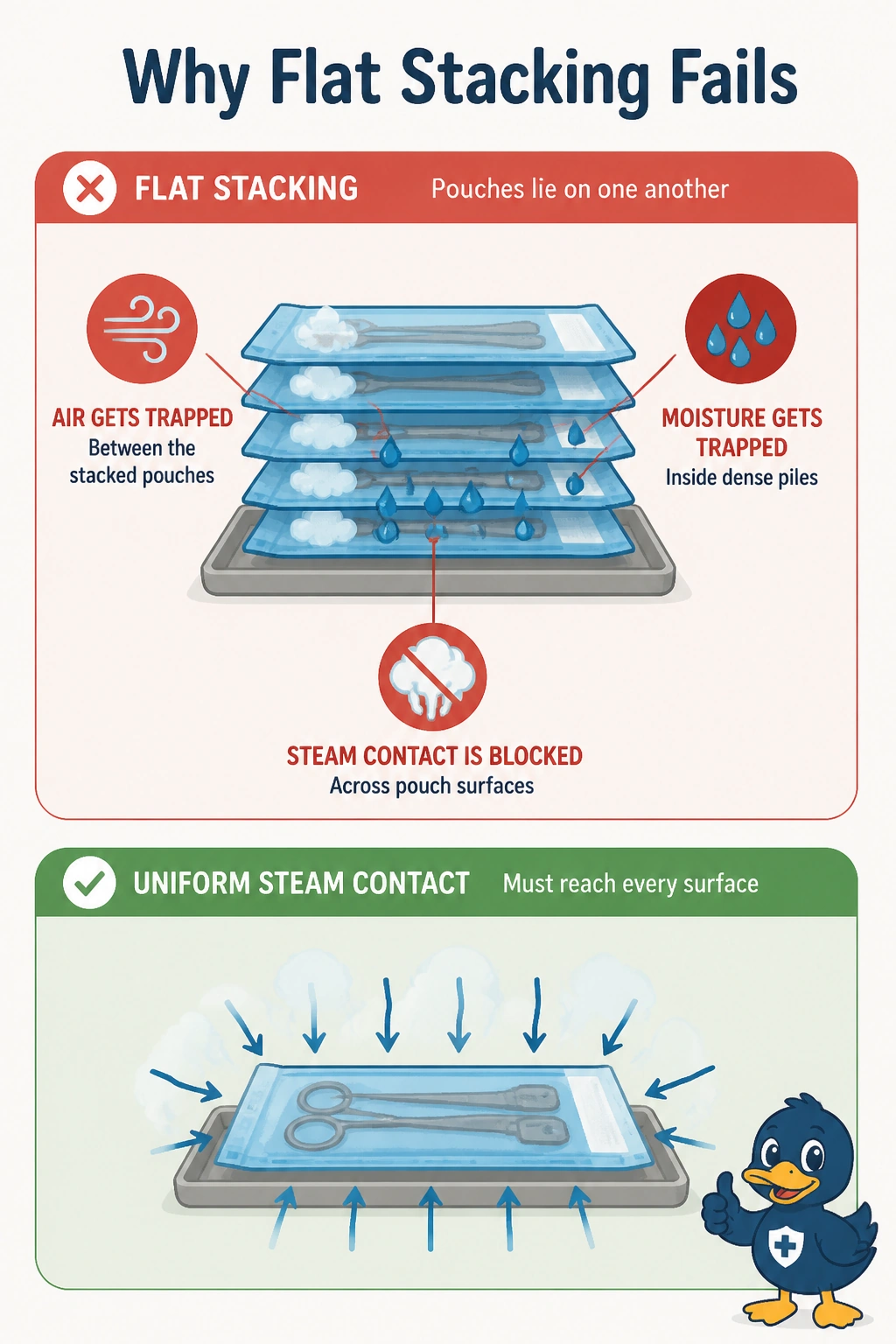
Steam needs room to move — if you stack pouches flat, you trap air and moisture so steam can't reach your instruments. Don't be fooled by color-changing indicators, extra pouching, or longer time — none of those fix a dense stack that blocks steam contact.
Full Explanation
Effective steam sterilization requires complete air removal and direct saturated steam contact on all instrument surfaces, followed by unobstructed condensate drainage during drying. Correcting the technician's practice is essential because Flat stacking traps air and moisture and blocks uniform steam contact with every surface, leading to sterilization failure and wet packs. Claiming that Pouch orientation is irrelevant if every external process indicator changes color is incorrect, as external indicators only show exposure to a process, not sterility or adequate steam penetration inside a dense stack. Insisting that Every peel pouch must be double-pouched regardless of the package IFU is incorrect, because unvalidated double-packaging adds barriers and can only be used when validated by the packaging IFU. Suggesting to Lengthen steam exposure while leaving the dense stack unchanged is incorrect, because improvised cycle extension without validation does not overcome trapped air and moisture and does not correct improper loading. As a caveat, peel pouches should be placed on edge in racks with paper facing plastic so steam enters through the permeable paper side and moisture drains downward. Operational check: Use a compatible rack, orientation and spacing specified by the packaging/sterilizer IFU.
Prefer to study offline? Printable PDF study book + test engine ($7.50, unofficial). These questions stay free here.