
An infection preventionist is designing a quarterly quality dashboard for hospital executives and nursing directors to monitor central line-associated bloodstream infection (CLABSI) prevention across critical care units. Which reporting approach best supports accountability and targeted improvement?
Select an answer to reveal the explanation.
Short Explanation
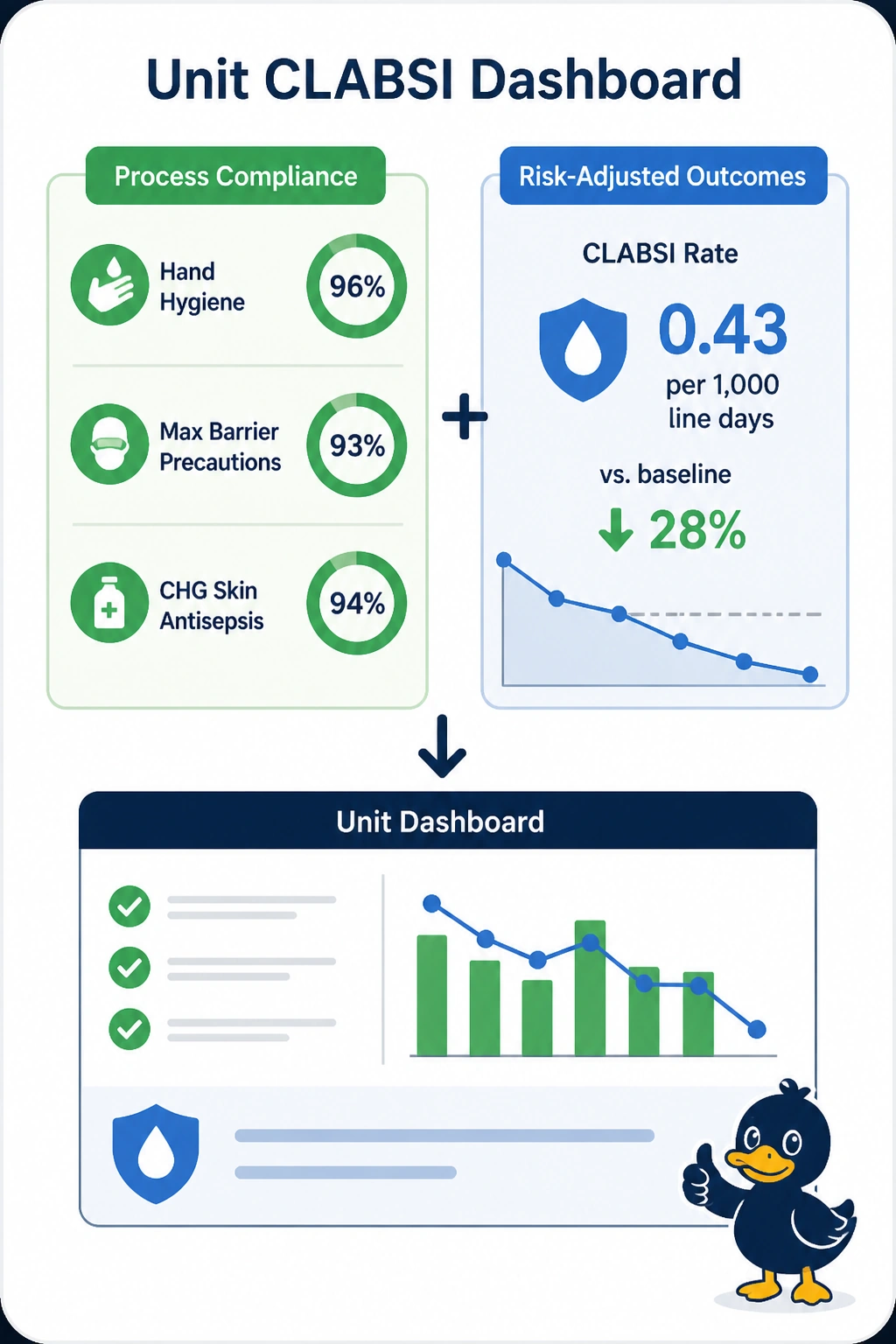
Imagine driving a car by watching only the odometer without checking the speedometer or fuel gauge. When you report to leadership, pairing process compliance with risk-adjusted outcomes shows both whether a bundle is followed and whether it is working. The trap is showing raw counts or outcomes alone, which hides where the breakdown actually sits.
Full Explanation
Effective infection prevention governance links leading indicators of daily practice with trailing indicators of patient harm, so pairing process compliance metrics with risk-adjusted outcome rates on a unit dashboard gives leaders actionable insight into both bundle adherence and clinical impact. Reporting only quarterly outcome rates such as total device-associated infections without compliance data tells executives that infections occurred without revealing whether staff skipped insertion steps or maintenance checks. Presenting raw unadjusted infection counts alone so unit managers can compare totals directly misleads decision-makers because high-volume or higher-acuity units naturally accumulate more device-days and patient risk. Reporting pooled hospital-wide rates and assuming they identify each unit’s process gaps leaves leaders blind to local failures. A pooled outcome may mask unit variation and does not replace unit-level process and outcome feedback. Caveat: process metrics must be collected with standardized definitions and sufficient sample sizes so unit-to-unit comparisons remain credible. Operational check: review dashboard trends monthly with unit nurse managers and pair any rising outcome metric with targeted direct observation audits.
Prefer to study offline? Printable PDF study book + test engine ($7.50, unofficial). These questions stay free here.