
An emergency department nurse sustains a deep percutaneous suture-needle injury from a patient whose HIV status is unknown, and laboratory results for the source patient will not return until the next morning. What occupational health action is indicated?
Select an answer to reveal the explanation.
Short Explanation
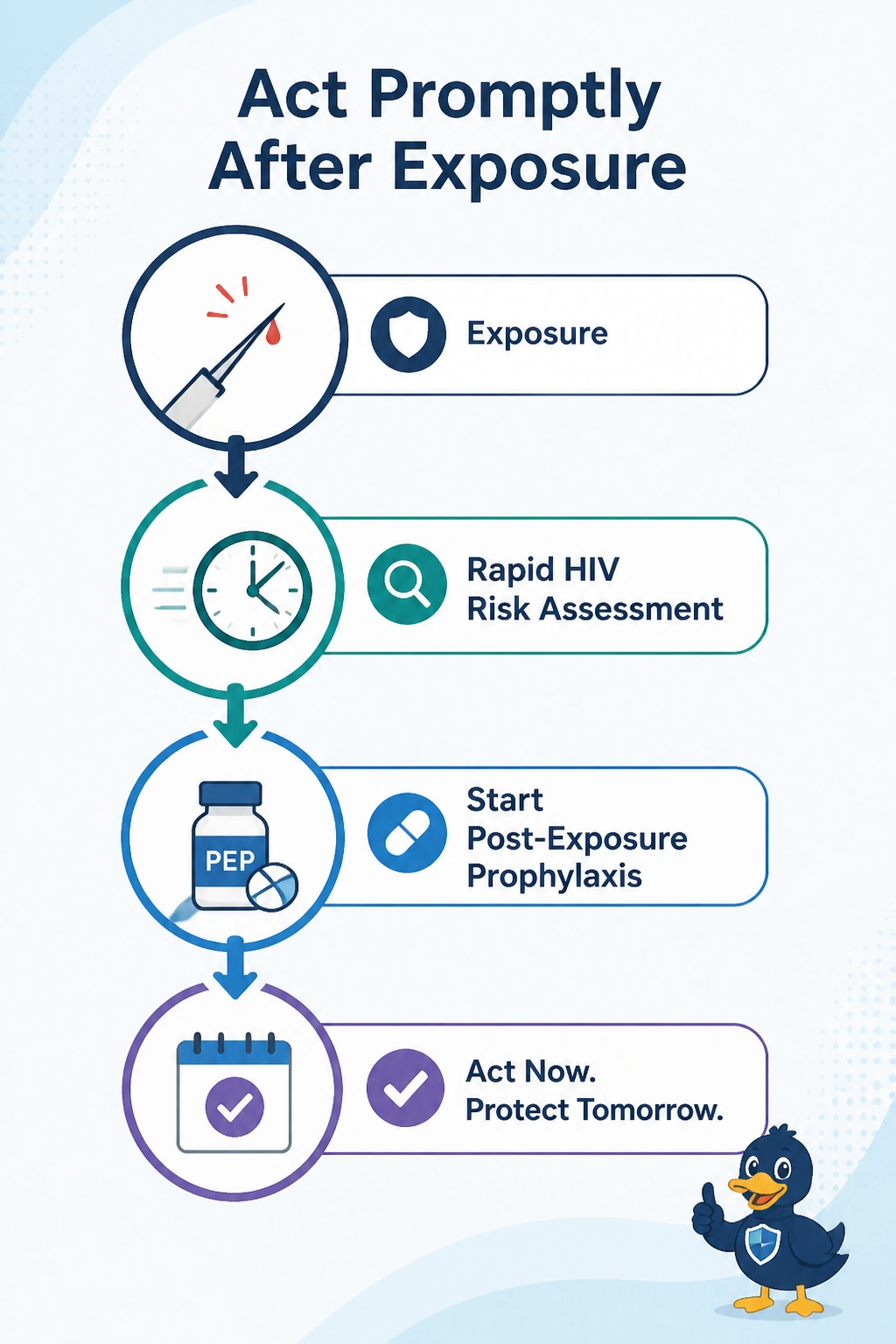
After a high-risk needlestick, the clock starts ticking immediately—every hour counts if HIV post-exposure prophylaxis is needed. You cannot wait until tomorrow's lab printout to decide on medication when the source status is unknown. Do not fall for the trap of delaying PEP or unnecessarily pulling the nurse off duty.
Full Explanation
Initiating rapid occupational HIV risk assessment and starting post-exposure prophylaxis promptly when indicated follows the 2025 US Public Health Service guideline (2025 update of the 2013 guideline), because PEP is started as soon as possible, up to 72 hours after the exposure; for high-risk exposures presenting after 72 hours, seek expert consultation rather than treating 72 hours as an absolute prohibition; PEP can be discontinued if the source patient subsequently tests negative. Delaying all antiretroviral decisions until the source patient's confirmatory HIV test returns wastes critical hours during which viral replication can establish infection. Limiting management to a baseline HIV antibody test for the nurse with repeat testing in six months omits immediate source evaluation, counseling, and timely preventive therapy. Restricting the nurse from all direct patient care duties until the source patient's serology is negative is unnecessary because an asymptomatic healthcare worker with a recent needlestick poses no transmission risk during routine care when standard precautions are followed. Caveat: a rapid HIV test should be pursued on the source patient alongside hepatitis B and hepatitis C screening, and baseline pregnancy and renal/hepatic labs should be obtained if PEP is started. Operational check: verify that starter packs of occupational HIV PEP medications are accessible 24 hours a day in the emergency department or occupational health clinic.
Prefer to study offline? Printable PDF study book + test engine ($7.50, unofficial). These questions stay free here.