
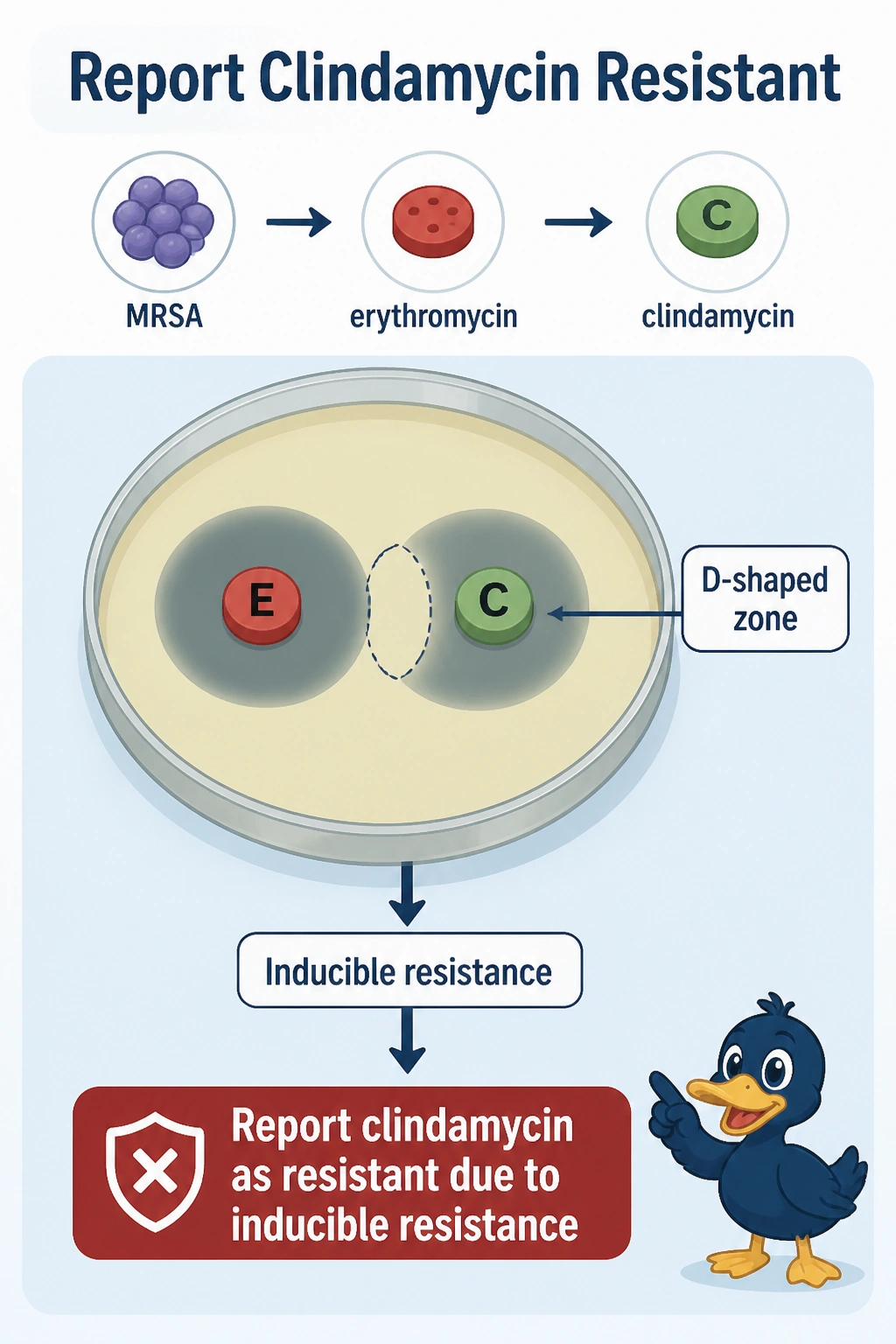
A wound culture from an outpatient with a skin abscess grows methicillin-resistant Staphylococcus aureus that appears resistant to erythromycin and susceptible to clindamycin on standard disk diffusion, but a flattened D-shaped zone appears where the two disks are placed adjacent to each other. How should the laboratory report clindamycin susceptibility?
Select an answer to reveal the explanation.
Short Explanation
A flat edge on the clindamycin zone is a warning flag that the bacteria carry a hidden resistance switch ready to flip on during therapy. The trap is trusting the apparent clindamycin susceptibility at face value, which can lead to treatment failure in your patient.
Full Explanation
A flattened D-shaped zone between adjacent erythromycin and clindamycin disks indicates a positive D-test, meaning the isolate carries an inducible macrolide-lincosamide-streptogramin B (erm) resistance gene, so the laboratory must Report clindamycin as resistant due to inducible resistance. Although clindamycin alone does not strongly induce the methylase enzyme in vitro, erythromycin diffuses into the agar and induces ribosomal target modification, revealing that resistance mutants can emerge rapidly during clinical clindamycin therapy. Choosing to Report clindamycin as susceptible for deep tissue infections risks clinical failure because high-inoculum abscesses or deep infections can select for constitutive resistance. Choosing to Report clindamycin as intermediate and repeat disk diffusion misinterprets a definitive inducible resistance phenotype that requires a resistant call rather than retesting. Choosing to Suppress erythromycin results while reporting clindamycin susceptible withholds critical resistance information and misleads prescribers into using an ineffective agent. As a clinical caveat, if an isolate is erythromycin-resistant and clindamycin-susceptible with a negative D-test (typically mediated by an efflux pump), clindamycin remains a viable option. As an operational check, confirm that your microbiology laboratory performs automated or disk-diffusion D-testing routinely on erythromycin-resistant, clindamycin-susceptible Staphylococcus aureus isolates.
Prefer to study offline? Printable PDF study book + test engine ($7.50, unofficial). These questions stay free here.