
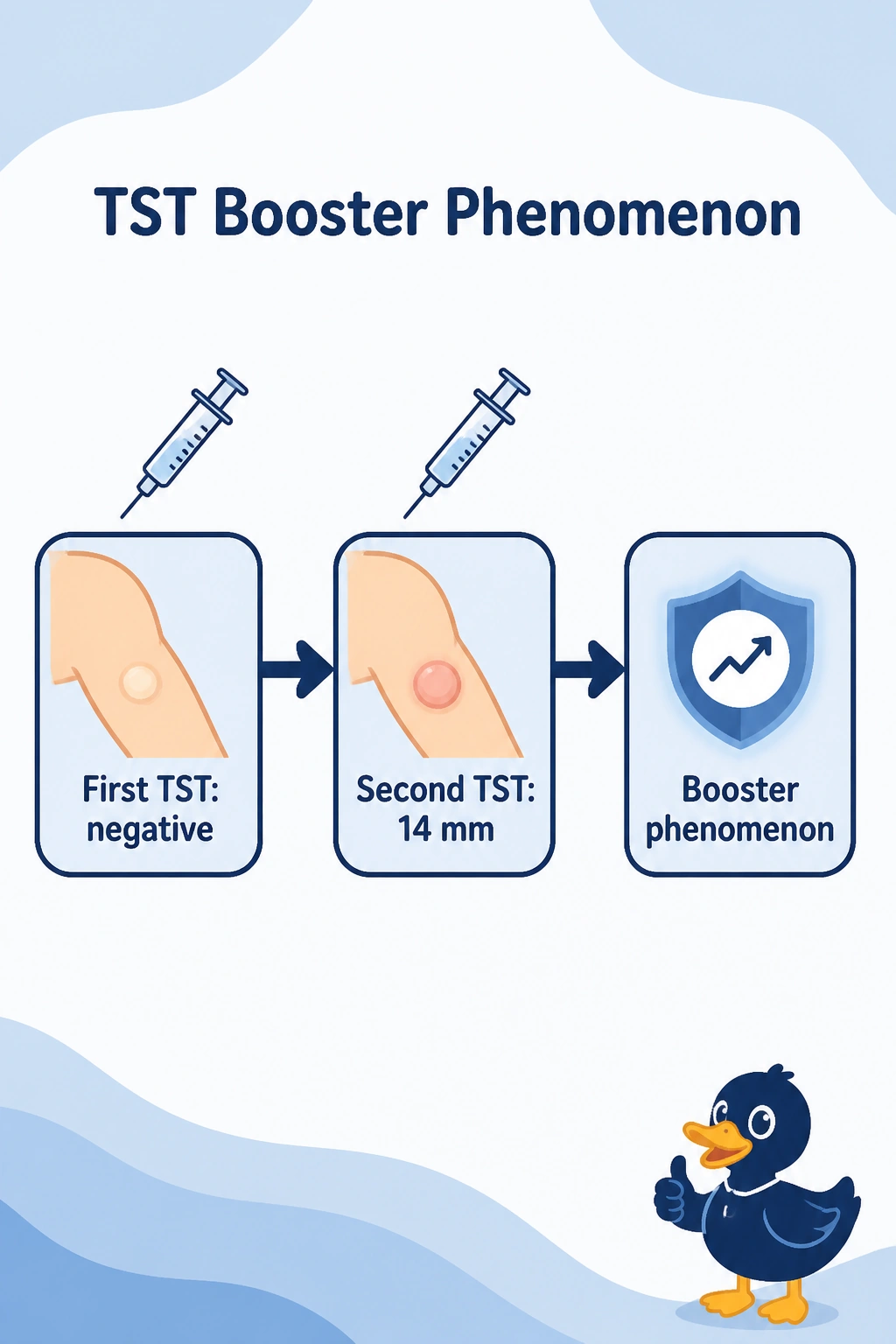
A long-term care facility performs baseline tuberculosis screening with a tuberculin skin test (TST) for a newly admitted 78-year-old resident who has not been tested in decades. The initial TST is negative, so the infection preventionist orders a second TST two weeks later, which measures 14 mm of induration. What does this two-step result most likely represent?
Select an answer to reveal the explanation.
Short Explanation
Two-step skin testing works like priming an old memory—the first test wakes up sleepy immune cells so the second test shows their true baseline. The trap is mistaking that boosted second reading for a brand-new infection. Recognizing the booster phenomenon helps you avoid false outbreak alarms and unnecessary contact tracing.
Full Explanation
The booster phenomenon from waned immunity to a remote infection explains a negative initial TST followed by a positive repeat TST one to three weeks later in an older adult or previously BCG-vaccinated person. Over decades, cell-mediated hypersensitivity to tuberculin can wane; the first skin test stimulates an anamnestic immune recall, allowing the second test to reveal pre-existing latent sensitivity rather than a recent conversion. An acute nosocomial tuberculosis exposure acquired after admission is unlikely. A positive second step at 1–3 weeks commonly represents boosted baseline reactivity; assess relevant exposures, because absence of an identified source does not exclude recent infection. A false-positive reaction caused by recent influenza vaccination is incorrect because inactivated influenza vaccines do not cause false-positive tuberculin skin test induration. Progressive active pulmonary tuberculosis requiring immediate isolation cannot be diagnosed by a TST alone, which does not differentiate latent infection from active disease and requires symptom screening and chest radiography. Two-step testing is used at baseline to prevent misclassifying boosted reactions as new conversions during future serial testing. Operationally, evaluate the resident for TB symptoms and obtain a chest radiograph to rule out active disease before considering latent TB therapy.
Prefer to study offline? Printable PDF study book + test engine ($7.50, unofficial). These questions stay free here.