
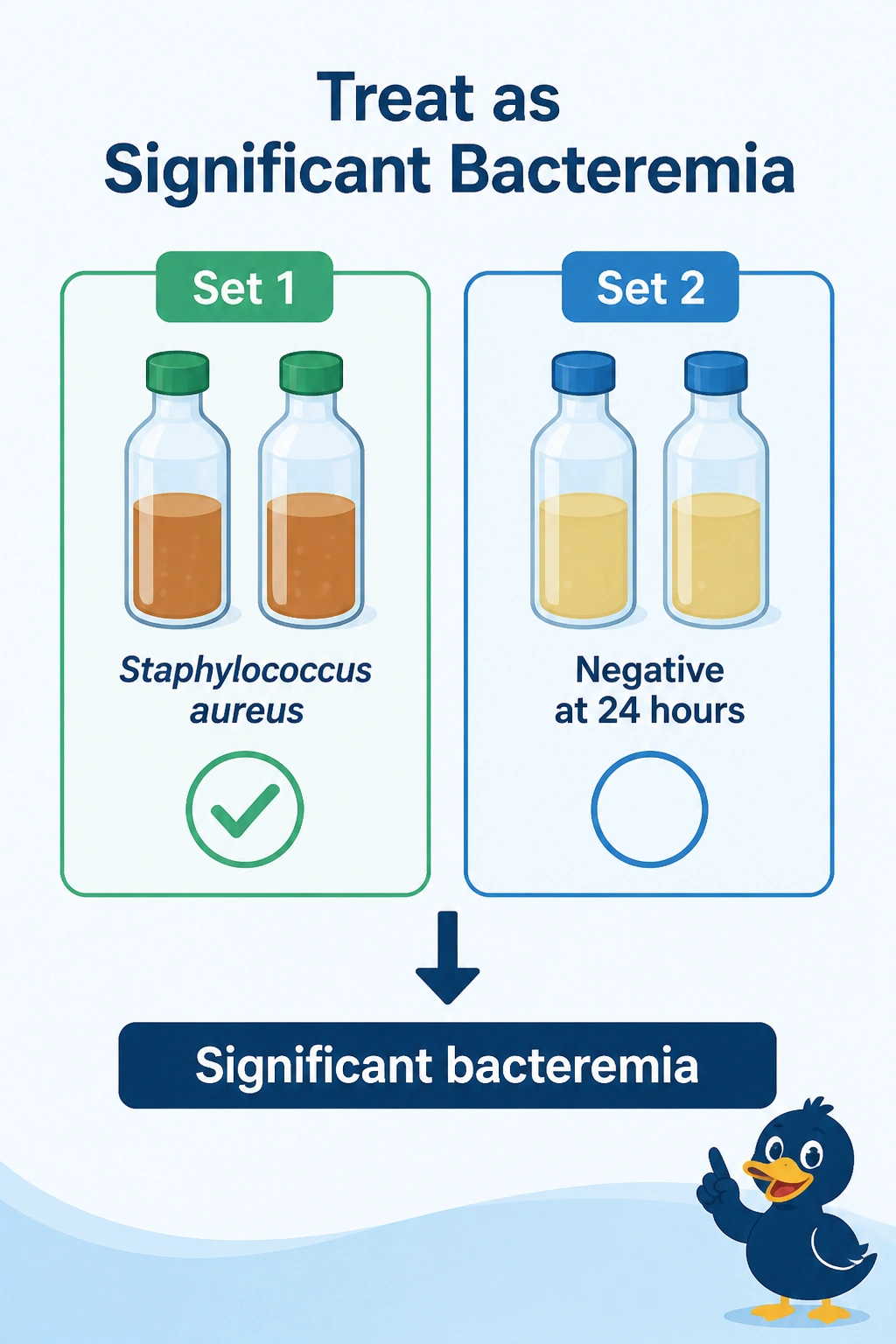
A hospitalized patient with a peripheral intravenous catheter develops new fever and rigors, and one of two blood culture sets grows Staphylococcus aureus in both bottles while the second set remains negative at 24 hours. How should the infection preventionist interpret this microbiology finding?
Select an answer to reveal the explanation.
Short Explanation
Unlike coagulase-negative staphylococci, Staphylococcus aureus is almost never a harmless bystander when it shows up in a blood culture bottle. You should treat even a single positive set as true bacteremia that demands urgent clinical evaluation and source investigation. The trap is applying the two-set contaminant rule meant for common skin commensals to a high-virulence pathogen.
Full Explanation
Staphylococcus aureus is a virulent pathogen capable of causing metastatic infections such as endocarditis, osteomyelitis, and deep abscesses, so its isolation from even a single blood culture bottle is rarely a contaminant. Choosing to Treat the isolate as a clinically significant bacteremia requiring evaluation ensures prompt antimicrobial therapy, catheter or source assessment, and follow-up blood cultures to confirm clearance. By contrast, deciding to Dismiss the isolate as skin contamination because only one blood culture set is positive misapplies criteria intended for low-virulence skin commensals such as Staphylococcus epidermidis. Opting to Wait until the second blood culture set turns positive before notifying the clinical team introduces dangerous treatment delays, as intermittent bacteremia or prior antibiotics can yield a single positive set. Similarly, choosing to Classify the result as asymptomatic colonization because the patient has a peripheral catheter confuses bloodstream invasion with superficial skin or catheter-hub colonization. As an important caveat, peripheral catheters can still serve as the portal of entry for S. aureus bacteremia. For an operational check, confirm the laboratory immediately communicates critical blood culture results and that the clinical team evaluates the insertion site and orders repeat clearance cultures.
Prefer to study offline? Printable PDF study book + test engine ($7.50, unofficial). These questions stay free here.