
A clinician asks the infection preventionist why an Escherichia coli urinary isolate is reported as susceptible to ciprofloxacin with an MIC of 0.25 mcg/mL but resistant to another antibiotic with an MIC of 4 mcg/mL, assuming a lower MIC number is always better across all drugs. How should the infection preventionist explain this?
Select an answer to reveal the explanation.
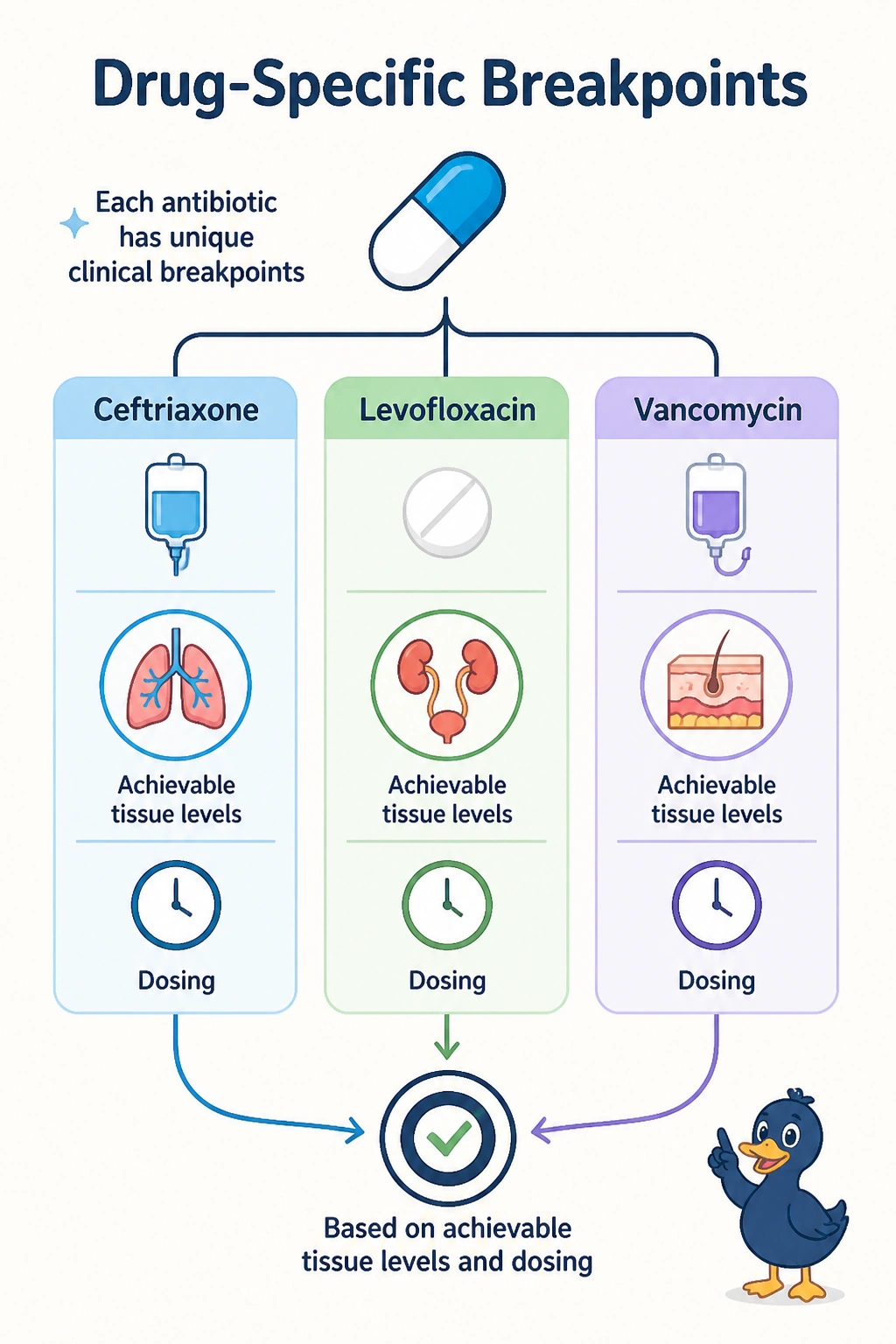
Short Explanation
Comparing raw MIC numbers across two different antibiotics is like comparing miles to kilometers without converting the scale. The trap is thinking a smaller MIC number automatically means a better drug. Your lab interprets each MIC against drug-specific breakpoints grounded in achievable dosing and tissue levels.
Full Explanation
Explaining that "Each antibiotic has unique clinical breakpoints based on achievable tissue levels and dosing" clarifies why raw minimum inhibitory concentration values cannot be compared directly between different antimicrobials. Laboratories interpret each MIC against established pharmacodynamic and pharmacokinetic breakpoints specific to that drug and organism pair to assign susceptible, intermediate, or resistant categories. Claiming that "A lower MIC number always proves stronger bactericidal activity regardless of the drug" is incorrect because one drug may reach far higher serum or urine concentrations at standard doses than another drug with a numerically lower MIC. Stating that "MIC values measure only how fast an organism grows in broth without antibiotics present" misunderstands the test, which determines the lowest antibiotic concentration that inhibits visible bacterial growth. Asserting that "The laboratory reports resistant whenever an MIC exceeds a universal cutoff of 1 mcg/mL" is false because breakpoints vary widely by antimicrobial class and infection site. As a stewardship caveat, site of infection matters: an agent that concentrates well in urine may succeed for cystitis even when it would fail in bloodstream or central nervous system infections. For an operational check, review susceptibility interpretations alongside the patient's infection site and renal function with antimicrobial stewardship or pharmacy.
Prefer to study offline? Printable PDF study book + test engine ($7.50, unofficial). These questions stay free here.