
An inpatient with a tunneled central venous catheter develops fever and chills without an obvious exit-site infection. Paired blood cultures drawn simultaneously from the catheter hub and a peripheral vein both grow Staphylococcus aureus, with the catheter-drawn culture turning positive more than two hours earlier than the peripheral culture. What does this differential time to positivity indicate?
Select an answer to reveal the explanation.
Short Explanation
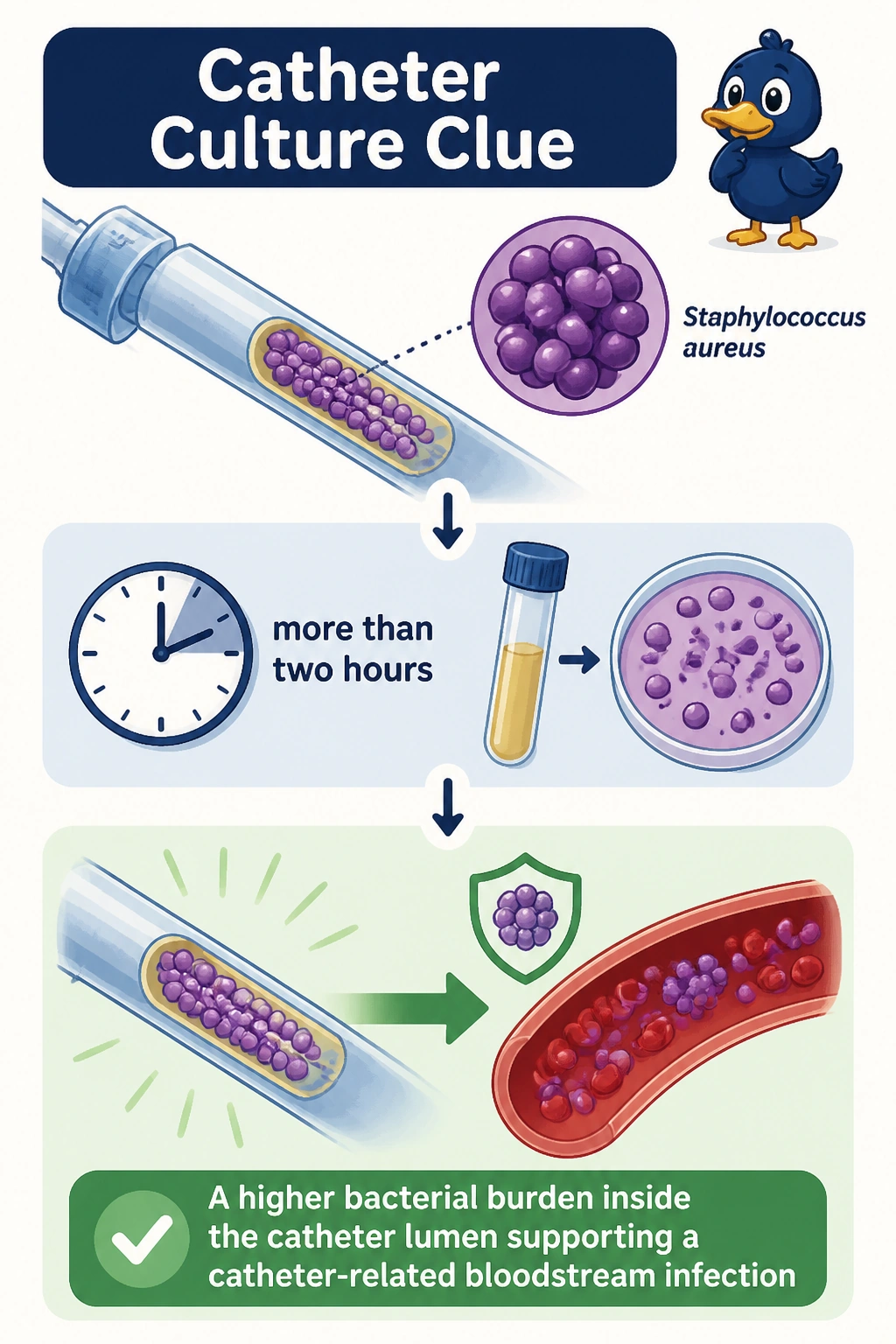
Think of blood cultures like a race between two samples drawn at the exact same starting gun. When the catheter sample crosses the finish line more than two hours ahead of the peripheral sample, the result supports the bacteria are concentrated inside the line itself. You can avoid the trap of blaming skin contamination.
Full Explanation
Differential time to positivity is a classic diagnostic clue for intraluminal colonization, because a catheter sample turning positive at least two hours earlier reflects A higher bacterial burden inside the catheter lumen supporting a catheter-related bloodstream infection. Because microbial growth rate correlates with initial inoculum size, a much faster signal from the catheter hub than from a simultaneously drawn peripheral vein points to the catheter as the primary source of Staphylococcus aureus bacteremia. Attributing the result to Skin flora contamination during peripheral venipuncture rather than true systemic bacteremia is incorrect because S. aureus in blood is clinically significant until evaluated; contamination is possible but must not be casually assumed and the catheter bottle flagged significantly earlier. Concluding it represents A secondary bloodstream infection originating from an occult urinary tract source ignores the markedly higher inoculum localized to the central line hub. Dismissing the finding as a Laboratory incubation delay that invalidates both sets of aerobic and anaerobic blood culture bottles overlooks a validated diagnostic criterion when both bottles are drawn together and loaded promptly. A caveat is that DTP is less reliable for S. aureus and depends on equal volumes and prompt incubation. Operational check: verify volume marks and simultaneous draw timestamps.
Prefer to study offline? Printable PDF study book + test engine ($7.50, unofficial). These questions stay free here.