
An immunocompromised inpatient develops healthcare-associated pneumonia, and a rapid Legionella urinary antigen test returns negative. Two days later, a bronchoalveolar lavage culture grows Legionella micdadei. Which diagnostic limitation explains this discordant result?
Select an answer to reveal the explanation.
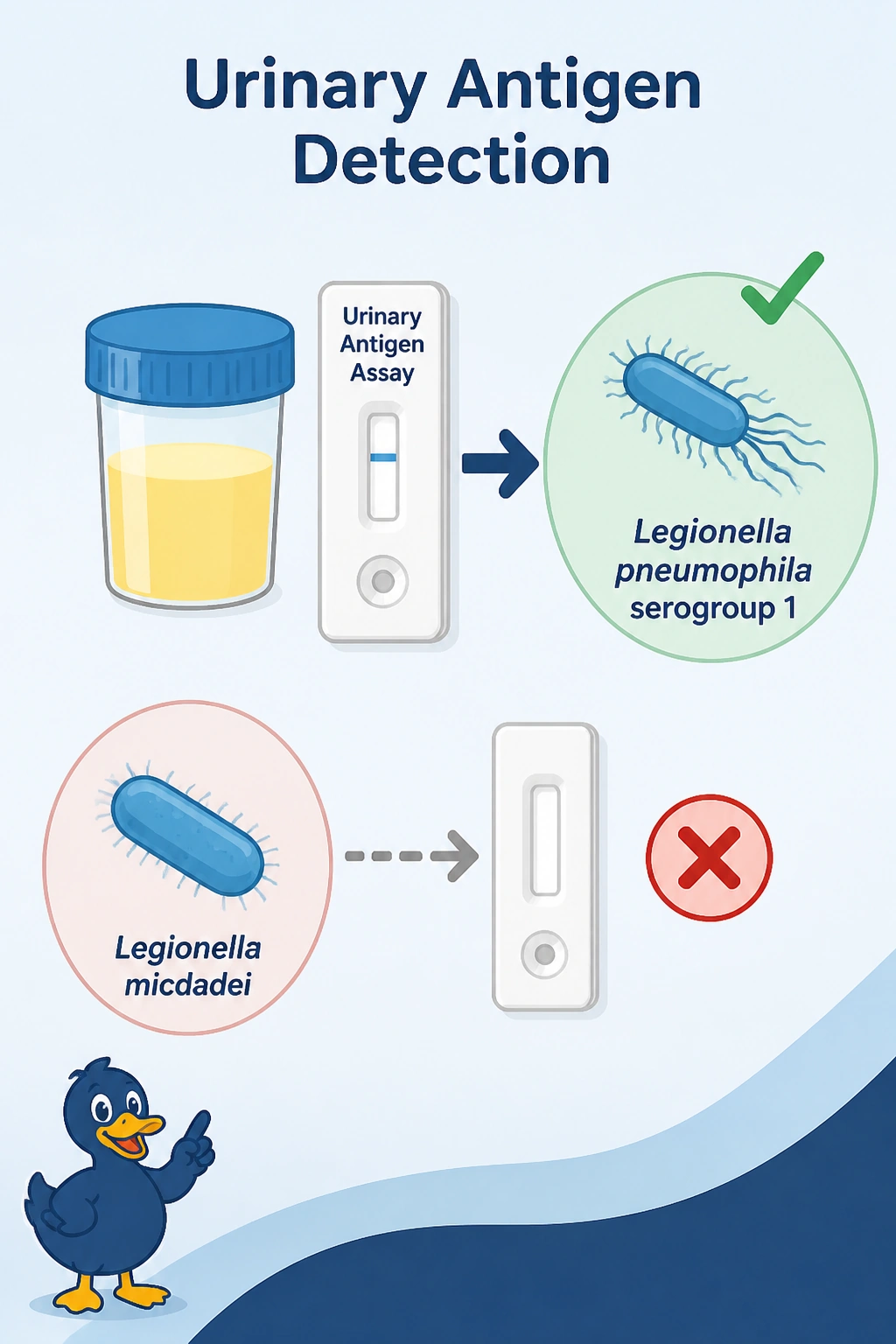
Short Explanation
A rapid urinary antigen test is like a spotlight aimed at one specific target in a crowded room. When you see a negative urine result alongside a positive respiratory culture for a different species, remember the assay misses non-serogroup 1 strains. The trap is ruling out Legionella completely based on a negative rapid urine screen alone.
Full Explanation
Selecting Standard urinary antigen assays primarily detect Legionella pneumophila serogroup 1 explains why an infection caused by Legionella micdadei yields a negative rapid urine test. While serogroup 1 accounts for the majority of community-acquired cases, immunocompromised hospitalized patients are disproportionately susceptible to other serogroups and non-pneumophila species that require buffered charcoal yeast extract culture or molecular testing for detection. Choosing Urinary antigen tests only detect Legionella after antibiotic therapy begins is incorrect because soluble antigen is excreted early in illness and remains detectable regardless of prior antibiotics. Choosing Legionella species are excreted in urine only during bloodstream dissemination misunderstands urinary antigen kinetics, as antigenuria occurs routinely in localized pneumonia without bacteremia. Choosing Bronchoalveolar lavage cultures routinely cross-react with oral streptococci is false because Legionella requires specialized selective media and specific colony morphology or identification to confirm. As a caveat, clinicians investigating healthcare-associated pneumonia should not rely solely on urinary antigen testing when clinical suspicion remains high. For an operational check, confirm that microbiology and infection prevention pair urinary antigen screening with lower respiratory culture or PCR during healthcare-associated Legionella investigations.
Prefer to study offline? Printable PDF study book + test engine ($7.50, unofficial). These questions stay free here.