
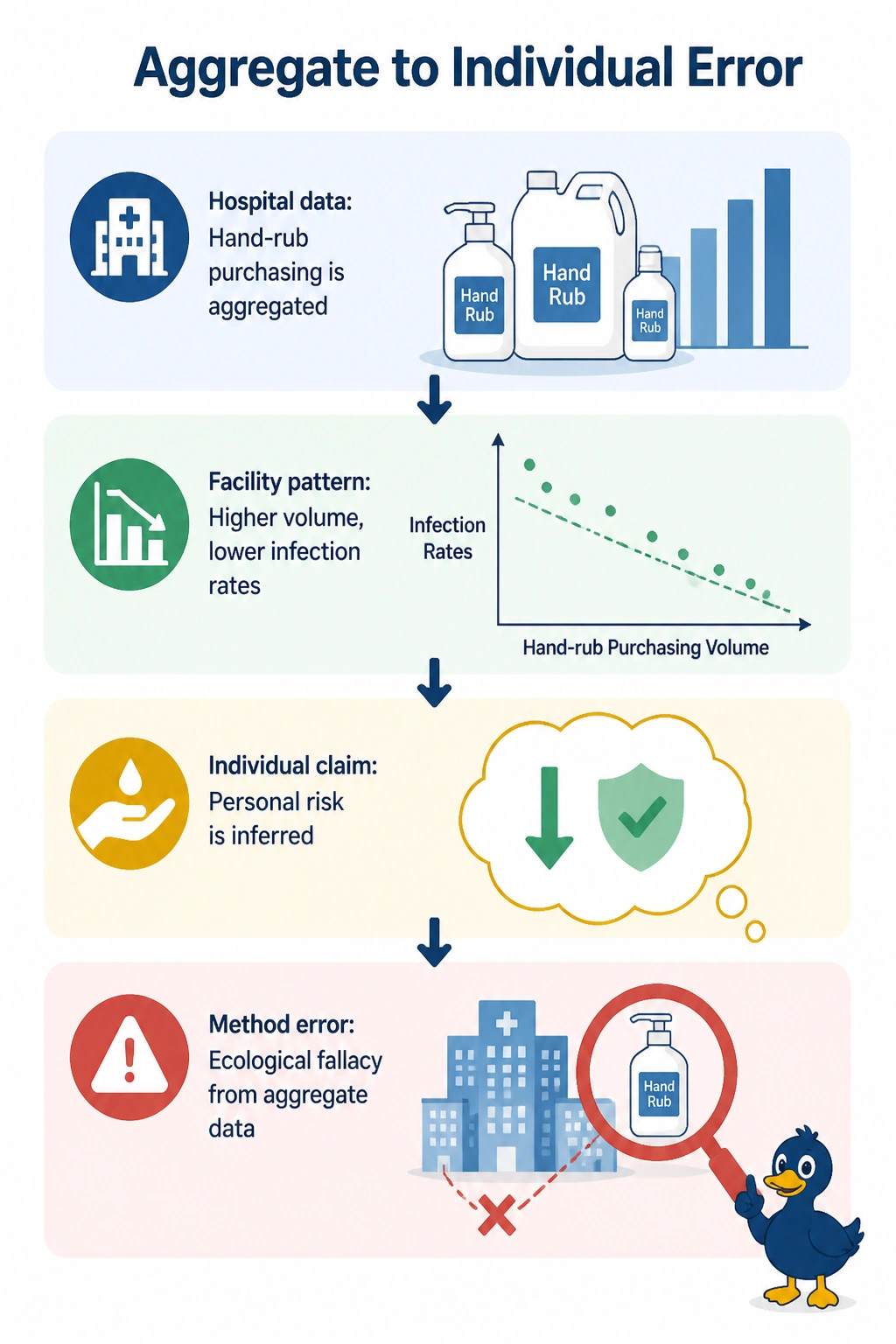
An infection preventionist reads an observational report showing that hospitals with higher overall hand-rub purchasing volumes have lower facility-wide bloodstream infection rates, and concludes that every patient cared for with hand rub had lower personal risk. Which methodological error does this conclusion illustrate?
Select an answer to reveal the explanation.
Short Explanation
Hospital-wide averages can hide what actually happened at a single patient's bedside, so you cannot automatically downscale group trends to individuals. The trap is assuming a facility-level correlation proves individual-level cause and effect.
Full Explanation
Concluding that an individual patient experienced lower personal risk solely because of a hospital-level correlation between purchasing volume and infection rates is an Ecological fallacy from aggregate data. Aggregate facility metrics cannot confirm whether the patients who avoided bloodstream infections were actually cared for by staff using that hand rub, or whether other hospital factors like nurse-to-patient ratios or catheter bundles drove the difference. Recall bias from retrospective interviewing occurs when cases and controls remember past exposures differently during interviews, which is unrelated to aggregate purchasing data. Publication bias favoring positive results arises when studies with statistically significant findings are published more often than null studies, distorting the overall literature rather than cross-level inference. Lead-time bias from earlier case detection artificially lengthens apparent survival time when screening detects disease earlier without changing the true outcome. As an appraisal caveat, ecological studies are valuable for generating hypotheses across facilities, but patient-level cohort or trial data are needed to confirm individual-level protection. As an operational check, when reviewing literature for your infection prevention committee, verify whether the unit of analysis—hospital, unit, or individual patient—matches the clinical conclusion being drawn.
Prefer to study offline? Printable PDF study book + test engine ($7.50, unofficial). These questions stay free here.