
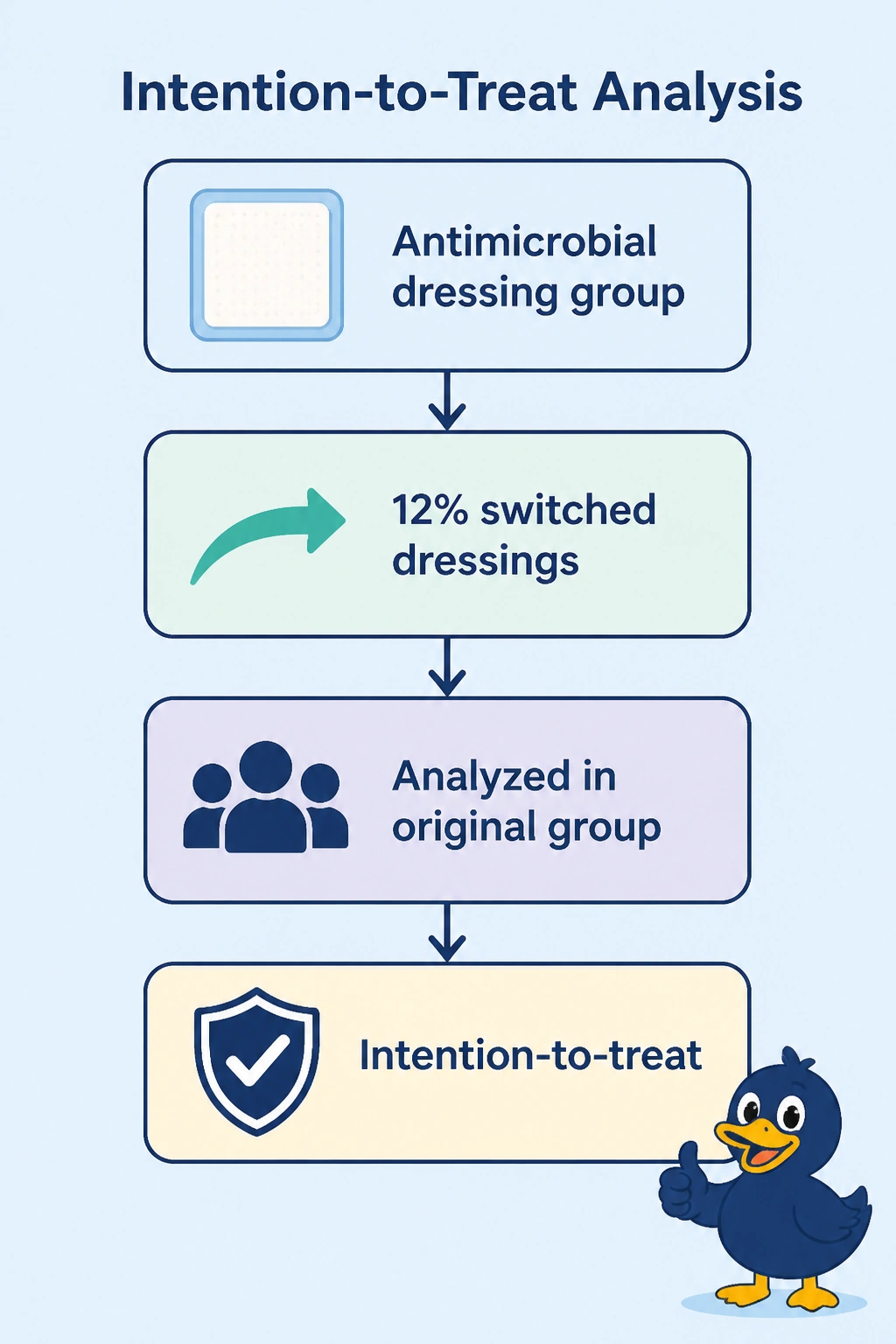
An infection preventionist reviews a randomized controlled trial comparing a new antimicrobial catheter dressing against standard transparent dressings. Twelve percent of patients assigned to the antimicrobial dressing group were switched to standard dressings due to skin irritation, yet the authors analyzed all participants in the groups to which they were originally randomized. Which analytical principle did the authors apply?
Select an answer to reveal the explanation.
Short Explanation
Randomization works like dealing a fair deck of cards—once you reshuffle players mid-game, the balance is gone. The trap is thinking you should only count patients who tolerated the assigned dressing. You want intention-to-treat analysis because keeping everyone in their original group preserves baseline comparability and reflects real-world effectiveness.
Full Explanation
In a randomized controlled trial, randomization balances confounders in expectation between study arms at baseline. By keeping switched patients in their original groups, the authors applied "Intention-to-treat analysis preserving baseline comparability across study arms" and preserves randomized allocation and reduces bias from treatment-based exclusions/reclassification; missing outcome data can still cause attrition bias. By contrast, "Per-protocol analysis excluding participants who experienced adverse skin reactions" drops patients who could not tolerate the intervention, which can artificially inflate efficacy and break the prognostic balance achieved by randomization. Similarly, "As-treated analysis grouping patients solely by the dressing they actually received" reclassifies participants based on post-randomization events, reintroducing confounding if sicker or more sensitive patients systematically switch arms. Finally, "Stratified analysis adjusting outcome rates for patient age and illness severity" controls for selected measured variables during analysis rather than addressing post-randomization protocol deviations. As a caveat, high crossover rates in an intention-to-treat analysis can dilute a true biological effect toward the null, making treatment adherence important to report. Operationally, check both intention-to-treat and sensitivity analyses when appraising clinical trials before adopting a new product.
Prefer to study offline? Printable PDF study book + test engine ($7.50, unofficial). These questions stay free here.