
An infection preventionist evaluates a hands-on aseptic blood culture collection workshop by recording whether the exact same 45 nurses pass or fail a return demonstration before training and again one month after training. Which statistical test is most appropriate to compare the paired pass-fail proportions?
Select an answer to reveal the explanation.
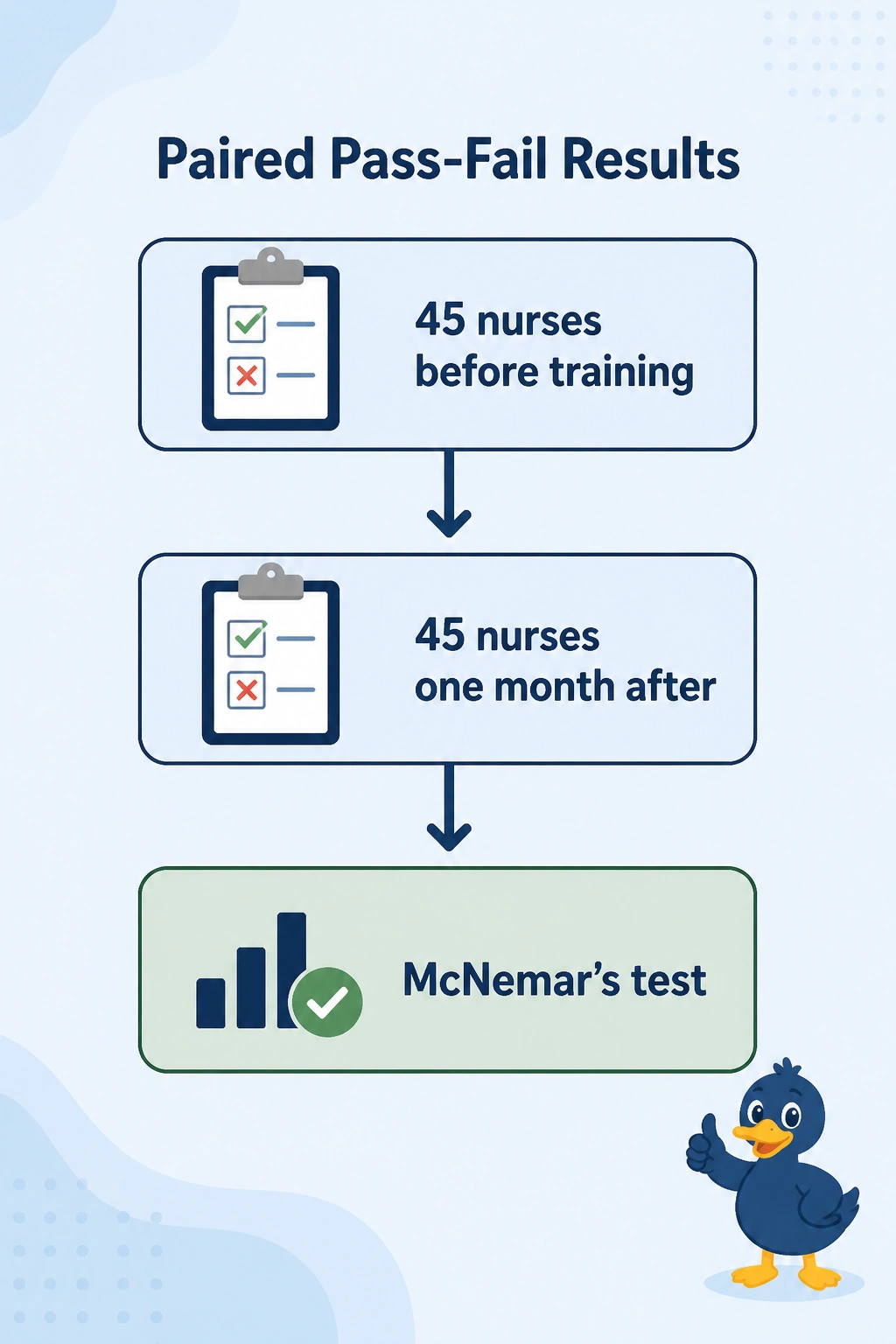
Short Explanation
You’re comparing the same nurses before and after training, so each pair of measurements belongs to one person. An independent-samples t-test, a standard Pearson chi-square test, and a one-way analysis of variance don’t account for this paired, binary, two-time-point design. McNemar’s test respects the matched pass-fail data and gives you a valid p-value.
Full Explanation
McNemar’s test for paired dichotomous outcomes measured on the same nurses is appropriate because each nurse contributes both a pre-training and post-training pass-or-fail observation, creating correlated rather than independent data. It focuses on discordant pairs—nurses who switch from fail to pass versus pass to fail—to evaluate whether training changed the competency proportions. An independent-samples t-test comparing mean scores between two separate groups ignores the paired design and is not the appropriate default for these matched binary outcomes. A standard Pearson chi-square test assuming two unrelated cohorts violates the independence assumption, distorting the variance estimate when the same nurses are tested twice. A one-way analysis of variance comparing three or more independent unit teams does not fit a design with two paired time points, one group, and a categorical outcome. As an exam caveat, when discordant pair counts are very small, use an exact binomial version of McNemar’s test. As a practical check, link each participant’s pre- and post-assessment records using a de-identified employee ID before running the analysis.
Prefer to study offline? Printable PDF study book + test engine ($7.50, unofficial). These questions stay free here.