
An infection preventionist reads a published quality study in which authors tested 20 different secondary clinical subgroups for surgical site infection associations at an alpha level of 0.05 without statistical adjustment and highlighted a single significant finding (p = 0.04) in the abstract. Which methodological limitation should the infection preventionist identify?
Select an answer to reveal the explanation.
Short Explanation
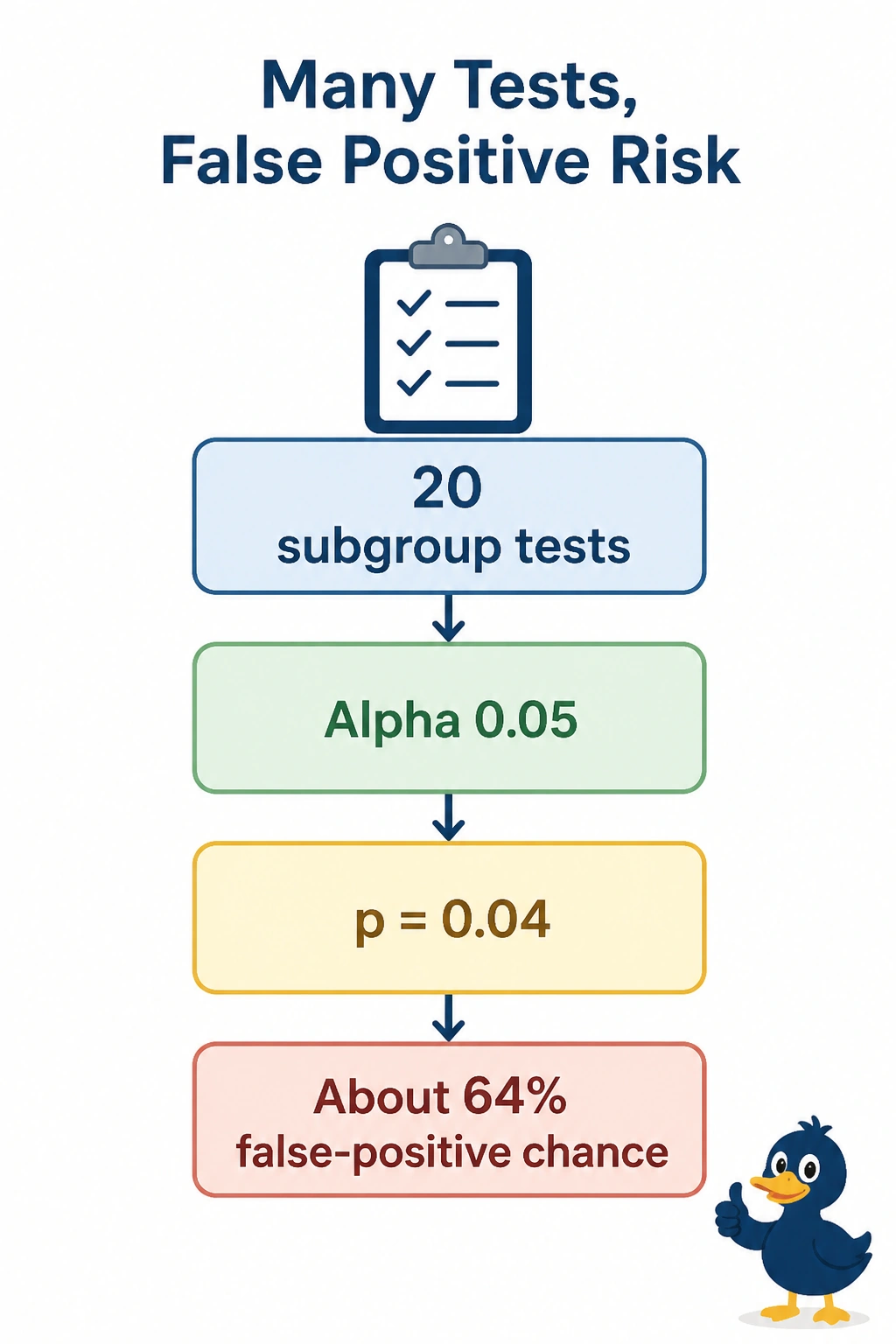
Think of each unplanned subgroup test as another chance to find a lucky result by chance. When you run 20 tests at alpha = 0.05 without adjustment, the chance of a false positive rises, so a lone significant p-value is not proof of a real clinical association.
Full Explanation
An alpha level of 0.05 accepts a 5% probability of falsely rejecting a true null hypothesis on any single test. Running 20 unplanned subgroup tests without adjustment inflates the probability of at least one false-positive Type I error; under independent true null hypotheses, that probability is 1 − 0.95^20, or about 64%. Thus, a subgroup p-value of 0.04 is not confirmatory simply because it meets the same nominal cutoff as the primary endpoint: the cutoff does not account for testing many subgroups. The claim that insufficient sample size caused false-negative results across the 19 non-significant subgroups describes possible Type II errors, but does not explain why the isolated significant finding may be spurious. Likewise, separate 0.05 thresholds apply to each test and do not keep the family-wise false-positive probability at 0.05. A caveat is that exploratory findings can still generate hypotheses for future studies. As a practical check, verify whether the authors prespecified the endpoints and used an appropriate multiplicity adjustment before adopting practice changes.
Prefer to study offline? Printable PDF study book + test engine ($7.50, unofficial). These questions stay free here.