
A published trial reports that a new antimicrobial-impregnated dressing reduced central line-associated bloodstream infections by a 50% relative risk reduction, lowering the absolute risk from 0.4% to 0.2%. Which conclusion should the infection preventionist share with the value analysis committee?
Select an answer to reveal the explanation.
Short Explanation
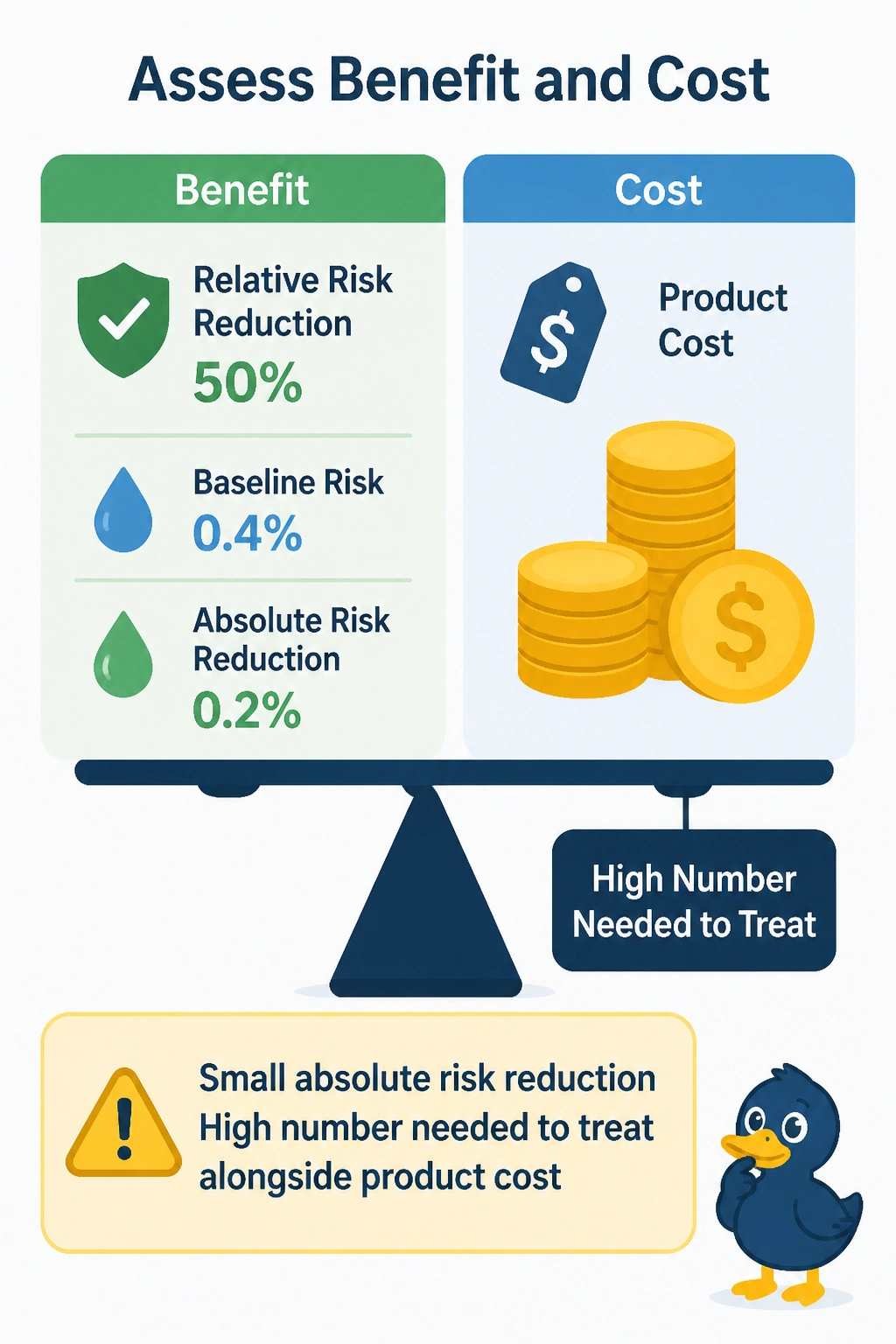
A 50% relative risk reduction sounds like a miracle cure until you check the baseline rate and see the risk barely moved in real numbers. You owe your committee both the absolute risk reduction and the number needed to treat before approving expensive new supplies. Watch out for marketing headlines that hide tiny absolute gains behind big relative percentages.
Full Explanation
Evaluating the small absolute risk reduction and high number needed to treat alongside product cost gives decision-makers an accurate picture of clinical and financial value, because a 0.2% absolute reduction translates to treating 500 patients to prevent a single infection. Relative measures magnify small differences when baseline event rates are already low. Assuming half of all hospital-wide bloodstream infections will be eliminated immediately after product adoption confuses a relative reduction in a specific trial cohort with overall institutional impact across diverse units and line types. Excluding baseline infection incidence from the financial analysis because relative risk reduction is constant ignores that absolute benefit shrinks dramatically when local baseline rates are lower than the trial's control group. Rejecting the trial findings solely because a 0.2% absolute difference cannot achieve statistical significance is incorrect, since a sufficiently large study can detect a statistically significant small difference; statistical significance does not automatically equal clinical or economic value. Caveat: even a small absolute reduction may be worthwhile in very high-risk populations such as neonatal or oncology units with elevated baseline CLABSI rates. Operational check: calculate your unit's current baseline rate and projected annual cost per prevented infection before recommending product adoption.
Prefer to study offline? Printable PDF study book + test engine ($7.50, unofficial). These questions stay free here.