
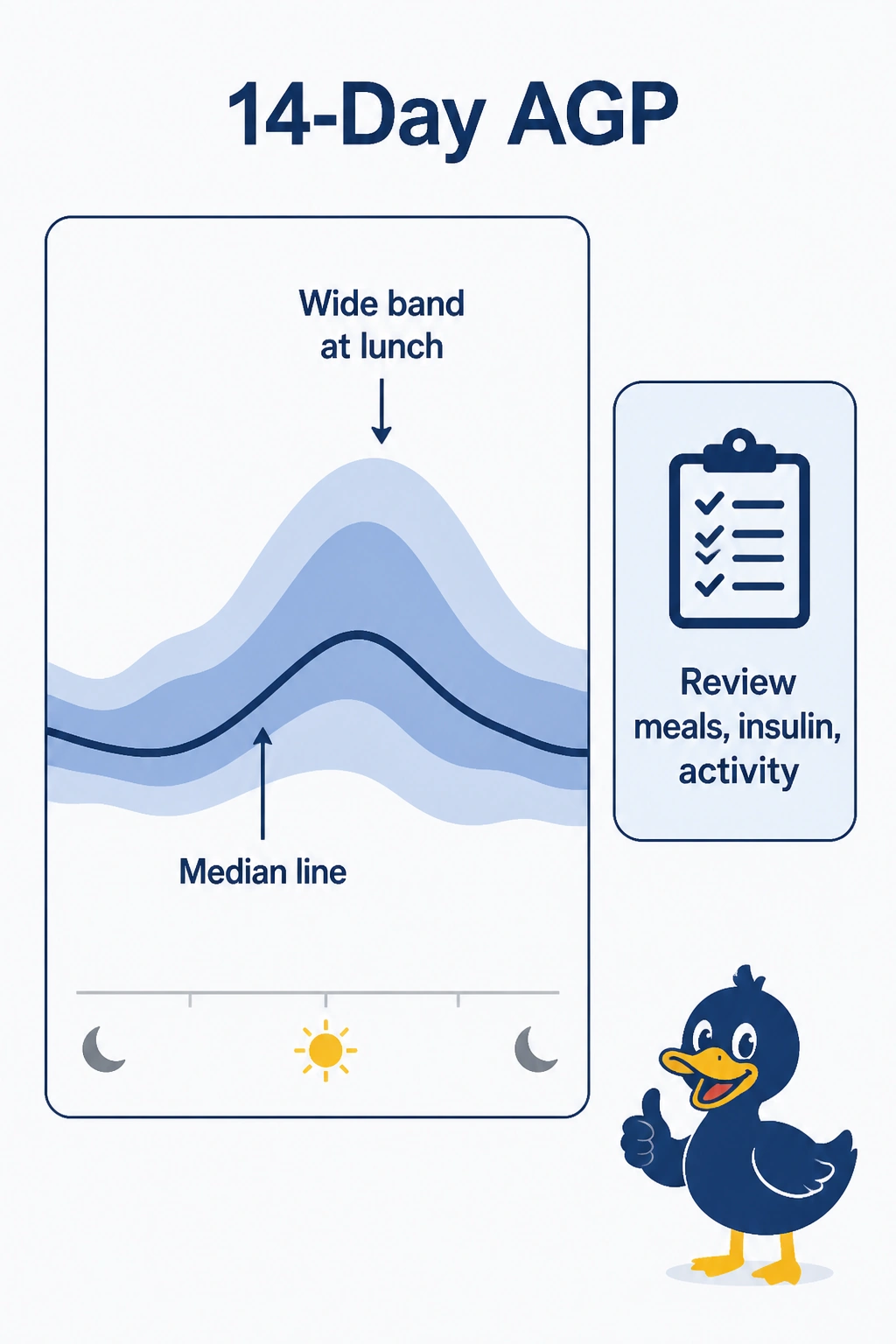
While reviewing a 14-day Ambulatory Glucose Profile with a 39-year-old woman with type 1 diabetes, the diabetes care and education specialist points to the wide shaded band around the dark median line at lunch. What does this wide band indicate?
Select an answer to reveal the explanation.
Short Explanation
On an Ambulatory Glucose Profile, a wide shaded band around the median line is like a weather forecast showing you unpredictable afternoon storms. You read that width as day-to-day variability, so review meals, insulin, activity and context with your patient before you adjust anything.
Full Explanation
In an Ambulatory Glucose Profile, the dark center line represents the 50th percentile median glucose while the shaded interquartile and outer bands display the spread of readings across 14 days, so a wide band indicates wide day-to-day glucose variability around lunch, warranting review of meals, insulin, activity and other factors. Review individual daily traces and context before attributing variability to behavior, dosing or sensor issues. Choosing consistent midday hyperglycemia that can be corrected simply by increasing the morning long-acting basal dose misreads variability as a uniform elevation and risks hypoglycemia on lower-glucose days. Choosing a higher mean lunch glucose without any information about spread confuses average level with dispersion, since band width describes spread rather than mean. Choosing a normal 14-day Glucose Management Indicator that confirms stable postprandial control across all weekdays overlooks that an average or GMI can appear acceptable even when high and low swings cancel each other out. As a caveat, always check Time Below Range alongside the median curve before recommending any upward dose adjustments. For an operational check, ask the patient to compare a high-lunch day and a low-lunch day in their log to spot differences in food, activity, or bolus timing.
Prefer to study offline? Printable PDF study book + test engine ($7.50, unofficial). These questions stay free here.