
A 66-year-old woman with type 2 diabetes and stage 3 chronic kidney disease takes metformin and tells her diabetes care and education specialist she is scheduled for an outpatient CT scan with intravenous contrast next week. Which action should the specialist recommend?
Select an answer to reveal the explanation.
Short Explanation
You protect her kidneys by having her confirm eGFR, AKI status and the radiology plan with her prescriber before the scan. Don't assume one hold rule fits every contrast route or restart on autopilot — you help her get the team's specific hold and restart instructions in writing.
Full Explanation
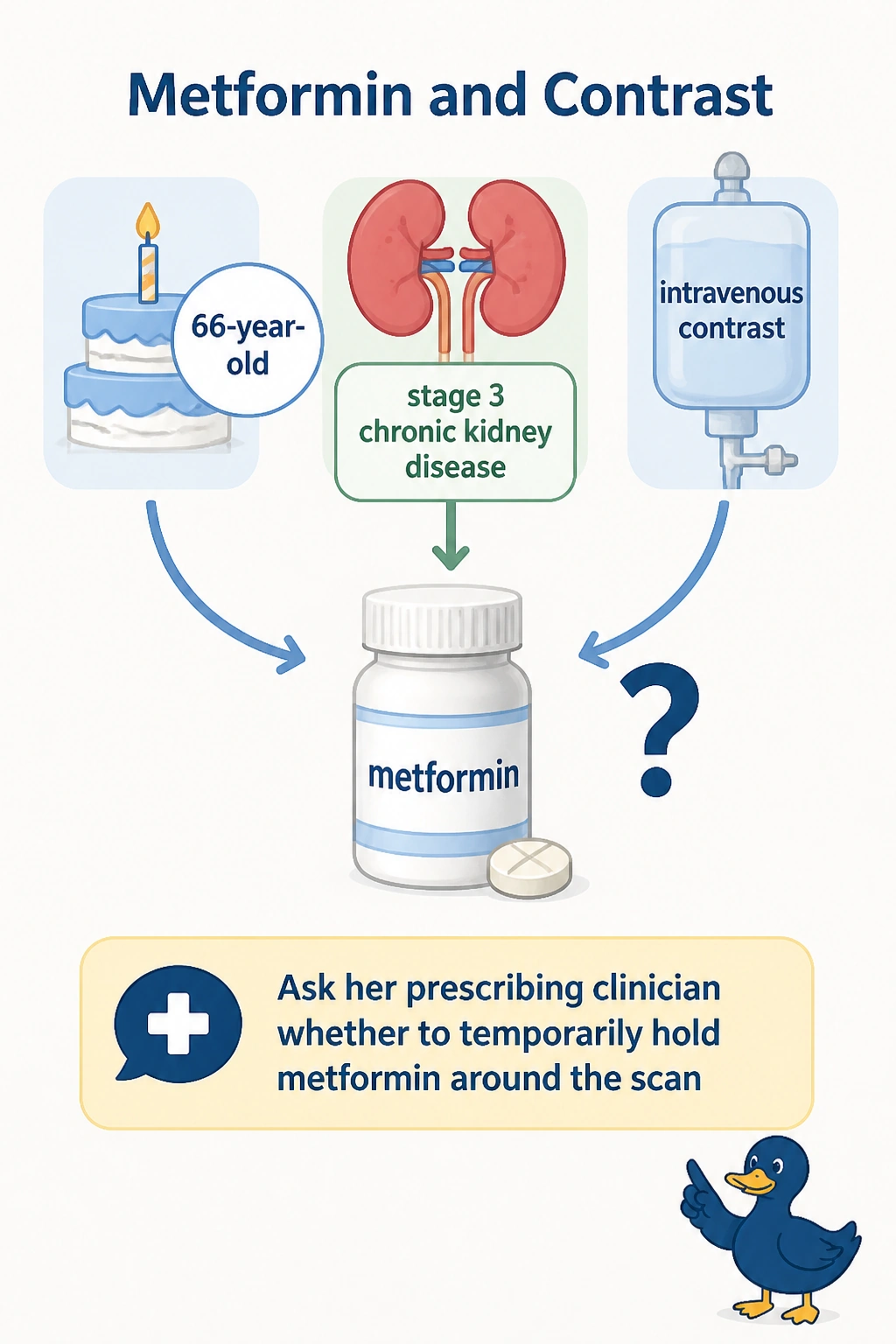
The appropriate guidance is to Ask her prescribing clinician whether to temporarily hold metformin around the scan. Because metformin is cleared unchanged by the kidneys, any acute decline in kidney function triggered by iodinated contrast—especially with pre-existing stage 3 chronic kidney disease—can cause accumulation and raise the rare but serious risk of lactic acidosis. FDA labeling is more restrictive for eGFR 30–60, while ACR guidance may allow continuation for IV contrast when eGFR is at least 30 without AKI; the team must specify the appropriate hold and restart plan. Coordinating with the prescriber and radiology team to confirm actual eGFR, AKI status and the agreed protocol ensures restarting only after kidney function is confirmed stable. Advising her to Continue metformin regardless of any acute kidney-function change ignores that new AKI would impair clearance. Counseling her to Treat every contrast route and kidney-function level as requiring the same hold rule is incorrect because intra-arterial, intravenous and eGFR thresholds are not managed identically. Telling her to Restart metformin automatically before reviewing the team’s instructions risks re-exposure before stability is verified and misses the written resume date.
Prefer to study offline? Printable PDF study book + test engine ($7.50, unofficial). These questions stay free here.