
A 32-year-old man with type 1 diabetes using a continuous glucose monitor reports repeated 2:00 a.m. alarms showing sudden drops to 52 mg/dL that rebound to 115 mg/dL within 15 minutes after he rolls over, while fingerstick checks during the alarms read 110 mg/dL. Which explanation and action should the diabetes care and education specialist provide?
Select an answer to reveal the explanation.
Short Explanation
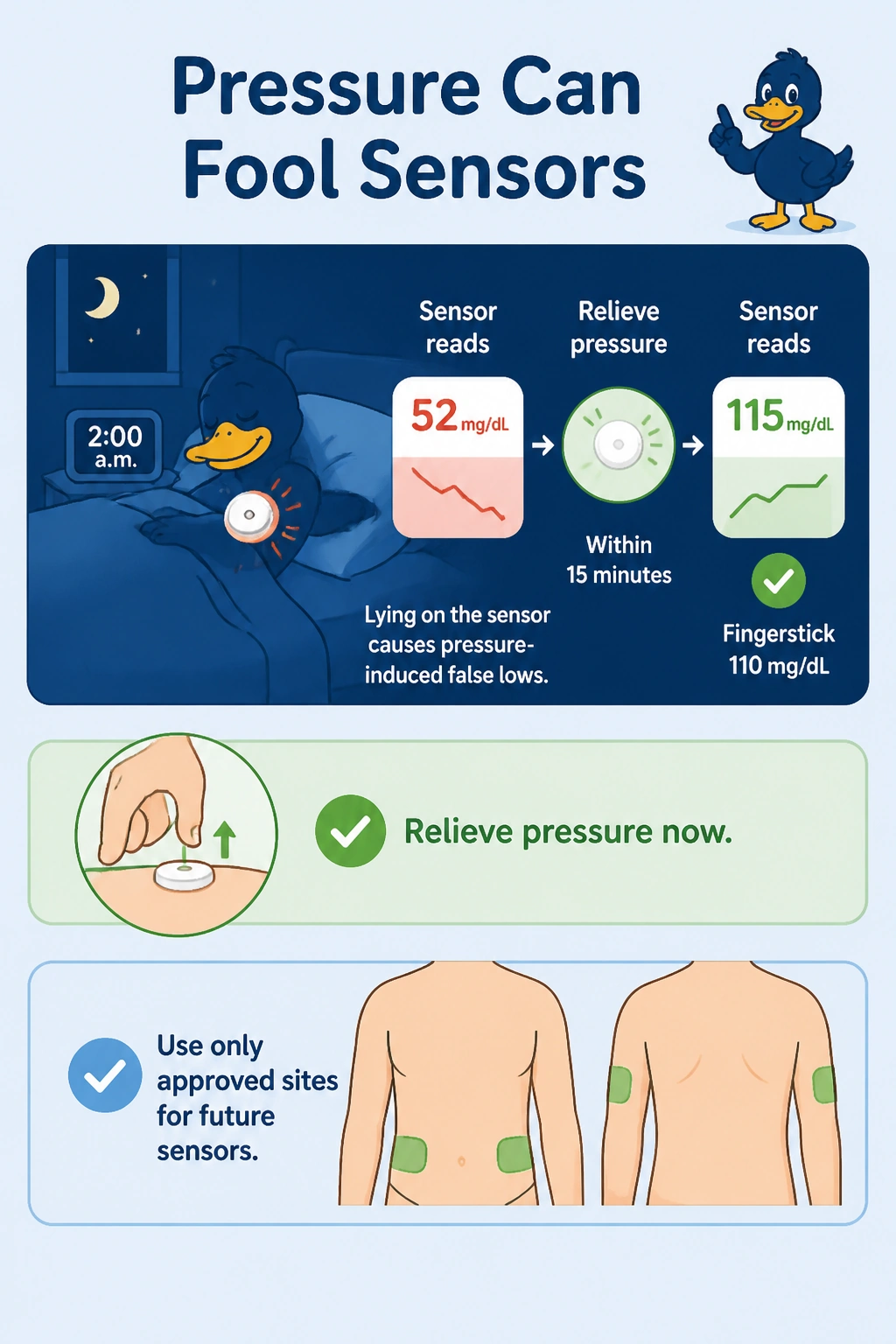
You can recognize this pattern as a compression low: pressure from rolling over can make the sensor reading drop artificially, then rebound when the pressure is relieved. Relieve the pressure and use only approved sensor sites in the future; avoid unnecessary carbohydrates or recalibration when the meter confirms your glucose is not low.
Full Explanation
Continuous glucose monitors measure glucose in interstitial fluid rather than capillary blood. External pressure can artifactually lower readings, creating a sharp downward spike known as a compression low. Here, the reading rebounds from 52 mg/dL to 115 mg/dL within 15 minutes after he rolls over, while a fingerstick during the alarm shows 110 mg/dL. Explain the pressure-related artifact, relieve pressure now and use only approved sites for future sensors. Recalibrating immediately whenever a low reading disagrees with a fingerstick can skew accuracy because calibration should occur when glucose is stable, not during a transient artifact. Consuming 15 grams of fast-acting carbohydrate before checking with a meter can cause unnecessary rebound hyperglycemia when the meter confirms that glucose is not low. Raising only the overnight low-alert threshold may increase false alarms without addressing the pressure causing them. As a clinical caveat, verify an unexpected sensor low with a blood glucose meter when symptoms do not match the reading. As a practical check, review overnight tracings for V-shaped drops followed by rapid rebounds.
Prefer to study offline? Printable PDF study book + test engine ($7.50, unofficial). These questions stay free here.