
A 67-year-old woman with a 17-year history of type 2 diabetes and known peripheral neuropathy mentions during an annual assessment that she has had three urinary tract infections this year and often feels as though her bladder does not empty completely. Which diabetes complication should the specialist assess further?
Select an answer to reveal the explanation.
Short Explanation
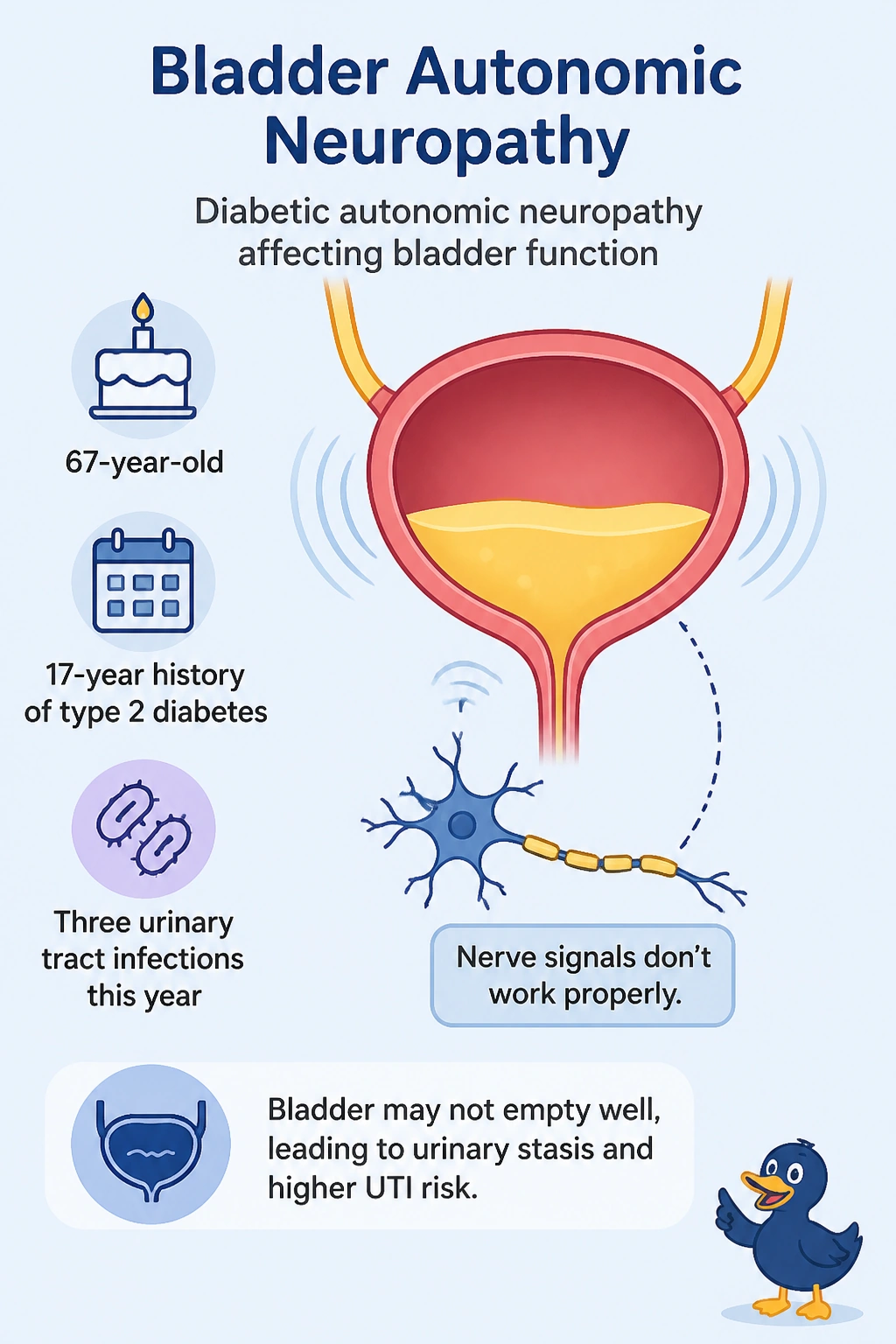
With longstanding diabetes and peripheral neuropathy, recurrent urinary infections and a feeling of incomplete emptying point you toward diabetic autonomic neuropathy affecting bladder function. You can distinguish this retention with residual urine from just making more urine or leaking with coughing by focusing on the incomplete emptying.
Full Explanation
Longstanding hyperglycemia can damage the autonomic nerves that sense bladder fullness and coordinate bladder muscle contraction, causing reduced awareness of the need to void, incomplete emptying, residual urine, and recurrent urinary tract infections. Diabetic autonomic neuropathy affecting bladder function is therefore the complication to assess, particularly with this patient’s longstanding diabetes and known peripheral neuropathy. Osmotic diuresis from hyperglycemia without impaired bladder emptying increases urine production and voiding frequency, but the bladder still empties effectively and does not leave the described sense of residual urine with recurrent infections from stasis. Medication-related urinary frequency without retention also produces more frequent voiding, yet it lacks impaired contractility and incomplete emptying, so it does not account for the retention pattern. Stress urinary incontinence during coughing or lifting involves leakage with increased intra-abdominal pressure due to pelvic floor or sphincter weakness, not failure to empty, and would present with leakage rather than residual urine. As an exam caveat, urinary symptoms alone do not establish autonomic neuropathy, so further clinical evaluation is needed. As a practical check, ask about voiding frequency and hesitancy, and coordinate referral to primary care or urology for bladder assessment.
Prefer to study offline? Printable PDF study book + test engine ($7.50, unofficial). These questions stay free here.